Hello,
I have been very passionate about studying the Collatz process symbolically, i.e. looking at the action of Collatz on numbers written in some bases, in particular bases 2, 3 and 6.
Part of my PhD thesis (Chapter 1) was to realise that these dynamics can be encompassed using the following set of 6 Wang tiles:
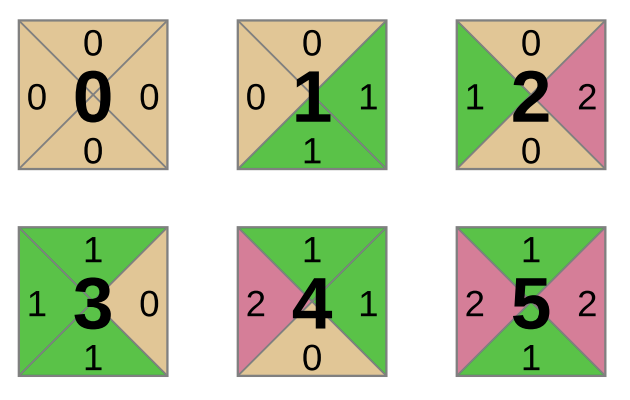
Each of these tiles corresponds to a base 6 digit, vertical sides speak in base 3 and horizontal sides speak in base 2. All corners but top-left are total and deterministic:
- Top-right corner is Euclidean division by 3:
tile_name = 3*top + right(e.g.5 = 3*1 + 2) - Bottom-left is Eculidean division by 2:
tile_name = 2*left + bottom(e.g.5 = 2*2 +1) - Bottom-right is Chinese remainder theorem for 2x3 = 6, e.g. 5 is the only number < 6 such that modulo 2 is 1 (bottom) and modulo 3 is 2 (right)
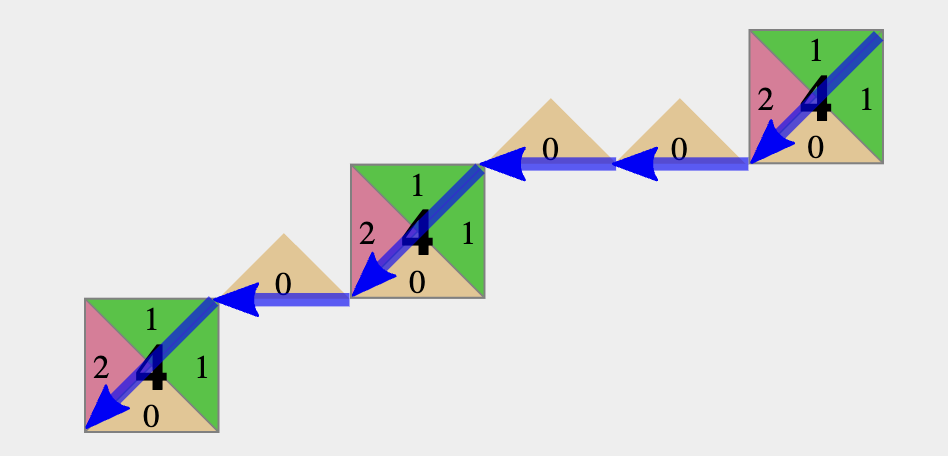
Collatz sequences can be constructed from parity vectors in the following way:
- Use tile 4 for odd entries of the vector (diagonal blue arrows below)
- Use horizontal arrow labelled 0 for even entries of the vector (horizontal blue arrows below)
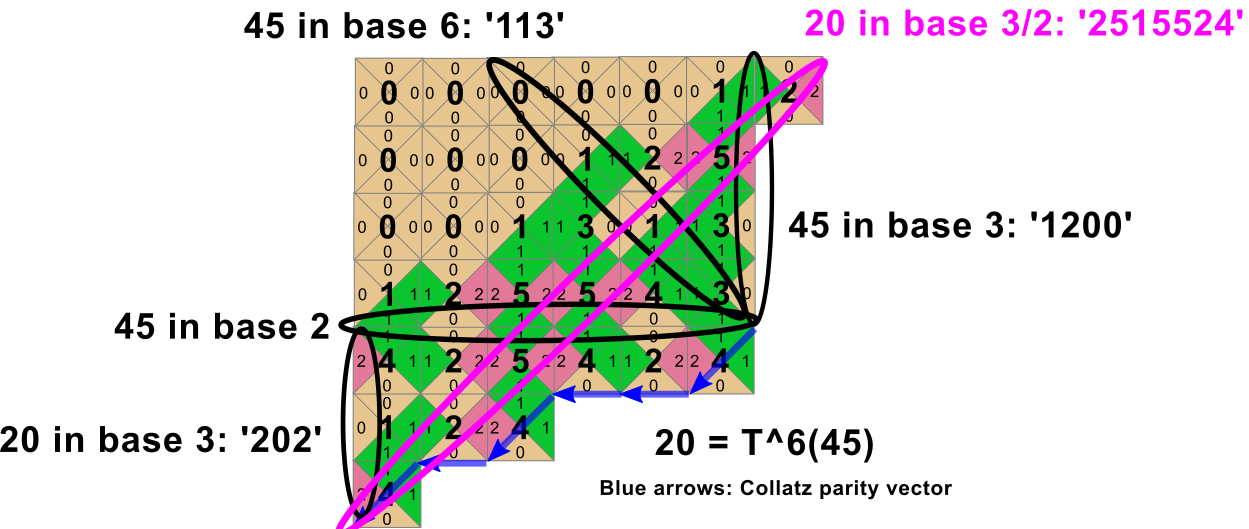
For instance, the parity vector 1, 0, 0, 1, 0, 1 is encoded as follows:
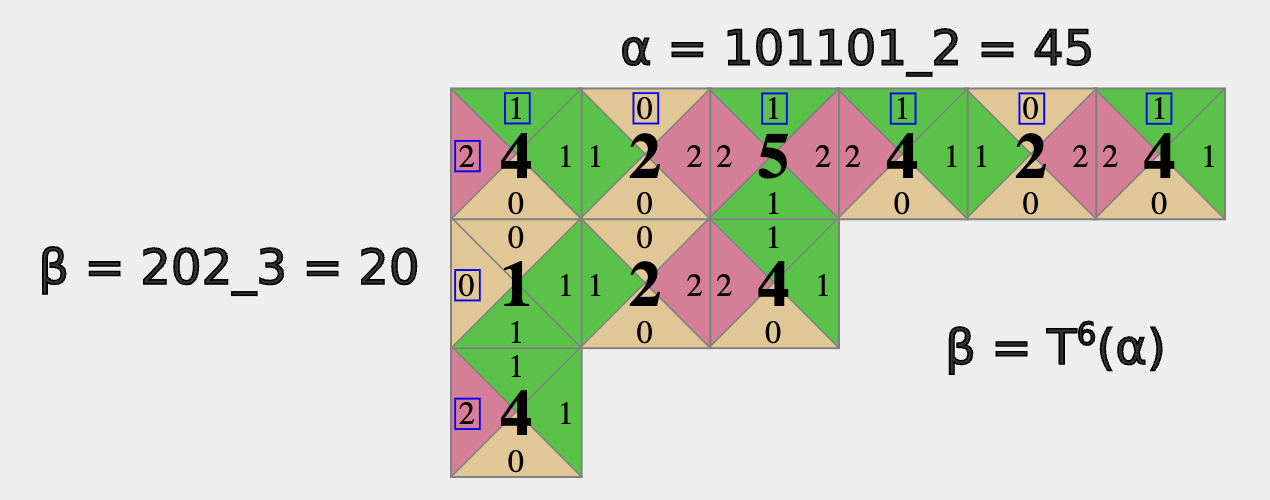
Then, since the bottom-right corner of the tiles is deterministic, there is a unique assembly to reconstruct:
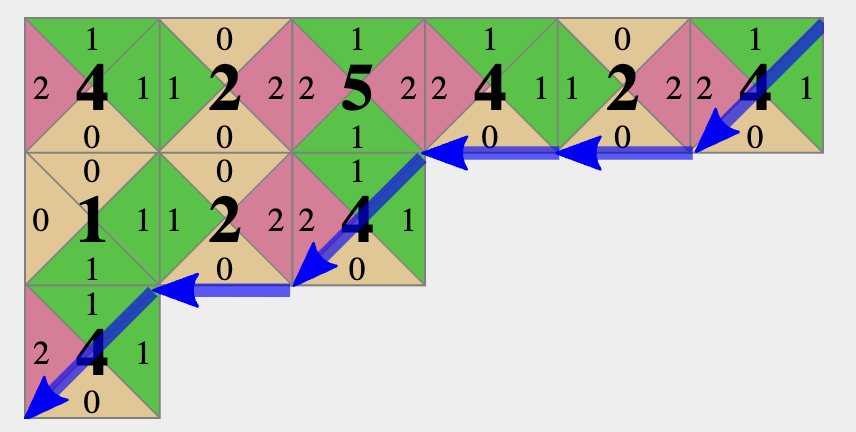
Which corresponds to the Collatz sequence 20 = T^6(45) where 45 is encoded in base-2 on the top of the assembly and 20 in base-3 on the left of the assembly:
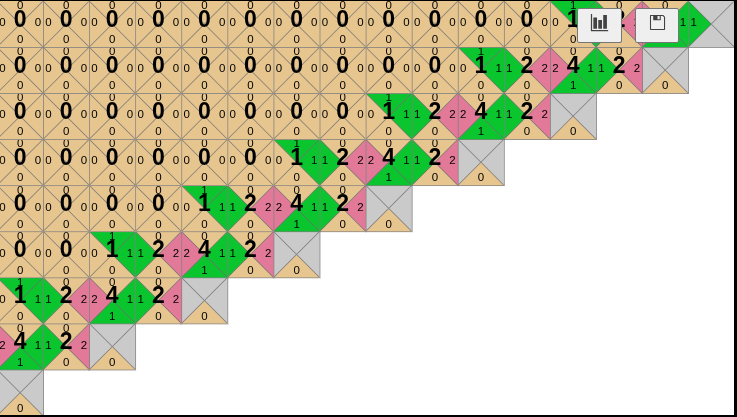
Here is a bigger example:
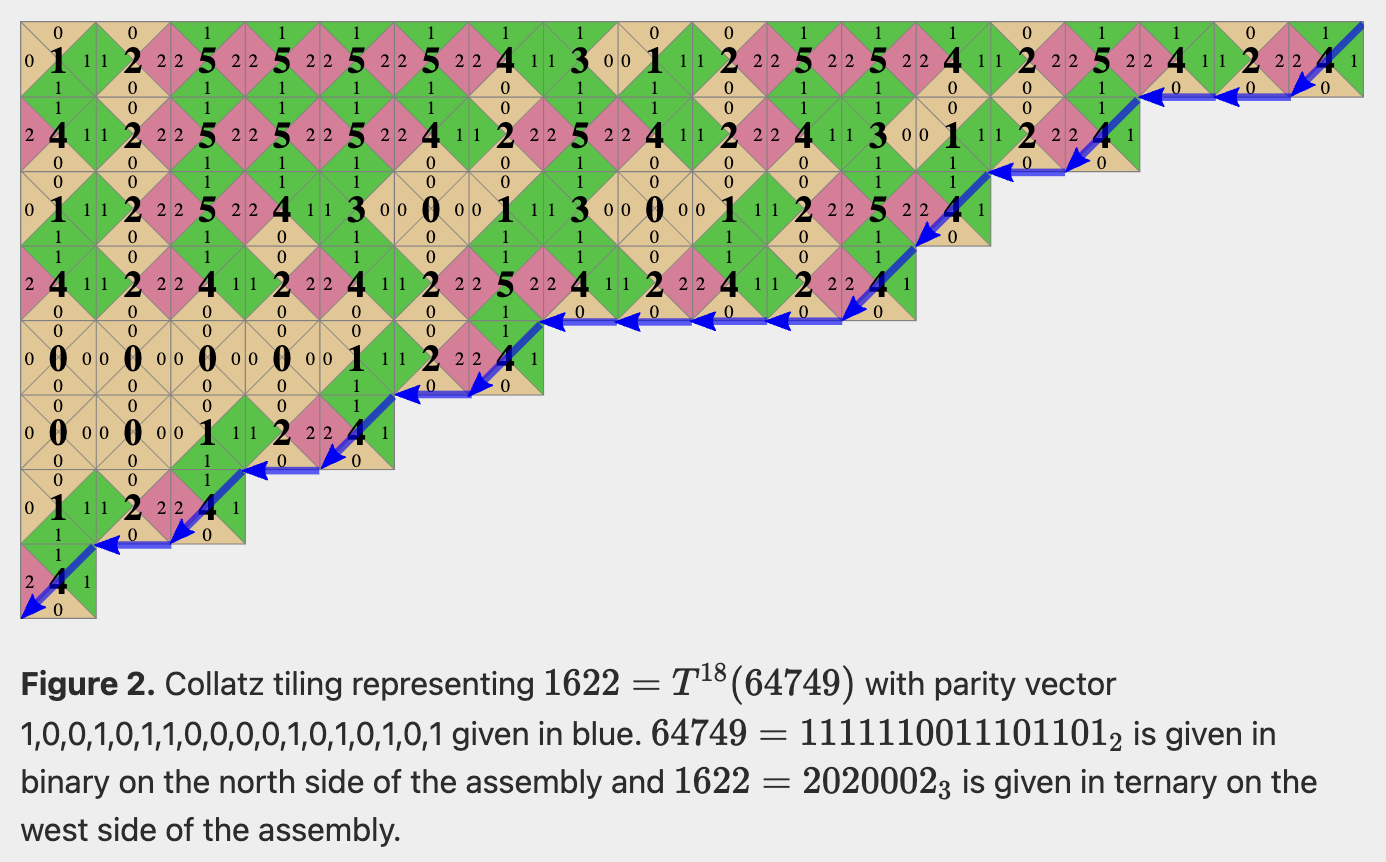
These images are extracted of a longer blog post I wrote on the subject  . The above focused on base 2 and 3 but these tilings also feature base 6 (top-left-going diagonal), base 3/2 (top-right-going diagonal), and more generally any base of the form 2^a3^b > 1 with a,b\in\mathbb{Z} by considering “macro-tiles”.
If you make the assembly cyclical (i.e. making the first and last point of the parity vector be the same) then, will appear 2-adic, 3-adic and 6-adic integers (i.e. base-n strings with infinitely many digits on the most significant side). See Appendix B for a survival guides on the p-adics.
In my thesis, I applied the tiles to thinking about Collatz cycles (§1.5) and ancestors (§1.6).
These tiles are also more general than Collatz and allow to represent other problems such as:
- Erdős’ conjecture on powers of two (Link outlined in §2.2.2)
- Mahler 3/2 problem (Appendix B of my thesis)
- The Hydra sequence
- You can construct similar tilesets for any p \times q with gcd(p,q) = 1. Hence you can represent other Collatz-like problems with similar assemblies (e.g. 5x+1).
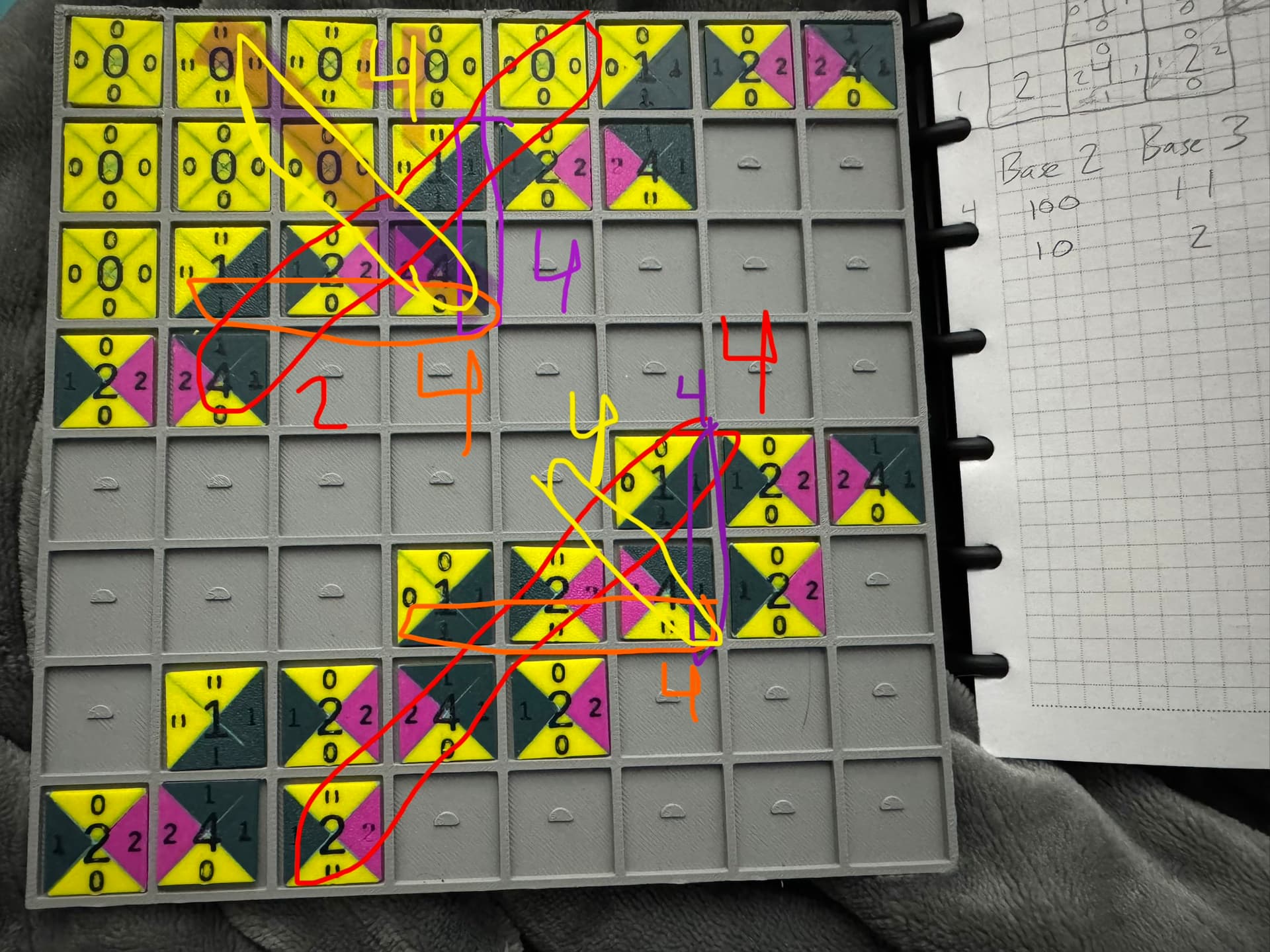
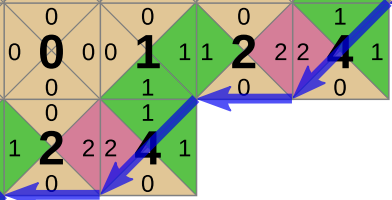
I particularly like the tiles for thinking about Collatz cycles because the question reformulates into a algorithmico-geometric question: “Why on earth, only the trivial parity vector results in an assembly with the same number in base-2 on top and in base-3 to the left”:
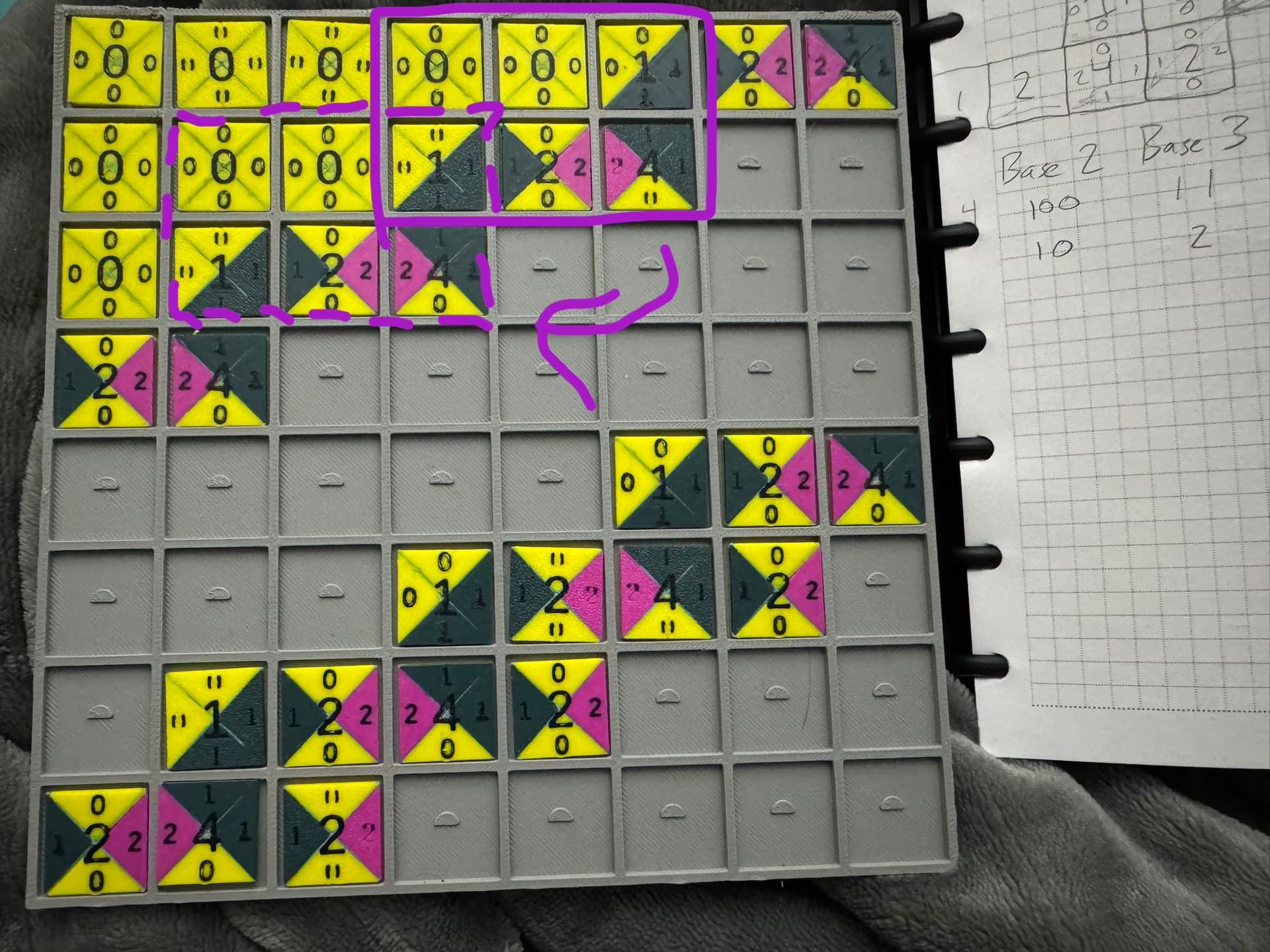
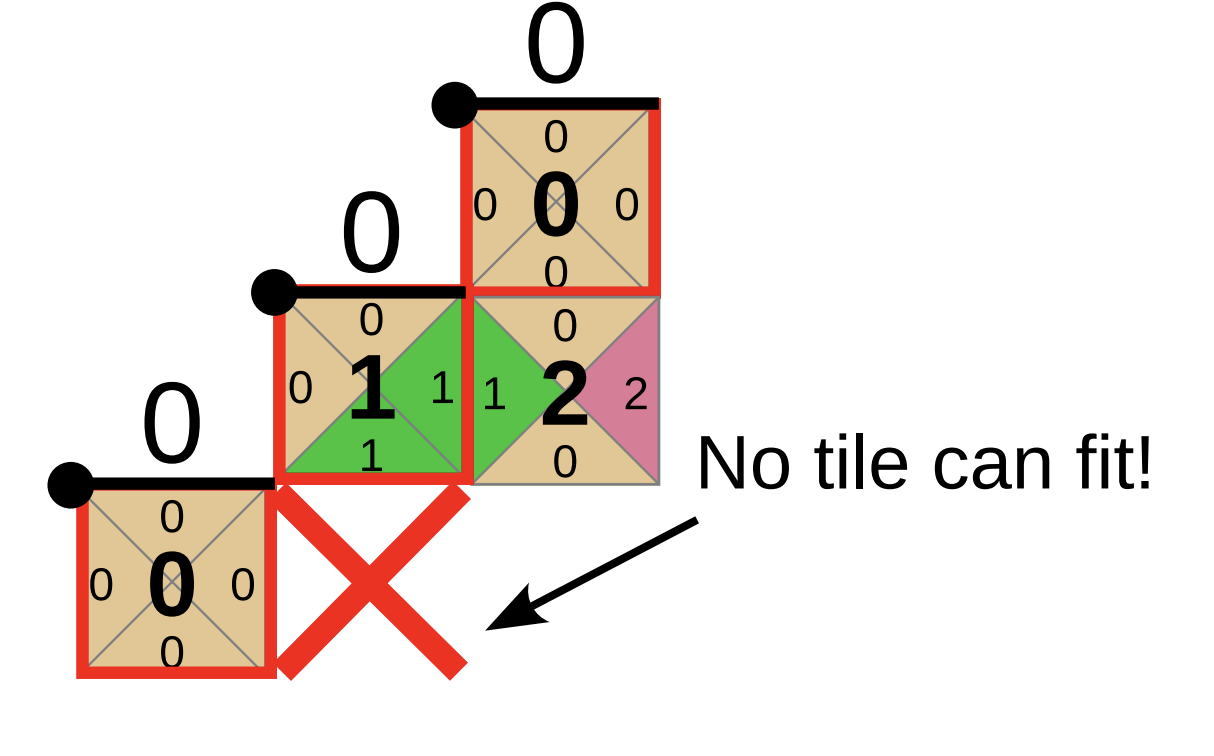
Tiles are also interesting because they allow to state simply phenomenons that would otherwise difficult to express, such as forbidden patterns in assemblies (always coming from the non-deterministic top-left corner):
My lines of research with the tiles include:
- representing known results about the Collatz conjecture using the tiles (I would love to be able to understand this result with the tiles)
- thinking about cycles and their parity vectors (in a similar way to the questions asked in Parity sequences and cycles or in Elementary proof of no circuits? )
- thinking a bout “generalised parity vectors” which are arbitrary tiles borders instead of the very specific Collatz ones (using only tile 4 and horizontal 0 moves), looking for what types of constraints empirically prevents positive cycles to happen
- inverse reconstructions: a positive cycle must eventually reach a translation of the parity vector where all values are 0. We can start from a 0-valued party vector and reconstruct (non-deterministically) in the bottom-right direction: may we detect some patterns or invariants that Collatz parity vectors do not follow? i.e. Why are Collatz parity vectors not in the pre-image of the all-0 parity vector?
I’d be happy to discuss, answer questions or anything if this framework interests you
P.S: @mathkook made a cool video about the tiles