I love this question!
Olivier Rozier has a simpler proof than Steiner’s, but it is only in French as far I know: https://www.probleme-syracuse.fr/cargo/Singularit�_1_3.pdf.
I actually have been looking for a proof using the tiles 
For fun, here is the tiling for x = 17, k = x + (x-3), gcd(x,k) = 1:
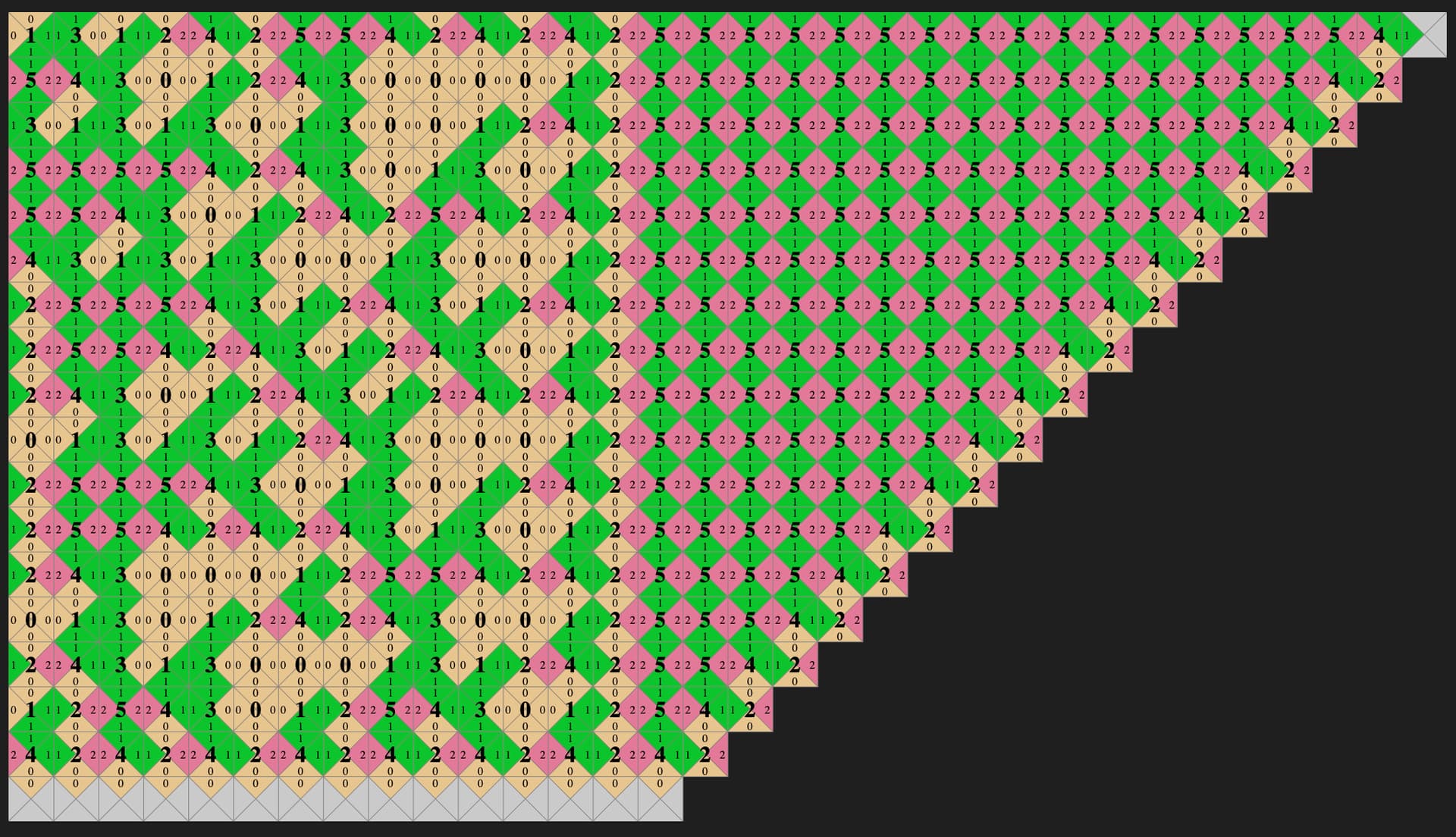
As generated by coreli:
import coreli
x = 17
k = x + (x-3)
pv = coreli.ParityVector([1]*x+[0]*(k-x))
tiling = pv.to_tiling()
tiling.all_steps()
tiling.draw_svg()
It is easy/known that the x odd terms will yield ternary number 2...2 x times, (i.e. 3^x - 1). Then, successive columns give (3^x - 1)/ 2^i in the multiplicative group of \mathbb{Z}/3^x\mathbb{Z}, with 0 \leq i < k-x , which starts enumerating all the members of that group in a weird order. However, discrete logarithm is not hard in that group (i.e. there is a fast algo) hence, the order is not too weird (see Remark 1.75), i.e. it is not too hard (in terms of computational complexity) to predict the ternary expansion of the last column, (3^x - 1)/ 2^{k-x-1}.
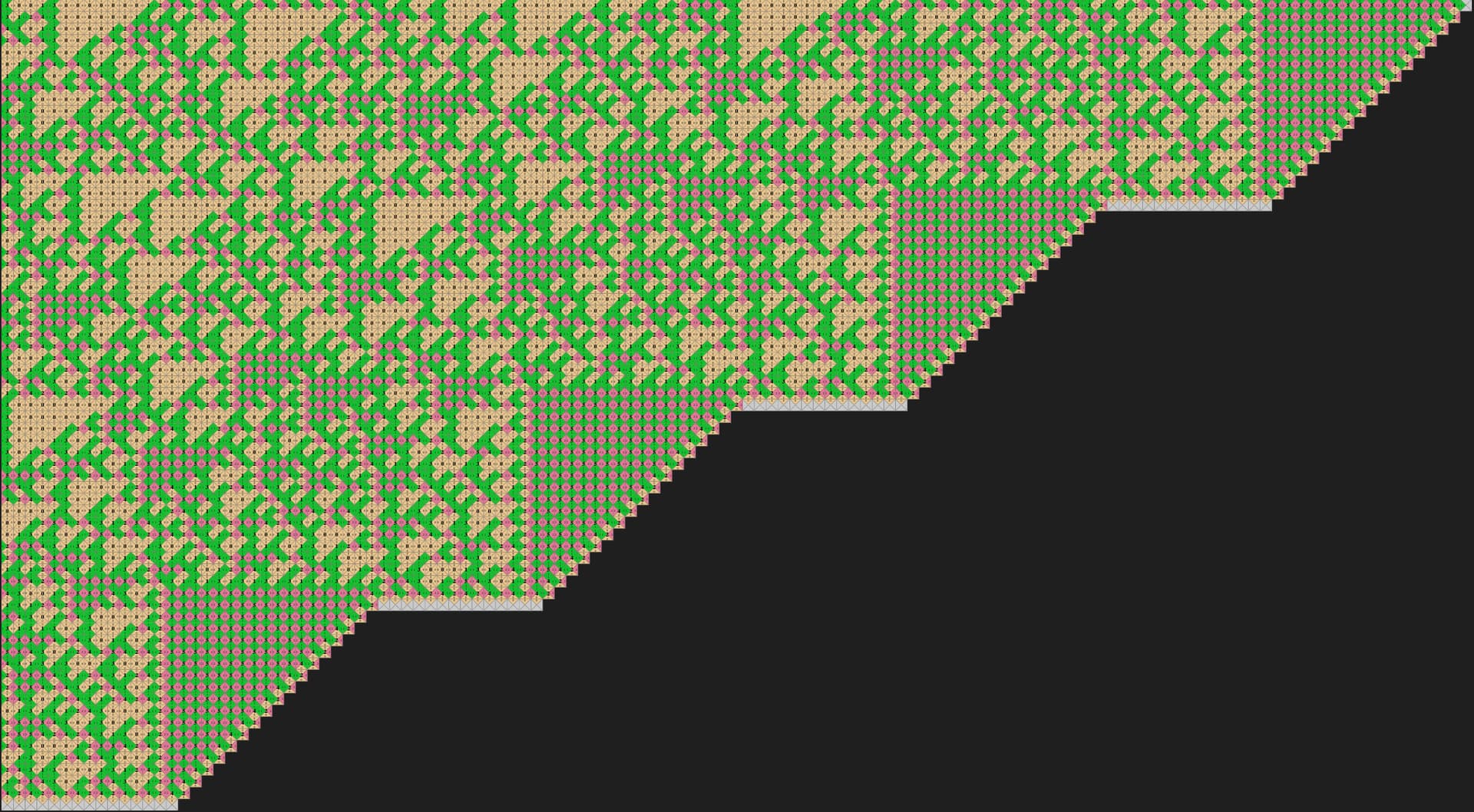
But then chaos seem to fully take over; for fun, here are 4 repetitions of this parity vector concatenated to get a (small) idea of the cyclic solution: