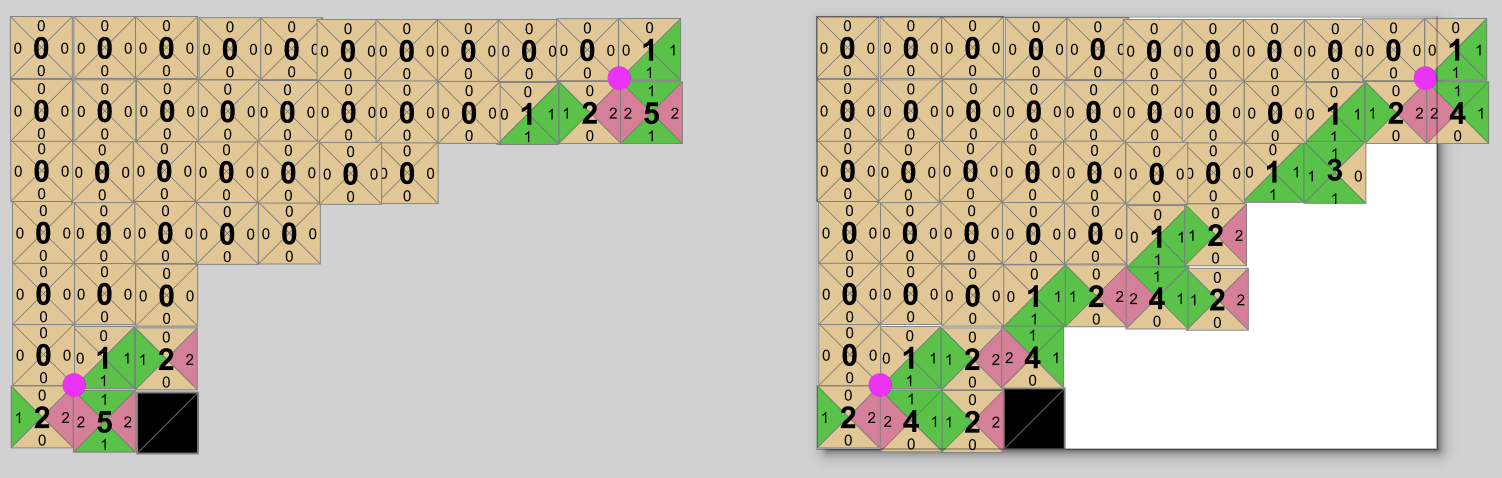
It’s known that no counter-example Collatz cycle can be a circuit, one whose trajectory starts with an odd positive integer m > 1, proceeds (exclusively) through odd numbers, then (exclusively) through even numbers, landing back at m.
The proof uses Alan Baker’s “big gun” that 2^k - 3^x rises exponentially in x. The big gun involves a lot of transcendental math.
Can we make an elementary no-circuit proof without the big gun?
The lowest member of a circuit has the value \cfrac{3^x-2^x}{2^k-3^x}, where k is the length of the circuit, and x is the number of odds. So the question boils down to:
Are there integers k and x for which \cfrac{3^x-2^x}{2^k-3^x} is a positive integer > 1?
When k and x have a common factor > 1, there actually is an elementary proof that “no”.
When k and x are co-prime, people bring out the big gun.
But maybe there’s a divisibility trick, or some kind of restriction?
For example, if 2^k-3^x always had a prime factor not shared by 3^x-2^x, that would do it.
When k and x are co-prime, the only time those two expressions do share a common prime factor p is when it’s a Kershaw prime, defined by:
\{p: \exists y: 2^y \equiv 3^y \equiv 2 \mod{p}\}
For co-prime (k, x), the first time it happens is k=41,x=11,p=331. Namely 2^{41}-3^{11} = 331 \cdot 5 \cdot 1328714851 and 3^{11}-2^{11} = 331 \cdot 23^2.
So we might want to show that 2^k-3^x never equals a product of Kershaw primes, i.e., it always has some other factor that 3^x-2^x doesn’t share.
For example, 2^k - 3^x will always have another factor besides 331, because
331 \equiv 3 \mod{8}, while 2^k - 3^x never has a remainder of 3 mod 8.
The known Kershaw primes are
p = 331, 1210483, 45661129, 107889071, 13220372117, 452802040997, 2381120538437, 5836609770097, 6196278645943, 8322368214791
with their corresponding certificates being
y = 121, 379107, 86668, 30855641, 7850019689, 172800778897,
969305705913, 1574816965408, 783190158058, 12363639911
(credit to youtubers @DLG03, @peepzorz, and @Perryman1138).
Any thoughts?
 … which addresses the possible magnitudes of these expressions rather than their divisibility properties. Another heavy artillery proof uses Ellison’s theorem that