After revising my closed question. i found that it’s an open problem due to Eric Roosendaal, namely the weak residue conjecture.
Digging a little bit into towards published results of the same nature, I found this paper, which was submitted on July , to Elsevier by Youchun Luo. He found an upper bound for which hasn’t been found in the literature, namely
$$\operatorname{Res}(N)<O(N)^{\frac{1}{9}}$$
which gives the corollary that when , it always holds that .
However, his method involved a lot of nasty sums and hairy calculations. And so, after reviewing his method, I found a better estimate: when , it always holds that .
So,
- Is what I found a new upper bound ?
- Could someone point me towards published papers like Luo’s paper?
Here is a proof of my estimate:
Given an odd positive integer , let , be the odd iteration steps and the even iteration steps when iterates to , respectively.
The residue of is given by $$\operatorname{Res}(N)=\displaystyle\frac{2^{E(N)}}{3^{O(N)} \cdot N}.$$
(These definitions are according to my notations - check this post.)
For an odd positive integer , if we let be the minimal number of steps such that , then , , and the residue is expressed as .
This motivates the definition of the -th residue of , denoted as or simply , for any :
$$R_k = \frac{2^{S_k} \cdot T^k(n)}{3^k n} = \prod_{i=0}^{k-1} \left( 1 + \frac{1}{3T^i(n)} \right)$$
Note that is not necessarily equal to 1 in this general definition. Furthermore, the sequence is strictly increasing, as:
$$\frac{R_{k+1}}{R_k} = 1 + \frac{1}{3T^k(n)} > 1$$
Proposed Estimate
We intend to demonstrate that if , then . This result remains valid regardless of the value of . This implies two significant consequences:
- In the case of cycles (where ), if , then , which simplifies to .
- For the standard Collatz trajectory (where and is minimal), it follows that when , .
Derivation
For the initial case , we have . We may therefore assume . The -th residue can be expanded as:
$$R_k = \prod_{i=0}^{k-1} \left( 1 + \frac{1}{3T^i(n)} \right) = \left( 1 + \frac{1}{3n} \right) \prod_{i=1}^{k-1} \left( 1 + \frac{1}{3T^i(n)} \right)$$
Given that for all , , it follows that must be an odd integer not divisible by 3. We can therefore bound as follows:
$$R_k \le \left( 1 + \frac{1}{3n} \right) \prod_{i=1}^{k-1} \left( 1 + \frac{1}{3a_i} \right)$$
where represents the sequence of integers greater than 1 that are odd and not divisible by 3 (specifically, , or the sequence ).
Applying the empirical result that the Collatz conjecture has been verified for all , we can safely assume . Consequently:
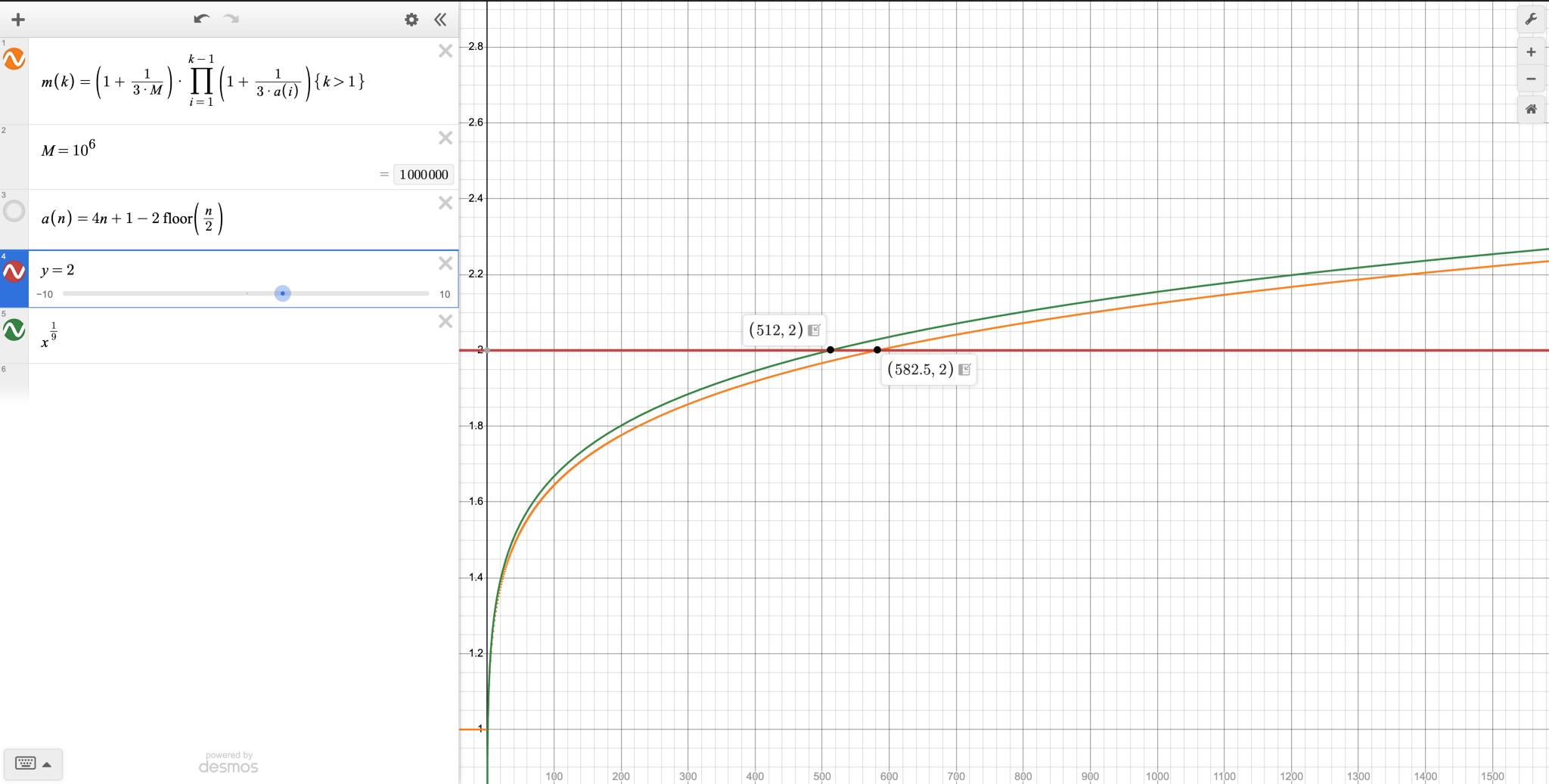
$$R_k < \left( 1 + \frac{1}{3 \cdot 10^6} \right) \prod_{i=1}^{k-1} \left( 1 + \frac{1}{3a_i} \right)$$
Numerical evaluation (via Desmos) confirms that this product remains less than for all .
 ) from