Thanks , it’s a wonderful post but what i’m asking now is how to prove the non-existence of 2-cycles !
- My attempt : I can show that if m is so big , also k does !
Firstly , we have in general the following identity:
\displaystyle \frac{2^{S_k}T^k(n)}{3^kn}=\prod_{i=0}^{k-1}1+\frac{1}{3T^i(n)} , so useful in many places !
So if T^k(n)=n (i.e a cycle of length k) :
\displaystyle \frac{2^{S_k}}{3^k}=\prod_{i=0}^{k-1}1+\frac{1}{3T^i(n)}
As an m-cycle is a cycle where p_1=p_2=\cdots=p_{k-m}=1 and p_{k-i} \ge2 , \forall i : 0 \le i\le m-1
Note that T^{i}(n)>T^{i-1}(n) iff p_i=1 and since T^i(n) is odd we get T^i(n) \ge T^{i-1}(n)+2
so T^i(n) \ge n+2i, \forall i : 0 \le i\le k-m (As p_{k-m} is the last p_i which is equal to one) ,
\implies \displaystyle \frac{2^{S_k}}{3^k} \le \prod_{i=0}^{k-m}(1+\frac{1}{3(n+2i)}) \times \prod_{i=k-m+1}^{k-1}1+\frac{1}{3T^i(n)}
and T^i(n) \le T^{i-1}(n) iff p_i \ge 2 , so we get T^{k-i}(n) \ge n+2i , \forall i : 0 \le i\le m-1
so , T^i(n) \ge n+2(k-i) , \forall i : k-m+1 \le i\le k
\implies \displaystyle \frac{2^{S_k}}{3^k} \le \prod_{i=0}^{k-m}(1+\frac{1}{3(n+2i)}) \times \prod_{i=k-m+1}^{k-1}1+\frac{1}{3(n+2(k-i))}
Again using S_k \ge \lceil k \log_23\rceil or the weak residue conjecture itself (doesn’t matter right now) ,
i can show things like when m\ge \cdots \implies k \ge \cdots ,
for instance , for m=1 (i.e 1-cycles) : that product \prod_{i=k-1+1}^{k-1}1+\frac{1}{3(n+2(k-i))} is just 1
taking n>10^4 (collatz true more than that) , will yield to k>200
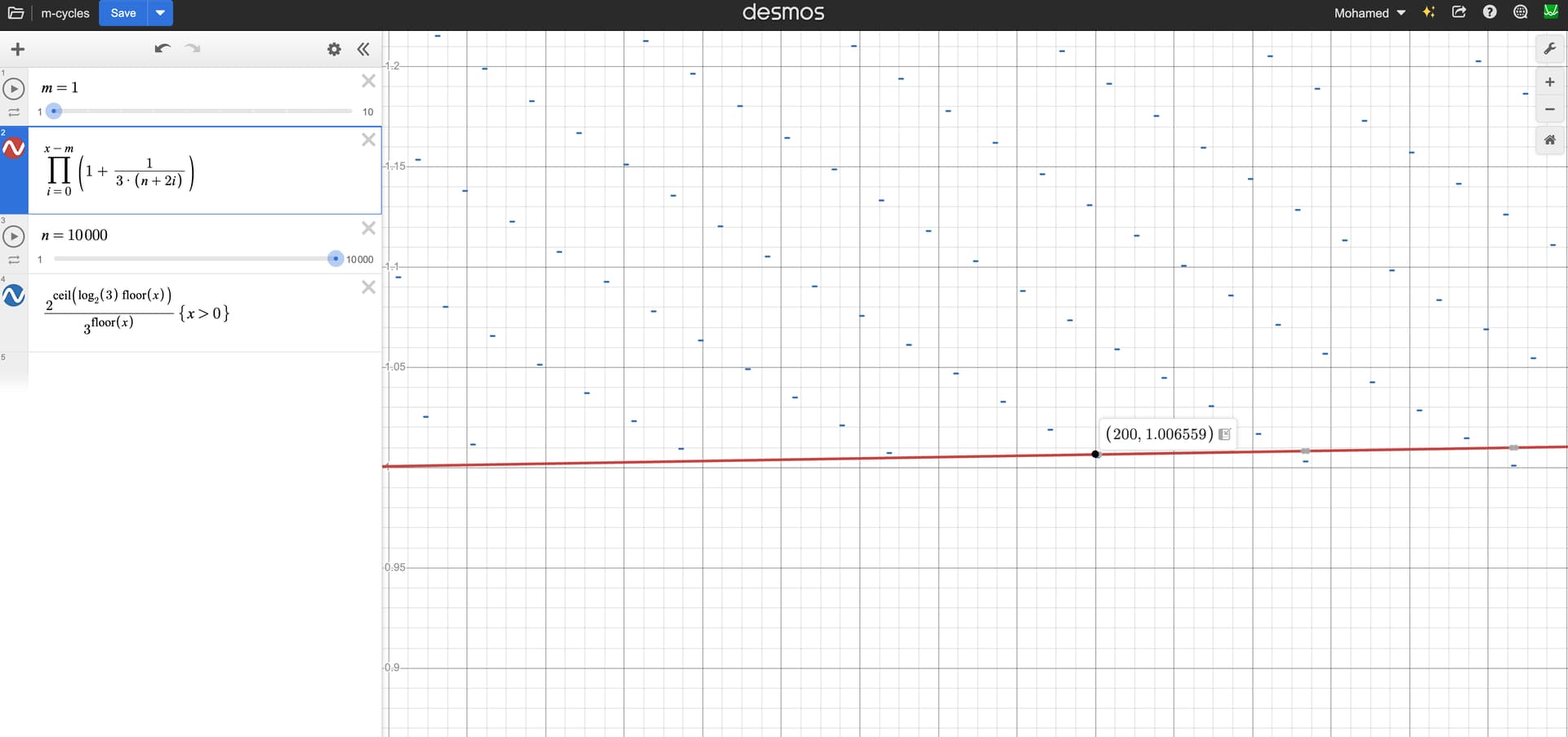
of course we can do more sharp estimates to that product like what Collag3n did here !
and Hercher already did so in this table :
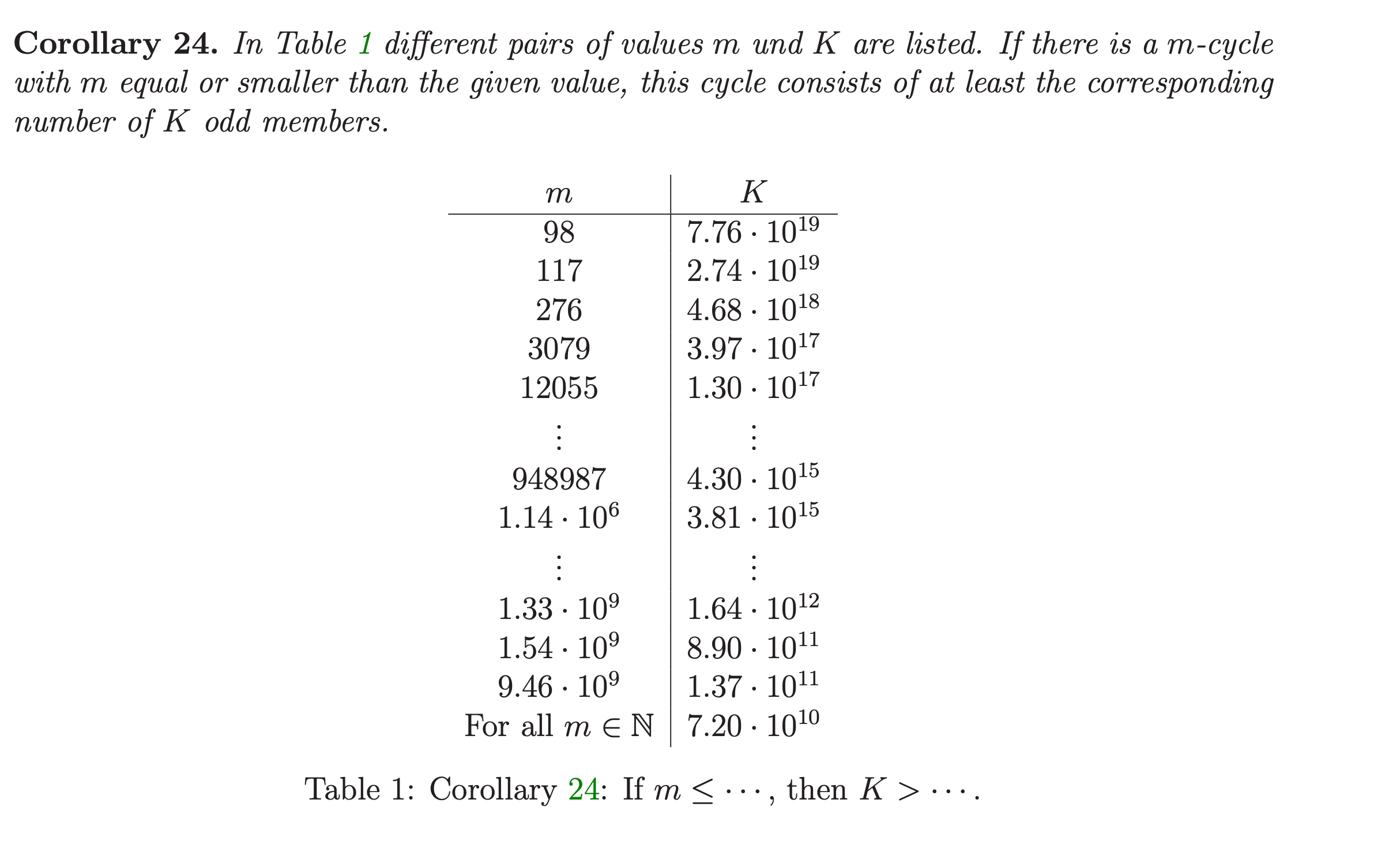
that’s cool , but my question is how we can derive an upper bound of k ?
i.e : can you show things like : if a non trivial 2-cycle exists, then k < 86 000 ?