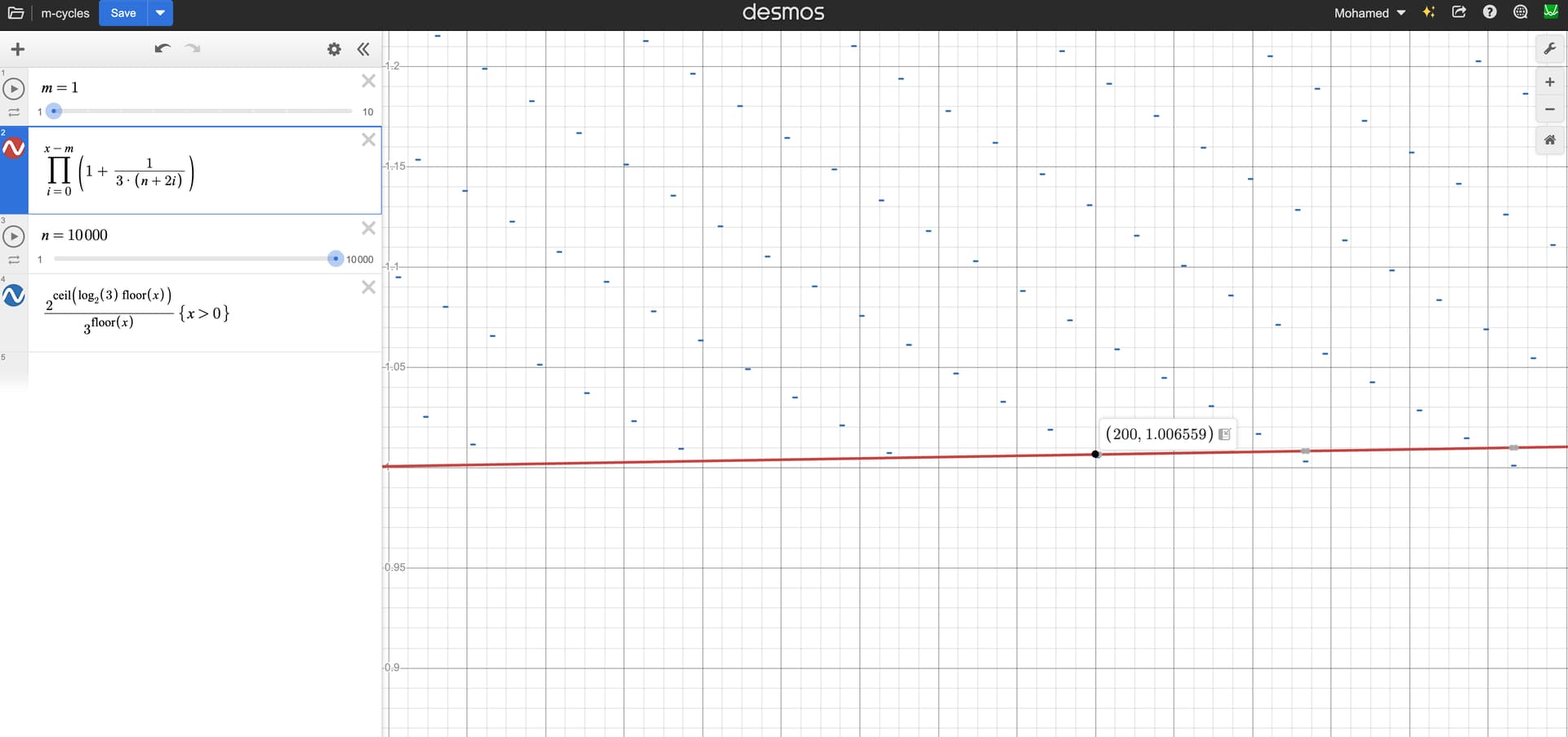
My specific notations for collatz :
Firstly , I will always take n odd and deal only with odd numbers
and instead of doing the trivial rule if n is even we divide n by 2 ,
I will directly do this instead : T(n)=\displaystyle \frac{3n+1}{2^{p_1}} where p_1=v_2(3n+1)
skipping powers of two is much more convenient for me .
and S_i=\displaystyle \sum_{j=1}^k p_j where S_0=0 , hence we get the following formula :
- T^{k}\left(n\right)=\displaystyle \frac{3^{k}n+\displaystyle \sum_{i=1}^{k}3^{k-i}2^{S_{i-1}}}{2^{S_{k}}} ,
so T^k(n)=n (i.e n does a cycle of length k) iff :
- n=\displaystyle \frac{\displaystyle \sum_{i=1}^{k}3^{k-i}2^{S_{i-1}}}{2^{S_{k}}-3^k}, let k >m with n>1
a simple upper bound of S_k is S_k \le 2k,
an m-cycle is a cycle where p_1=p_2=\cdots=p_{k-m}=1 and p_{k-i} \ge2 , \forall i : 0 \le i\le m-1
so n=\displaystyle \frac{3^k-3^{m-1}2^{k-m+1}+\displaystyle\sum_{i=k-m+2}^{k}3^{k-i}2^{S_{i-1}}}{2^{k+q}-3^k} where q=\displaystyle\sum_{i=0}^{m-1}p_{k-i}-m\ge m since p_{k-i} \ge 2
(since S_k=k+q \le 2k \implies q \le k )
for m=1 (i.e 1-cycle) , the sum going from k-m+2 up to k is just 0 and q=p_{k}-1\ge1
so n=\displaystyle \frac{3^k-3^{1-1}2^{k-1+1}+0}{2^{k+q}-3^k} =\displaystyle \frac{3^k-2^k}{2^{k+q}-3^k} , which lead to 2^{k+q}-3^k \mid 2^q-1
Using the Rhin bound we get : 2^n<2^{\lceil n \log_23\rceil}-3^n as shown here by Collag3n ,
so 2^k<2^{k+q}-3^k\le 2^q-1<2^q \le 2^k which is clearly a contradiction !
Now , for m=2 we have :
n=\displaystyle \frac{3^k-3^{2-1}2^{k-2+1}+\displaystyle\sum_{i=k-2+2}^{k}3^{k-i}2^{S_{i-1}}}{2^{k+q}-3^k} where q=p_k+p_{k-1}-2 \ge 2
n=\displaystyle \frac{3^k-3\cdot2^{k-1}+3^{k-k}2^{S_{k-1}}}{2^{k+q}-3^k}=\displaystyle \frac{3^k-3\cdot2^{k-1}+2^{k+r}}{2^{k+q}-3^k} where r=p_{k-1}-2 \ge 1
Now, using that 3^k \equiv 2^{k+q} \pmod{N} , where N=2^{k+q}-3^k
we have by Rhin bound : N>2^k and 3^k \equiv 3\cdot2^{k-1} - 2^{k+r} \pmod{N}
so 2^{k+q} \equiv 3 \cdot 2^{k-1}-2^{k+r} \pmod{N} \implies 2^{q+1} \equiv 3 - 2^{r+1} \pmod{N} (since N is odd)
so N \mid 2^{q+1}+2^{r+1}-3 \implies 2^k < N \le 2^{q+1} + 2^{r+1}-3 which isn’t a contradiction yet
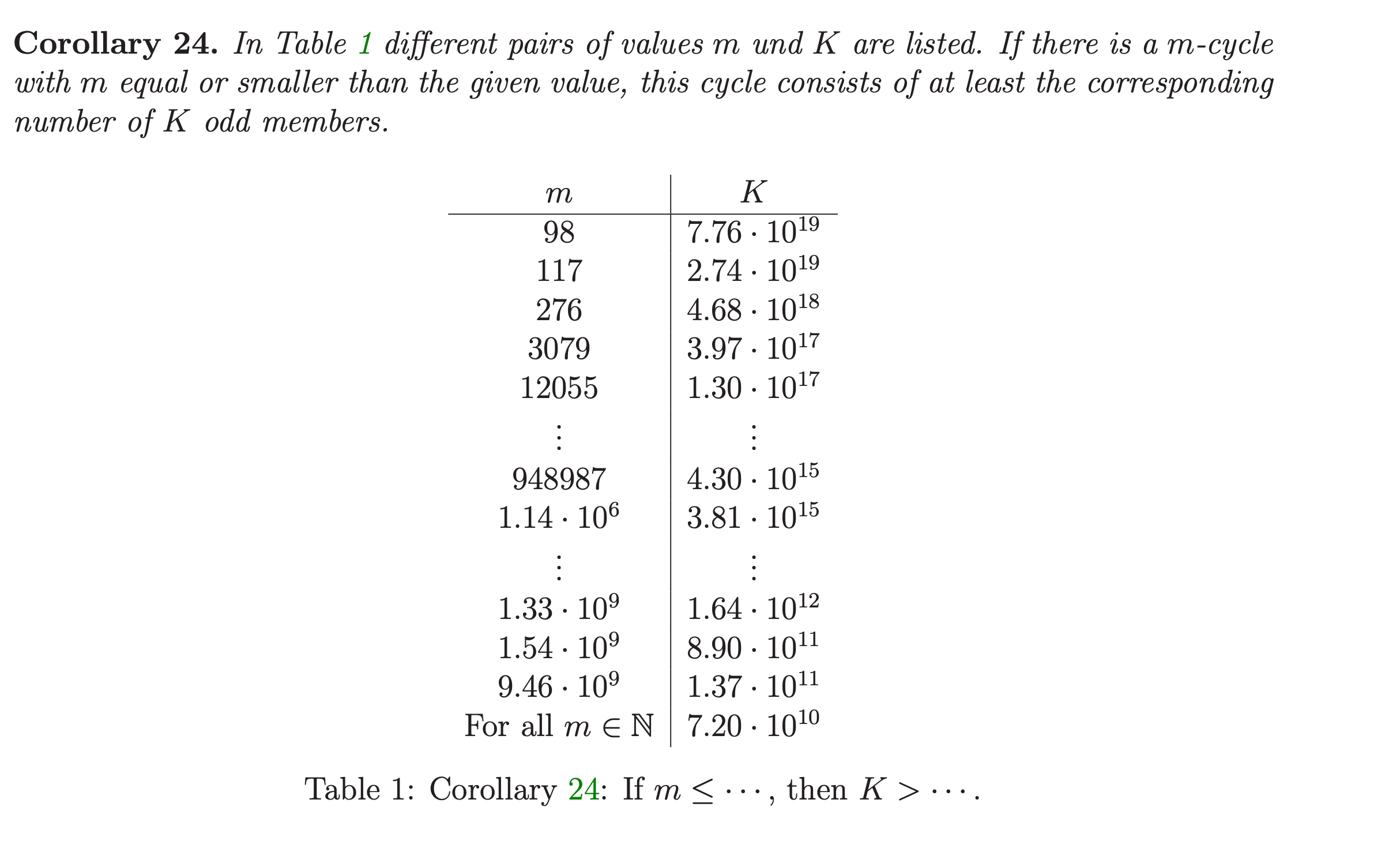
Hercher extended the method further and proved that there exists no m-cycle with m \le 92
- What method /tools he used to do so ?
I want to know just the main theorems he used in transcendental theory (like Rhin bound for m=1),
even assuming the weak residue conjecture which will lead to an explicit formula of S_k,
\bbox[1px,border:1px solid #0a0]{\bbox[8px,border:1px solid #0a0]{S_k = \left \lceil \displaystyle k\log_2(3) \right \rceil}}
So any attempt of him (Hercher) , to bound S_k or to compare it to \log_2(3) ect , isn’t my intereset
As we’re assuming that we already have the exact formula of S_k no need to bound it
but rather the divisibility techniques he should exploit to prove the non existence of m-cycles
is what i’m looking for , like what we did in the (1-cycle case) and almost in the (2-cycle case)
Finally , I would know why If you assume the Collatz conjecture, then you can derive a bound between powers of 2 and 3 similar in nature to the one you can derive with Baker’s theorem ?
tao has written about this (Informal sketch only) on his blog using Fourier-analytic computation involving Riesz products and more sophisticated tools
is there a simpler way to do so ?
Thanks for help !