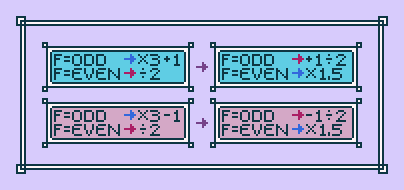
3n-1: More than a mirror formula of 3n+1?

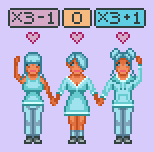
Don’t be fooled by the simplicity of my new art piece, there is quite a story behind this.

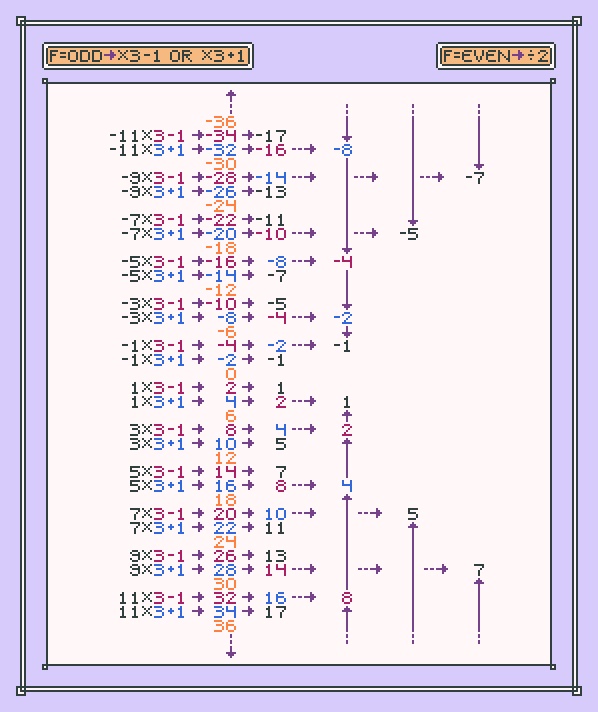
I think the 3n-1 and 3n+1 formulas are more than just mirror formulas. At first I thought they each had their own numbers and it didn’t matter which formula owned which. But this turned out to be very important. Instead of the uneven numbers they also own their own even numbers.

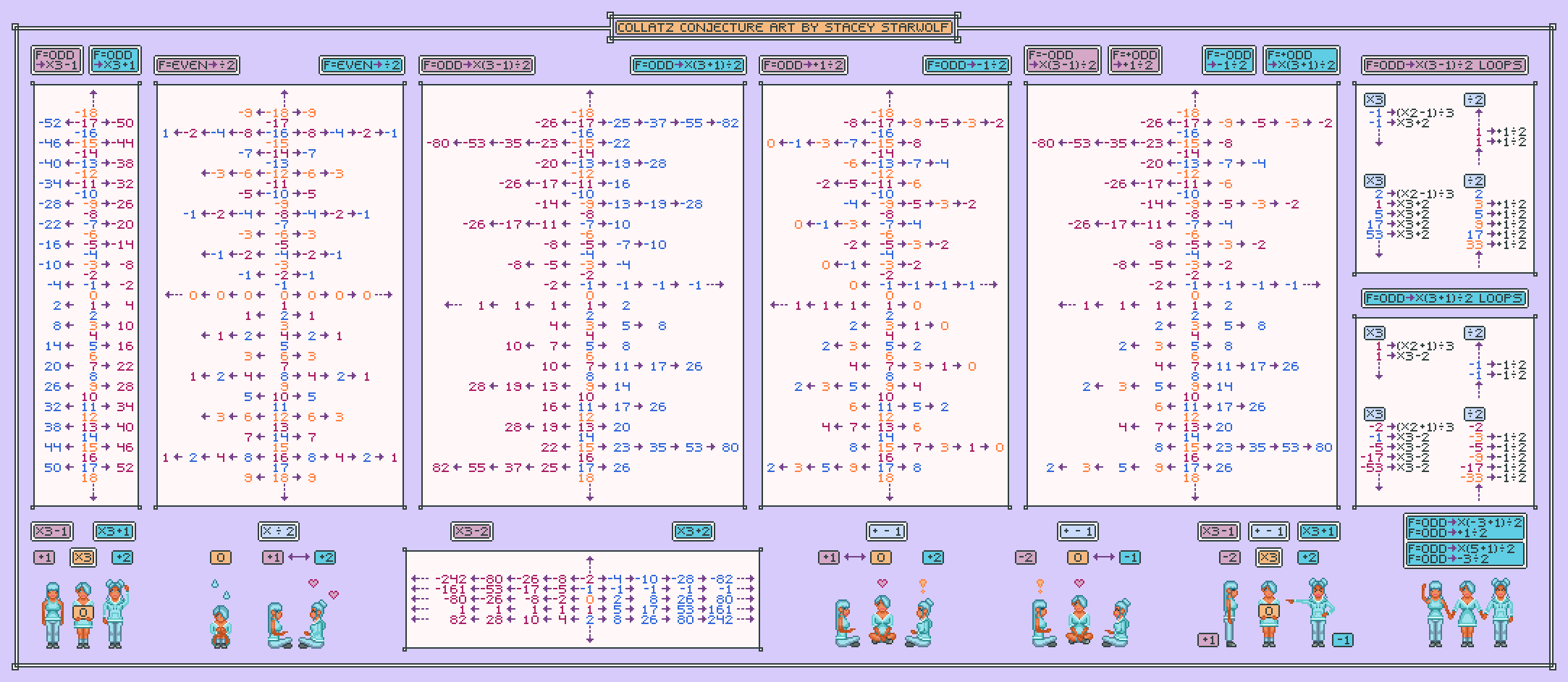
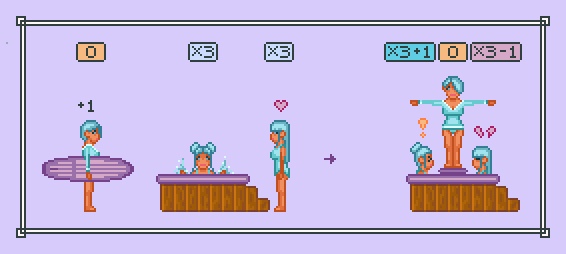
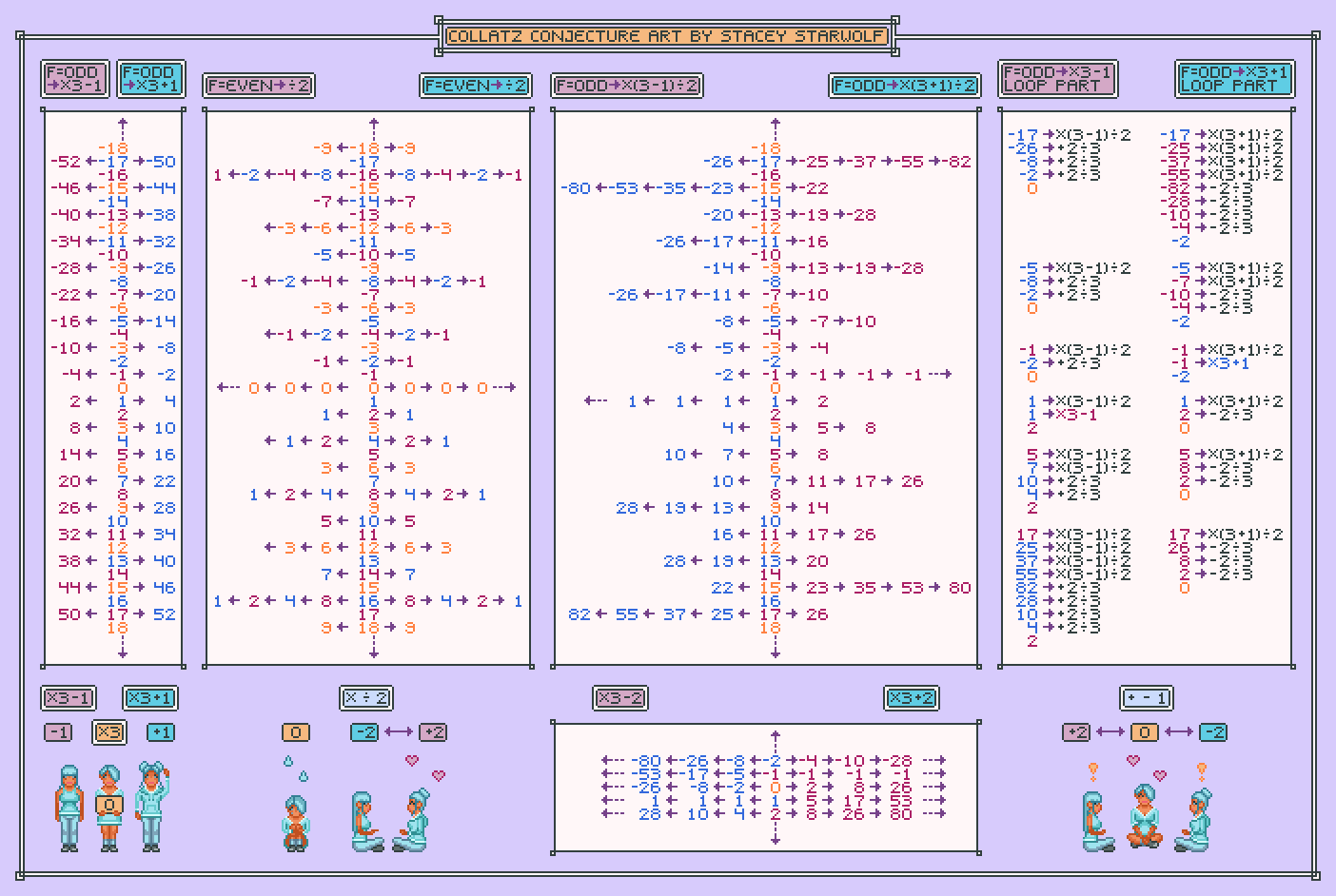
So what is happening when we enter a number in the 3n+1 part of the formula? As soon as the number is entered any uneven number becomes even. This even number is automatically owned by the formula. For example 3 (a neutral number) * 3+1 = 10. 10 Is owned by 3n+1 represented by Stacey who has the blue numbers. Gaby 3n-1 has the red and Nully has the yellow neutral numbers.

Now comes the /2 part. Any even number that is owned by 3n+1 and gets split stays within the 3n+1 formula. Is that number uneven, we can use 3n+1 again, if it is even it becomes 3n+2 which is also part of the 3n+1 formula. However, once we start to split that even number again it becomes part of the 3n-1 formula and the numbers are used as such! That means 3n+1 sequences are using parts of the 3n-1 sequences and vice versa, the sequence is formula hopping.
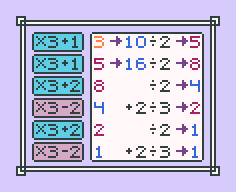
With this now in mind, loops have to contain parts of the mirror formula and vice versa. The same rules apply to for example 5n-1 and 5n+1. Although these are way more tricky because they are dealing with 4 different formulas due to a double offset. These are the positive loops, the negative ones are obviously mirrored but still part of 5n+1!
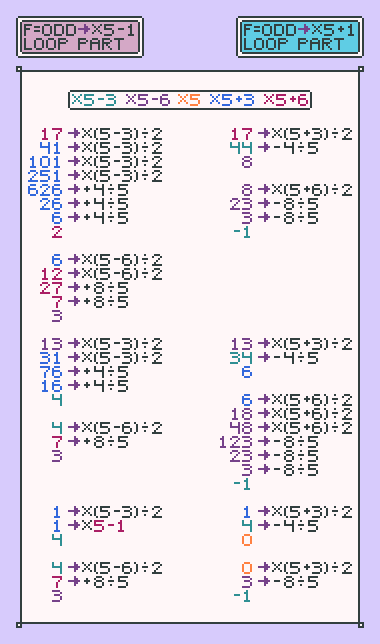
Now I am not a mathematician and maybe my art is supper silly, but I was pretty amazed and I hope you are too.
2 Likes

I think you missed what is usually meant by “mirror formula”, but that’s ok. I’ll try to explain it in layman’s terms.

Let’s picture numbers (positive and negative) as some kind of aliens somewhere in the universe (U1). They have a complex legal system that requires that each of them has a heir, should they die. It happens that this is decided by the Collatz rule: number 1 is odd, so their heir is number 3x1+1=4. number -14 is even so their heir is number -14/2=-7, etc.

At the same time, there is another parallel universe (U2) where the rule is 3n-1 instead.

Well, we know that number X in U1 has the same structure of heirs than number -X in U2. That’s what is meant by saying that’s a “mirror formula”.

1 Like

I don’t know, I read someone say people don’t look into it, because it is just a mirror formula and I went with it. But now my theory is that they are both in the same universe and linked together. When using one of the formulas, you are sneakily using both.

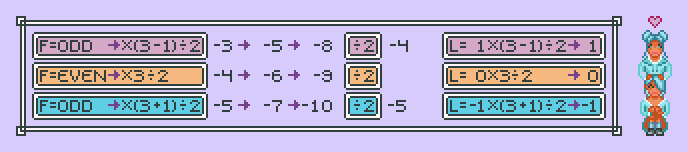
Nully can usually never reach any other number but herself when dividing or multiplying, but by adding and thus subtracting at the same time she can:

0 (*3-0) / 2 = infinitely 0
0 (*3-2) / 2 = -1

0 (*3+0) / 2 = infinitely 0
0 (*3+2) / 2 = 1

Her inability to reach any other number but herself has now been split 4 ways:

1 (*3-1) / 2 = infinitely 1
2 (*3-2) / 2 = infinitely 2

-1 (*3+1) / 2 = infinitely -1
-2 (*3+2) / 2 = infinitely -2

This creates two offsets: one for the even and one for the uneven numbers. I think it is now possible for sequences to accidentally cross loop back into each other trough the gap in between.

Unfortunately I found out that this will eventually create an infinite amount of offsets with a gap that grows infinitely bigger. I should have tested some of the bigger numbers first, because those started to create loops that didn’t exist.

1 (*3-1) / 2 = infinitely 1
2 (*3-2) / 2 = infinitely 2
4 (*3-4) / 2 = infinitely 4
8 (*3-8) / 2 = infinitely 8
etc.

1 (*5-3) / 2 = infinitely 1
2 (*5-6) / 2 = infinitely 2
4 (*5-12) / 2 = infinitely 4
8 (*5-24) / 2 = infinitely 8
etc.

I had good hopes, but something else is going on. I still think the ‘mirror’ formula has something to do with it though.

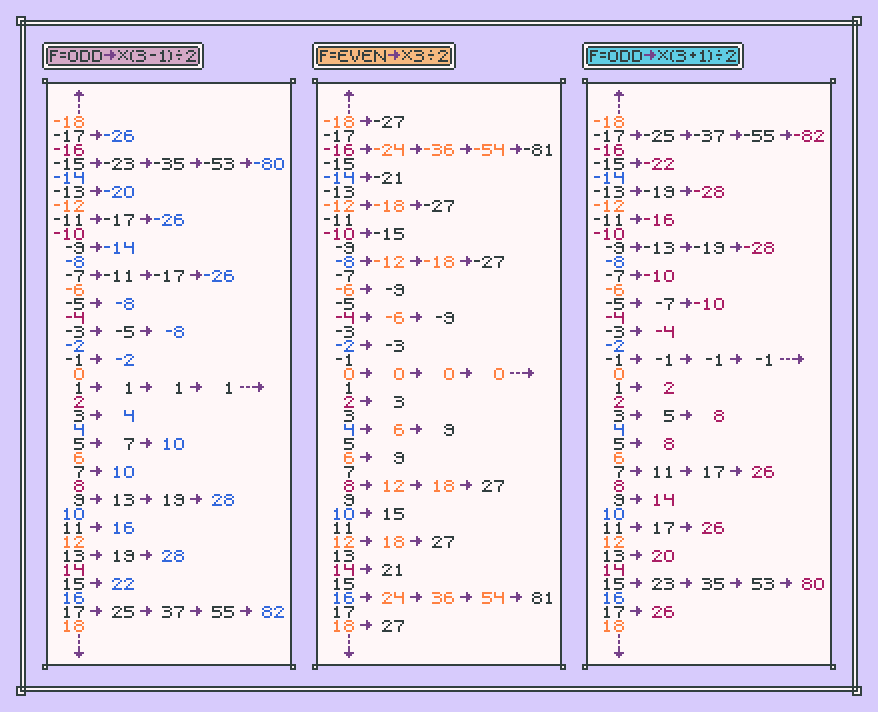
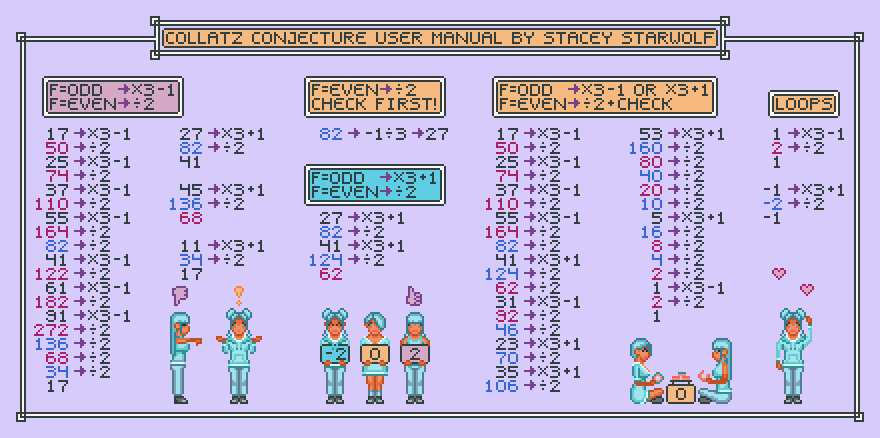
Let’s say we use the Collatz User Manual and follow its rule. Instead of dividing indiscriminately we look at which formula owns the uneven number and use that formula to multiply during the next step.

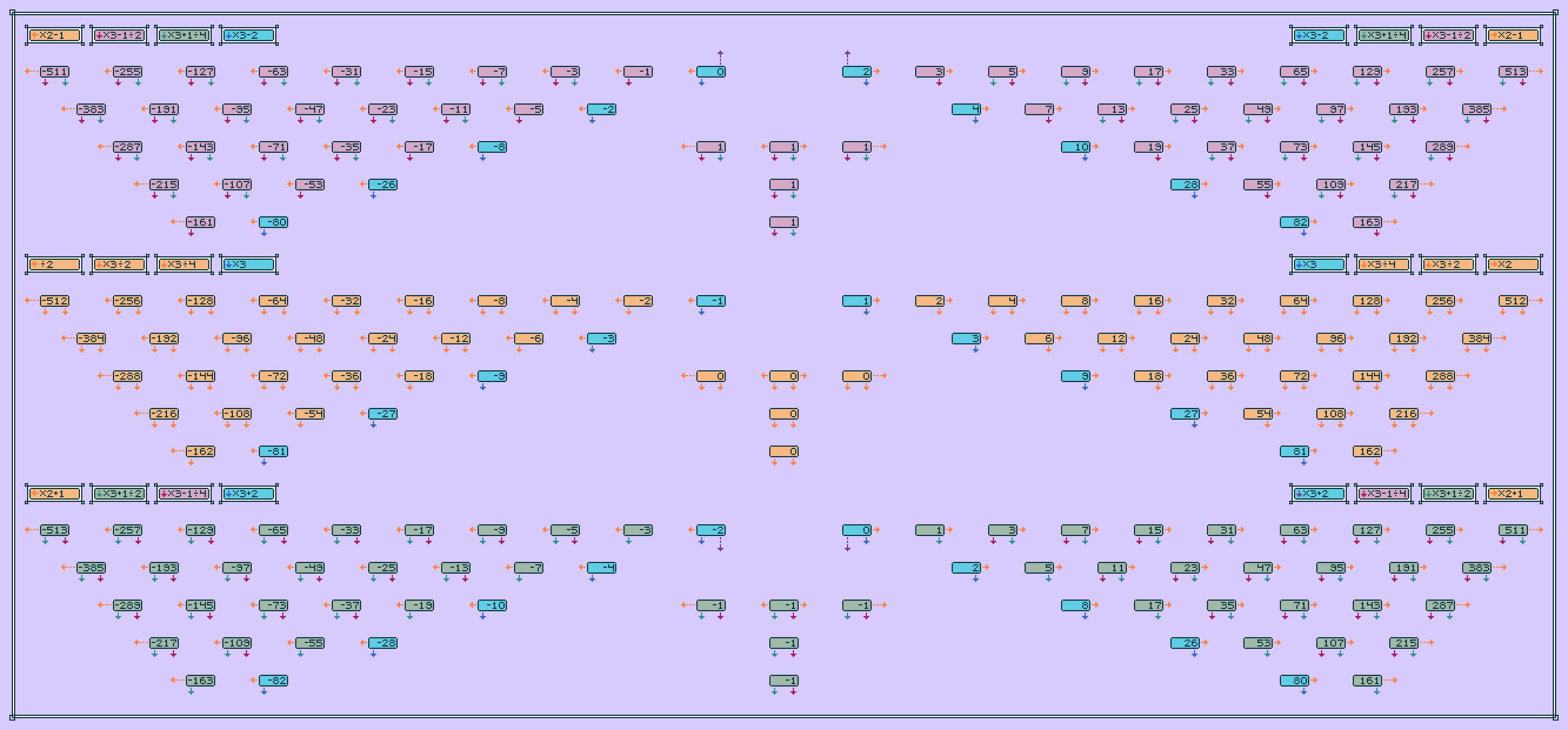
Every even number owned by one of the 3 formulas:

Problem 1: Will the Collatz Conjecture used this way lead to infinity?

First lets split up the even numbers. Sorry Nully, neutral ones are not participating:

Lets take the uneven number 5 as an example:

5 * 3-1 /2 = 7. The 5 is now effectively chained to the 7 and we can continue with 3n-1. This is a good thing, we are going up by *1.5-0.5. But something else is happening at the same time:

5 * 3+1 /2 = 8. This 8 gets split by 2 again and becomes a 4 (5 * 3+1 /4) . This 4 is set aside and linked into the /2 grid with the numbers 2 (3 * 3-1 /4) and 1 (1 * 3+1 / 4) which are already activated because we started with 5.

So for every number used both formulas are working together to push the sequence up and to set it up for falling down. For this example I used -7 starting with 3n-1:

Increasing our starting number or the number getting increased due to a positive chain doesn’t help. The highest uneven number and all the uneven numbers before it, including the neutral ones, are already activated and locked into the /2 grid to catch the sequence. It is now not a matter of if, but a matter of when the sequence reaches 1 again.

Problem 2: Will the Collatz Conjecture used this way have more loops?

These are the 3 formulas when they succeed with their *3/2 sequence and at the end fail (*3/4):

Even though they were previously not participating, the sequences of the even numbers of the *3/2 are exactly the same as those of the uneven numbers of the *3-1/2 and *3+1/2. Also there is no blindly dividing anymore, which means the /2 at the end of a sequence will lead into the other formula and not back into itself. This allows us to compare both formulas with the 3/2.

Unfortunately or fortunately the even numbers in the x3/2 sequences can only x3/2 until the sequence runs out and we hit an uneven number which we can’t divide. That means a fail (*3/4) is not possible for all formulas, except for Nully herself.

I don’t understand a lot of things on this forum because I am not a mathematician. I try to, but it is hard. So I am not sure if all of this is correct and even if it is, it is not how the Collatz Conjecture is used. I wouldn’t know how to deduce randomized sequences into a solution.

Anyhow, I do hope you liked the read and enjoyed the cutesy art. Feel free to comment on this be it positive or negative or feel free to play with the information or use it to your own advantage. Maybe you had a good laugh or even gained something from my silly thoughts, who knows.

1 Like

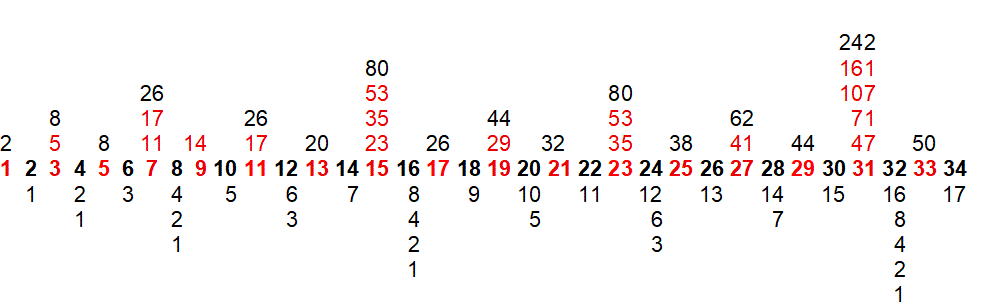
I focused on your use of the term “Mirror” and would like to show you an alternate instance of mirror in the Collatz system. Feel free to experiment with it as you wish. Collatz has immense amounts of structure, most of it being hidden until some effort is made to unearth it. I have done an archaeological dig on the Collatz tree and unearthed many structural elements. Upward runs of (3N+1)/2 are odd values, terminating in an even value. Even values move down by /2 until an odd is reached. Both sets are mirror images of paths of the same length and both form a binary tree indentation pattern forming a binary sieve related to run lengths.

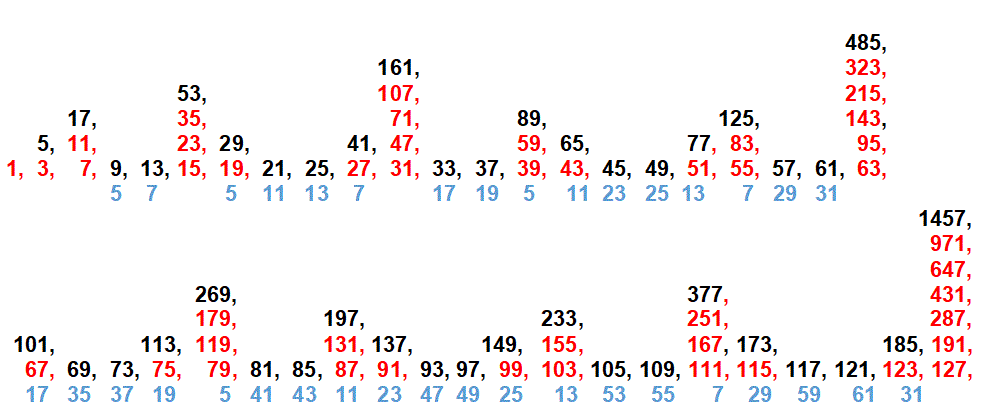
Looking at just the upward runs and removing duplicates, a fractal structure emerges.

All the flights of steps that begin with 2^n (1, 3, 7, 15, 31 …) are the longest in a local area. Other flights come in families and the family number is in blue below the base of the graph. Each range between 7-15 or 15-31 or 31-63 is a magnified copy of the previous one with more infill detail added. All flights in one interval grow in length by one step in the next interval and new pairs of fillers are added after each pair of flights. These will grow in following intervals. This is a regular simple binary tree structure growing into a discreet digital fractal form and the Collatz tree is on the cusp of chaotic effects. This is just one instance of hidden structures. There are many more hiding in the system.

When I get full access to create a new topic I will be able to present them.

1 Like

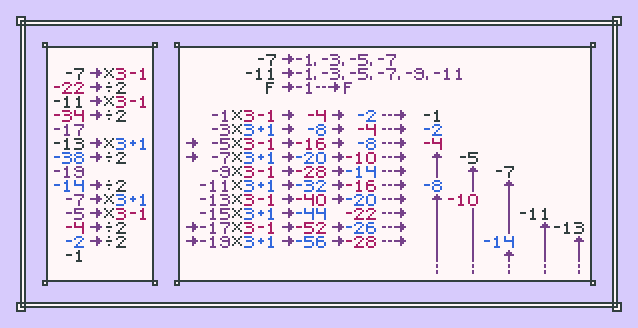
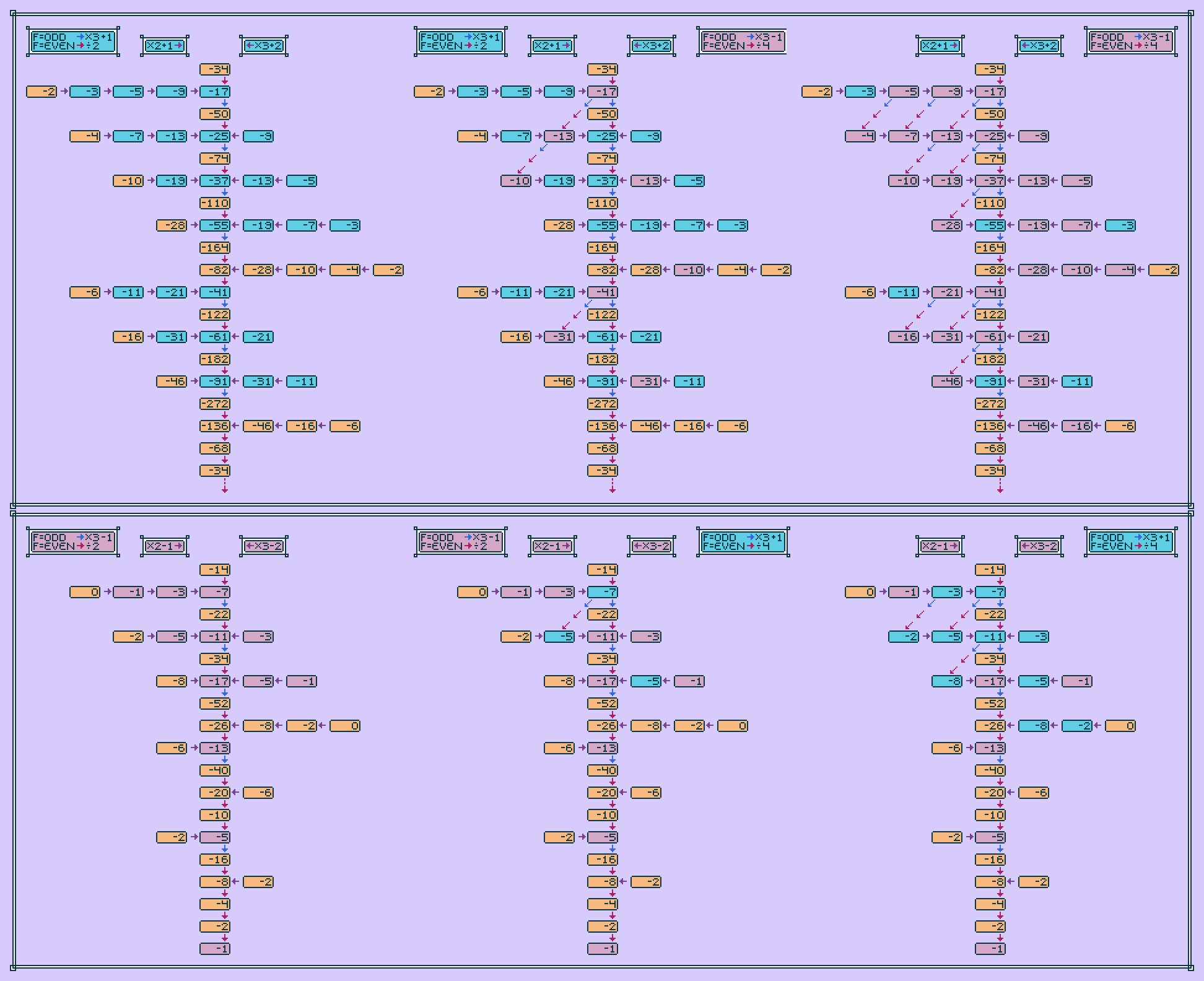
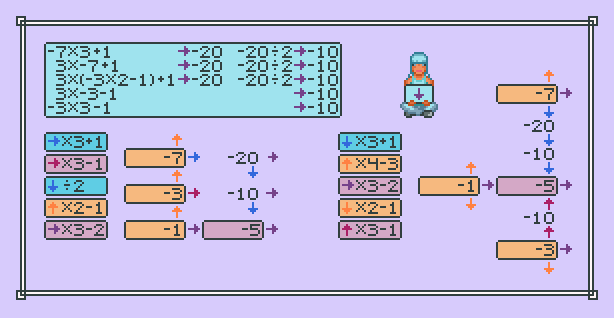
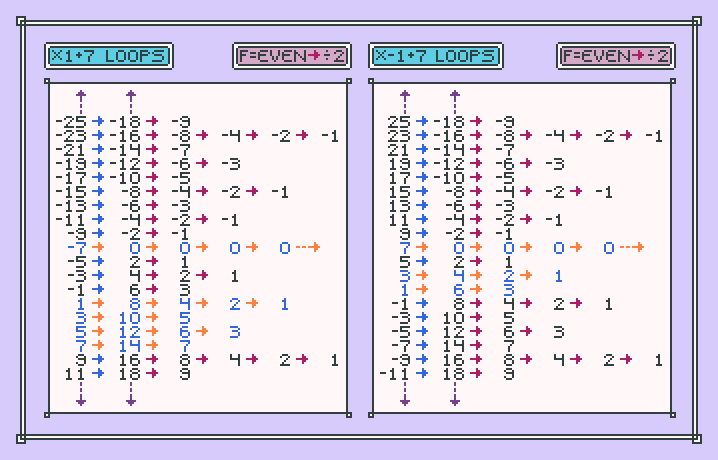
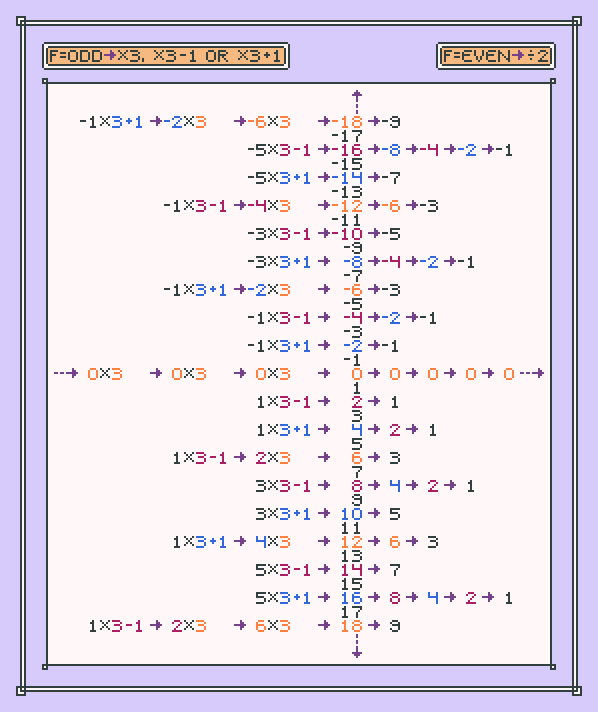
My first art piece (I corrected a few mistakes) of the Collatz Conjecture shows how to trace every number back to its origin number. The numbers that hit the same number after the modulation into the other formula is a loop.

Example: -17 > -9 > -5 > -3 > -2 > (modulation) -1 > -5 > -17.

Now I found out that this art piece isn’t so modular anymore and it is probably a conversion instead:

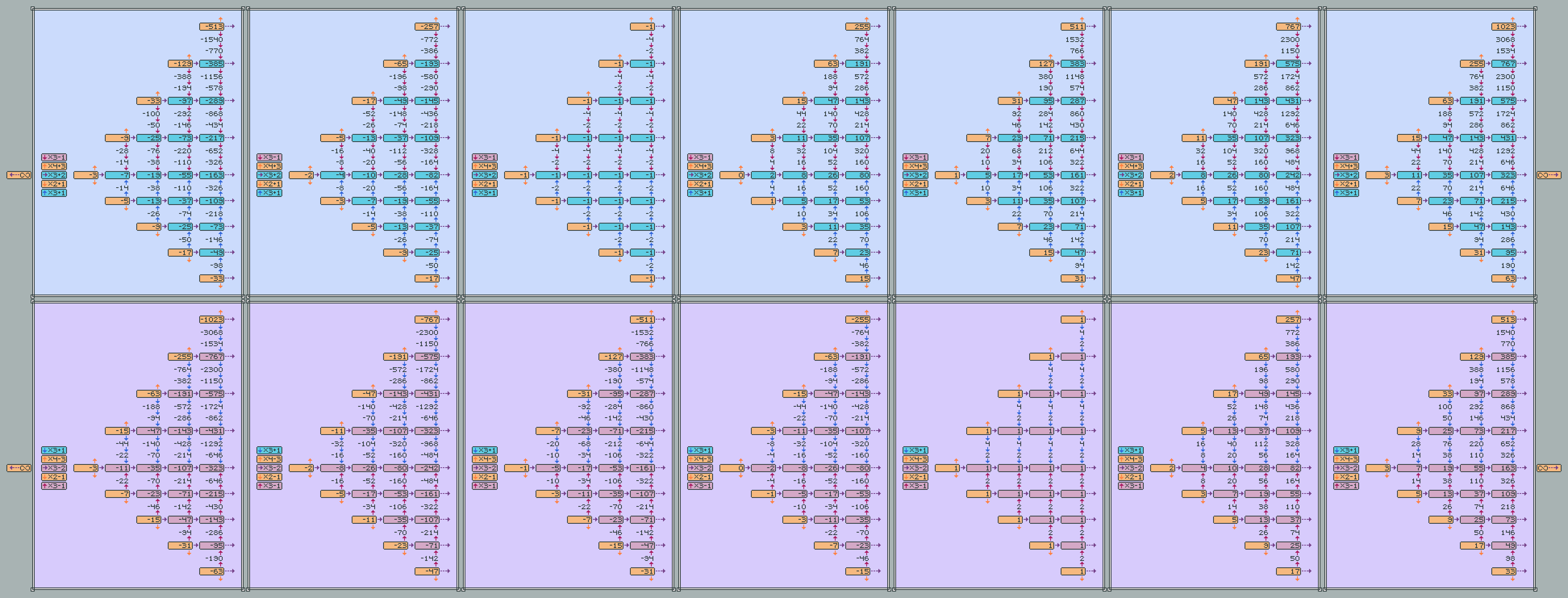
The 3n+1 and 3n-1 formulas are interwoven and using the same grid but with their own little pieces connected to other pieces. I wanted to show how the formulas interact in this weird angular way, but to show that the x2+1, x3+2, x2-1 and x3-2 are infinite:

You can even move all the numbers so that both formulas are aligned with the even grid of the 3n again:

Example: (-17+1) -16 > -8 > -4 > -2 > -1 > (conversion) -2 > -6 > -18 (-17-1)

Anyhow, that is it for now. Maybe you gained something, maybe I just wasted a lot of time. I don’t know. What I do know is that I need a little break from this formula.

Bye

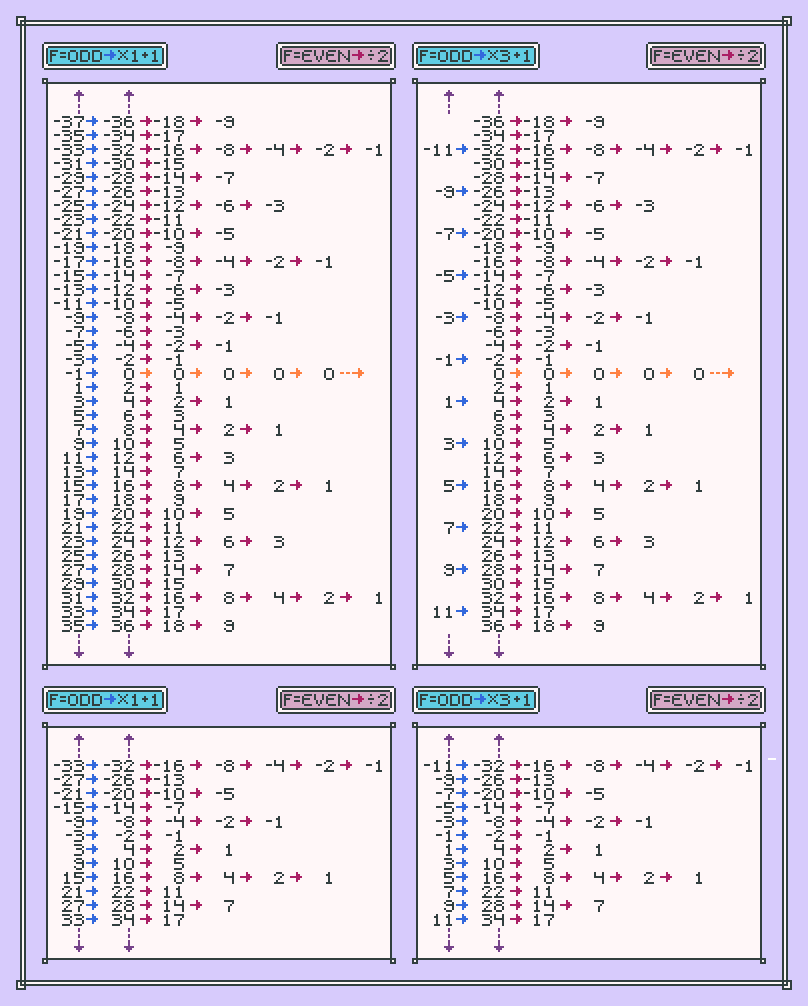
Sorry, I couldn’t resist creating another art piece. This shows how the 3n+1 and 3n-1 formulas intertwine and work together.

I still think Nully is the culprit by joining the formula and creating the offset and randomness. Nully not knowing how to play along is just Nully being Nully I guess.

I hope you like the art.

2 Likes

Maybe relevant or not but if you take the odd numbers 1,3,5,7……and give them a sequence positions 1=1, 3=2, 5=3……. Call the sequence S and the odd N, the bijection for S to N is S×2-1, as we know for any N×3+1=even, we can say that all S will convert into the collatz conjecture via (3(S×2-1)+1)÷2 which is S×3-1. For all even s this will result in an odd number so for all even s we can say 3(s×3-1)+1 to continue the collatz function from S. This relationship exists between the collatz function and the sequential movements of odd numbers.where sequentialy the only S returning to itself is 1

Very fancy and I had to think there for a bit. I took the liberty of using -7 as an example and as you can see it is in my artwork. In this case the -7 is part of the x3-2 sequence of the 3n-1 formula and it could be responsible for the -5 loop.

So sorry for spamming the website yet again, I am pretty sure some people prefer more mathematical stuff. But I looked over my previous art piece and I think I know what is going on.

Nully being Nully is the only even integer not being able to divide or multiply. But by adding the +1 she now can. With her joining the formula she has created an offset, this offset is -1 > 0 > 1 or 1 - 2 = -1, so -2 and with this she has sneakily split the 3n into the 3n+1 and 3n-1.

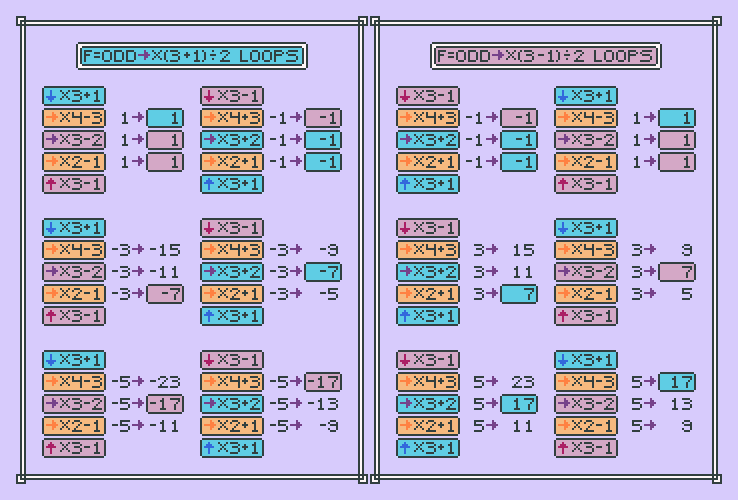
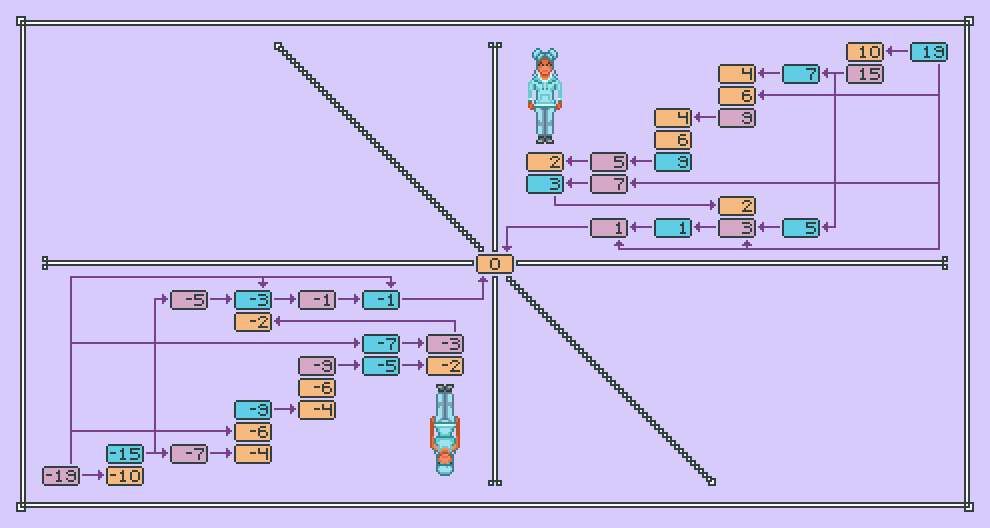
But it is not only Nully her fault. Thinking the two formulas are unrelated we decided to indiscriminately divide without caring which of the two formulas is attached to the even numbers. This made things an uncontrolled mess, because now numbers can interact with both formulas and form a loop. Based on my previous artwork I created this, which shows which formula and which part of the formula is responsible for a loop:

As you can see, very messy. But now the big question, are there any more loops besides these for the 3n+1 and 3n-1 formulas? Unfortunately I think there are not and this will hopefully show you why:

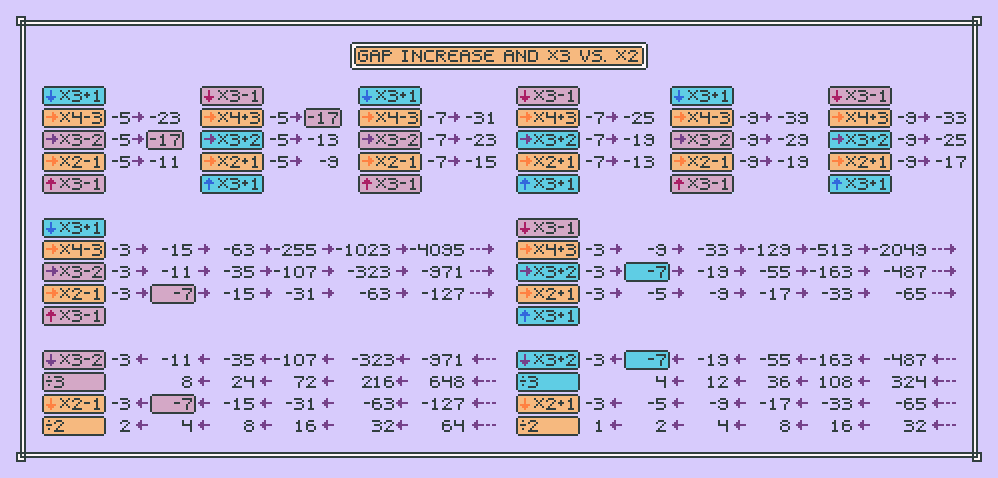
I took -5, -7 and -9 as an example. As the numbers used go down, the gaps between the answers compared to the answers of the previous number used grow: -5 (-17 and -17), -7 (-23 and -25), -9 (-29 and -33) This is obviously the same for positive integers and makes it so that it is no longer possible for the x3 parts of the formulas to link up with the x2 parts.

But Stacey, why not multiply by 2-1, 2+1 or 3-2 or 3+2 more so they can link up together that way? Well, multiplying anything by 2 to try and fit into a x3 grid or vice versa will not work . All numbers here might look uneven and reach another uneven number on paper, but they are bound to the grid they are meant for. I decided to show this by subtracting the uneven numbers. It is like trying to fit 7x3 into a x2 grid. Closest you can get is 10x2 or 11x2, but you will never be able to fit in the 7x3.

If you got any questions or comments let me know. Again I am not mathematician, so I might have trouble with complicated stuff, but I will try my best. Last but not least: Nully, you are a special integer and I love you for it!

In the late 70s an artist friend was playing around with visualizing tables related to Mersenne primes I was toying with. He worked for a print studio where some artists were integrating grids into their work to represent technology and structure. I have one of their prints hanging behind my desk that combines a grid with images related to gold and peace negotiations.

As you might know I tried to create some art for the 5n+1 and 5n-1 formulas in the hope of solving those loops the same way as with the 3n+1 and 3n-1 formulas. Not sure if that is even correct, but I tried and tried and to no avail. Being frustrated I had the post removed instead. Either I am not smart enough or something is wrong. Well, I might have found something wrong and I will try to explain what that is.

To find out I decided to start from scratch and why not start by looking at the 1n formulas. At first I started looking at the loops they make. For example 1n+X has X in all her loops and uses twice the amount of X*2 even numbers to reach them compared to the -1n-X formulas which doesn’t reach all X, but specific X for every next formula. It is an awesome process; you should check it out if you have the time:

But it made me wonder though, what created this process and why is it not working with the other Xn formulas? Lets compare the 1n+1 and 1n+3 formulas and their /2 part.

Notice how the /2 part for the formulas never changes. This means that whatever we do with the first part of any Xn formula changes the outcome. In this case by using the 3n+1 formula we are actually using the 1n+1 formula, but only her numbers that we can divide by 3.

Does it matter? Yes, any odd number, whether it is doubled or divided by an uneven number, will become an odd number. One which will fall under the 1n+1 formula and, I think, should be used as such especially if (Xn+1)/2 can be seen as a single formula.

Not all is lost for the 3n+1 formula though:

Finally the proof I wanted. The 3n-1 is involved and suddenly my weird theories about it messing around with the 3n+1 formula and vice versa are not so silly anymore. Note that this only happens with the 3n+1 and 3n-1 formulas and of course if we neglect the continuation of the 1n+1 and 1n-1 formulas.

I now also know that the 5n+1 and 5n-1 and any other Xn+1 and Xn-1 formulas can not be deduced the way I wanted. This is because the formula that matches the 1n+1 to the 5n+1 is 5n-2 and this goes up by 1 for every next formula, so for 7n+1 this is 7n-3 etc.

Again just some of my silly thoughts on this topic for the Collatz Conjecture. I hoped you enjoyed the art and maybe you gained something from it.

1 Like

Not sure I follow your whole way of thought, but here is a piece that I think you’ll like.

If you take a rule like 3n+1 (or any Xn+k), you can try to draw the relations between different numbers as a big graph: For example if we get 7n+5 you’d have 1 → 7*1+5=12 so you draw an arrow from 1 to 12.

There is always exactly one arrow that depart from a number (you can easily figure why), but you can also see how there can only be at most 2 arrows that point to any number.

1 Like

Hey Failix,

Thank you so much for reading my silly posts! My thoughts can be very chaotic and sometimes I don’t even understand myself. But with these posts I am trying to find out if the 3n-1 formula has a connection with the 3n+1 formula and if it is responsible for the loop creation process within the 3n+1 formula.

But unfortunately I am also having very serious doubts about our rules and use of the Collatz Conjecture and am trying to make people think about this.

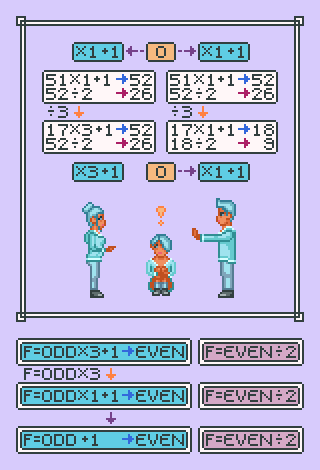
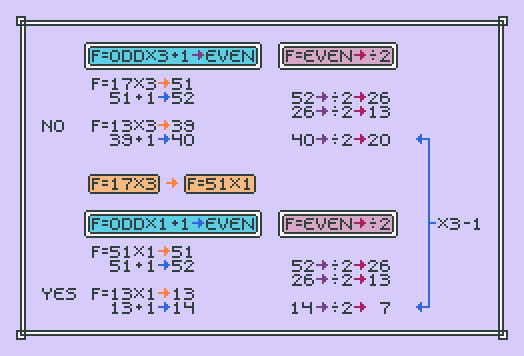
What I am trying to say in my previous post is that 51x1 divided by 3 is not 17x3 but 17x1. I hope this clarifies it better:

So by using the rules for the 3n+1 formula, which states that every odd number should be multiplied by 3 and have 1 added, we are actively ignoring the rules for the 1n+1 formula, which states that every odd number should be multiplied by 1 and have 1 added.

After dividing the even numbers, we are compensating for the results with 3n-1, which overlaps with the 3n-1 formula.

The question that keeps going trough my mind is: Should the 1n+1 rules not be in play when using the 3n+1 rules and be an order of operations specifically for these types of formulas?

1 Like

Ok, here is something else you can look at to better figure what “mirror formula” means.

Picture numbers on a line: zero at some point, one step to the left you have -1, one step to the right of 0 you have 1, etc.
Now picture a mirror that cuts this line, passing through 0. When you look at a number through the mirror you actually seen it as it it were its opposite. “Looking through the mirror” is also reversible: the image of N is -N, so the image of that image is N.

Now, pick any number and look at what 3x+1 does to it, all the different steps.
Pick the mirror image of this number and look at what 3x-1 does to it.

2 Likes

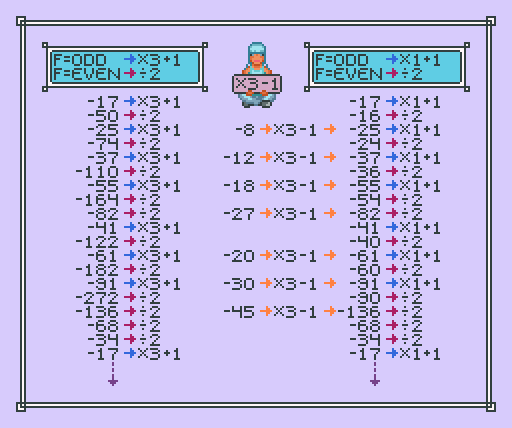
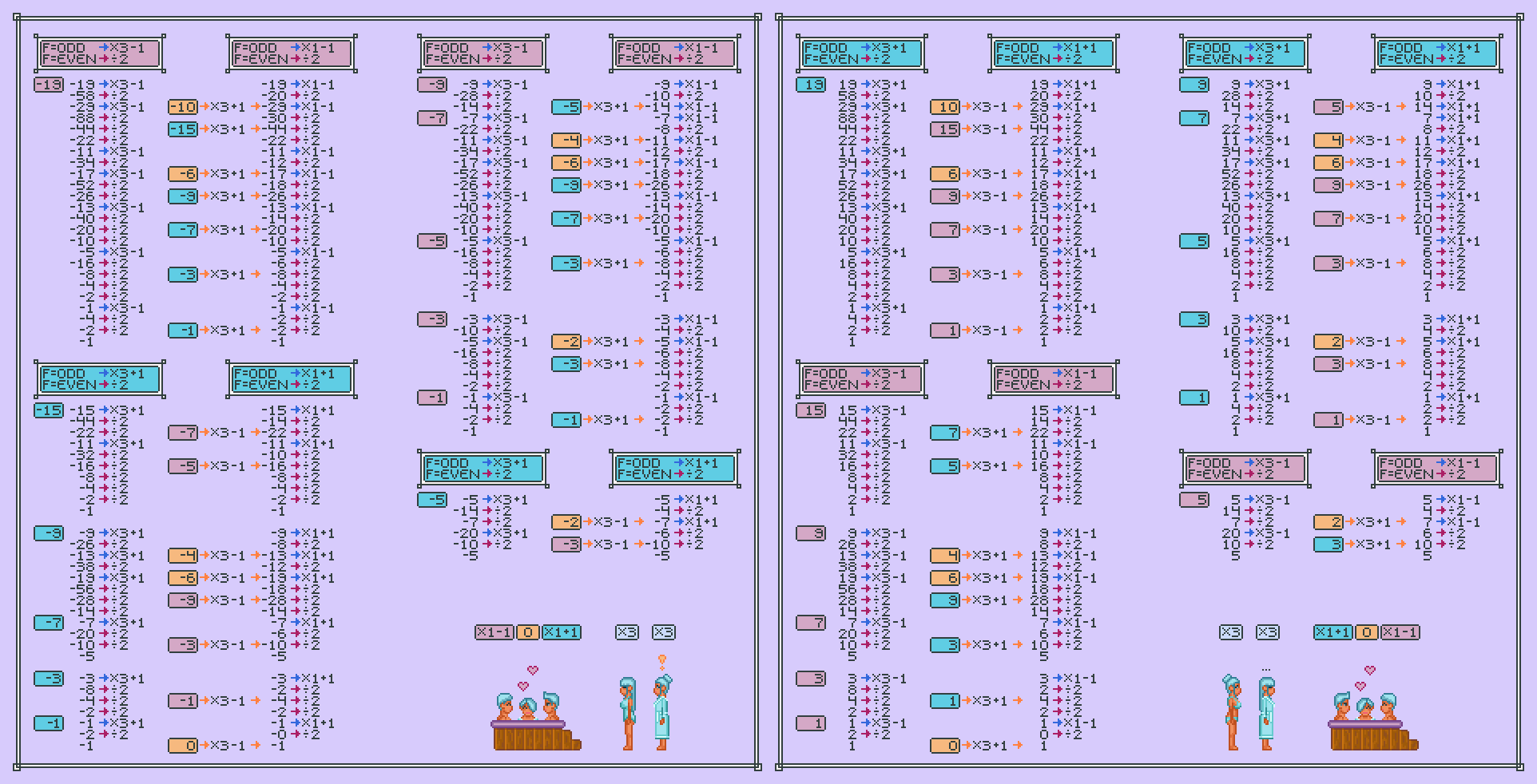
I tried to make what you suggested, but it got complicated extremely fast. First I tried 17, but that one is linked to the 27 of the 3n-1 formula and thus got extremely big. This is the -19 of the 3n-1 formula and the 19 of the 3n+1 formula:

1 Like

That’s not what I suggested (or I really don’t understand what you are talking about).

Here you tried passing 19 through 3x+1. Great! Now for the “mirror world” version of this you can try passing -19 (the mirror version of 19) through 3x-1.

Are you familiar with negative numbers? (I assumed you were but if that’s not the case that’s ok)

I think the implications is that by applying 3n+1 to negative numbers, you get the mirrored 3n-1 results of positive numbers, whether this is the correct definition of mirror sequence i dont know. Is the point being that applying 3n-1 to positive numbers, or 3n+1 to negative numbers if you like, that this seems to close the inequality that stops loop formation in 3n+1?

I am sorry if I am confusing, but what I am trying to say in my posts is that:

I think we shouldn’t be ignoring the 1n+1 rules. These rules should always go first because by ignoring them 3n-1 got introduced.

And this was the proof I was looking for. The proof that both the 3n+1 and 3n-1 formulas are using the same grid and are connected with each other. I just didn’t know back then it would be by Nully trough the 1n+1 and 1n-1 formulas:

However, not all is lost, unlike with the 5n+1 and 5n-1 formulas this creates the opportunity for us to compare both 3n+1 and 3n-1 formulas and see what the relationship is between the two. I always thought they were both responsible for each others loops and this is what I tried to proof in my previous posts.

So if you would ask me now: ‘Is 3n-1 more than a mirror formula of 3n+1?’

I would say: ‘Yes, it is also an auto correction for ignoring the 1n+1 rules when using the 3n+1 formula.’

1 Like

3n-1 is actually really unteresting and links the 3n-1 cycles to the trajectories of some numbers under the normal 3n+1, which makes you able of predicting that a small subset of numbers have wich trajectories atleast initially. This is because 3n-1 is the same as applying 3n+1 to the negative numbers, and actually both Z+ and Z- are connected within the collatz application. I will talk about col(x)=(3x+1)/2 if x odd and x/2 even collatz formalism, then for any k in Z there is a very well known formula : for all p in N* : col^p((2^p)k-1)=(3^n)*k-1, with col^p(.) the reiterated p times version of col(.).

the reason this formula actually works so neatly, is because for the negative numbers the cycle -1, -2 actually encodes this formula and is equivalent to this formula working for all k, indeed if you plot k=0, you exactly get that col^p(-1)=(-1) which is the equation of this cycle. This is because any numbers of the form for k interger, (2^p)k+x where x is any element of any collatz loop whether it is in the positive or negative side of the intergers has the exact same parity vector as x for exactly p iterations of this col(.) function and then it becomes chaotic again, for example if we want a general formula of some numbers using the -5 -14 -7 -20 -10 cycle, we have using -5 : for all k in N* col^(3k)((2^k)-5)=(3^2k)-5 and you can use 3k+1 or 3k+2 (the number behind the k is the amount of even numbers in the said cycle) but then you will get other member of the cyles as images of the col(x) function or also use other elements of the cycles as starting point but everything here contrarely to the general behaving of the syracuse sequence is very deterministic, not pseudo-random and easy to use.

The reason for that is that the following relation for any x in N : col^p((2^p)k+x)=(3^n)k+col^p(x) with n the amount of odd integers in the terms of the 3n+1 sequence of x actually works for both positive and negative k integers. What it means is that paradoxally, the more hypothetical cycles you would have for your relatives numbers whether they are in Z+ or Z- the more structure and predictibility you would have on the behaving of the syracuse sequence of those numbers atleast initially.

To summarize, The way I see it is that the positive side of integers and negative sides of numbers are actually very well linked together in the way they behave within the 3n+1 sequence and it may actually make sense to study both the negative and positive integers as they are both interlinked under the 3n+1 rules.

Unfortunately, there are too many numbers not congruent to the element of a cycle modulo 2^p to predict the behavior of a significant portion of numbers and those numbers whose initial trajectories are well known actually represent a null density of integers, but it was still very intereseting to find this connection for me.