Stacey’s 2-Peak approach for the Collatz Conjecture

Welcome into my weird world of art and math. Again, my mind is just a bit weird, so I sincerely hope this is useful at all. Maybe I should have posted this in experimental stuff, but I think there is quite a bit of math behind this, so decided to create a new topic for it. I truly hope someone will understand this and can translate it into proper math for others.

Anyway, here we go, this is my 2-Peak approach and can hopefully contribute to the solution for the Collatz Conjecture.

Step 1: Alignment of t he formulas
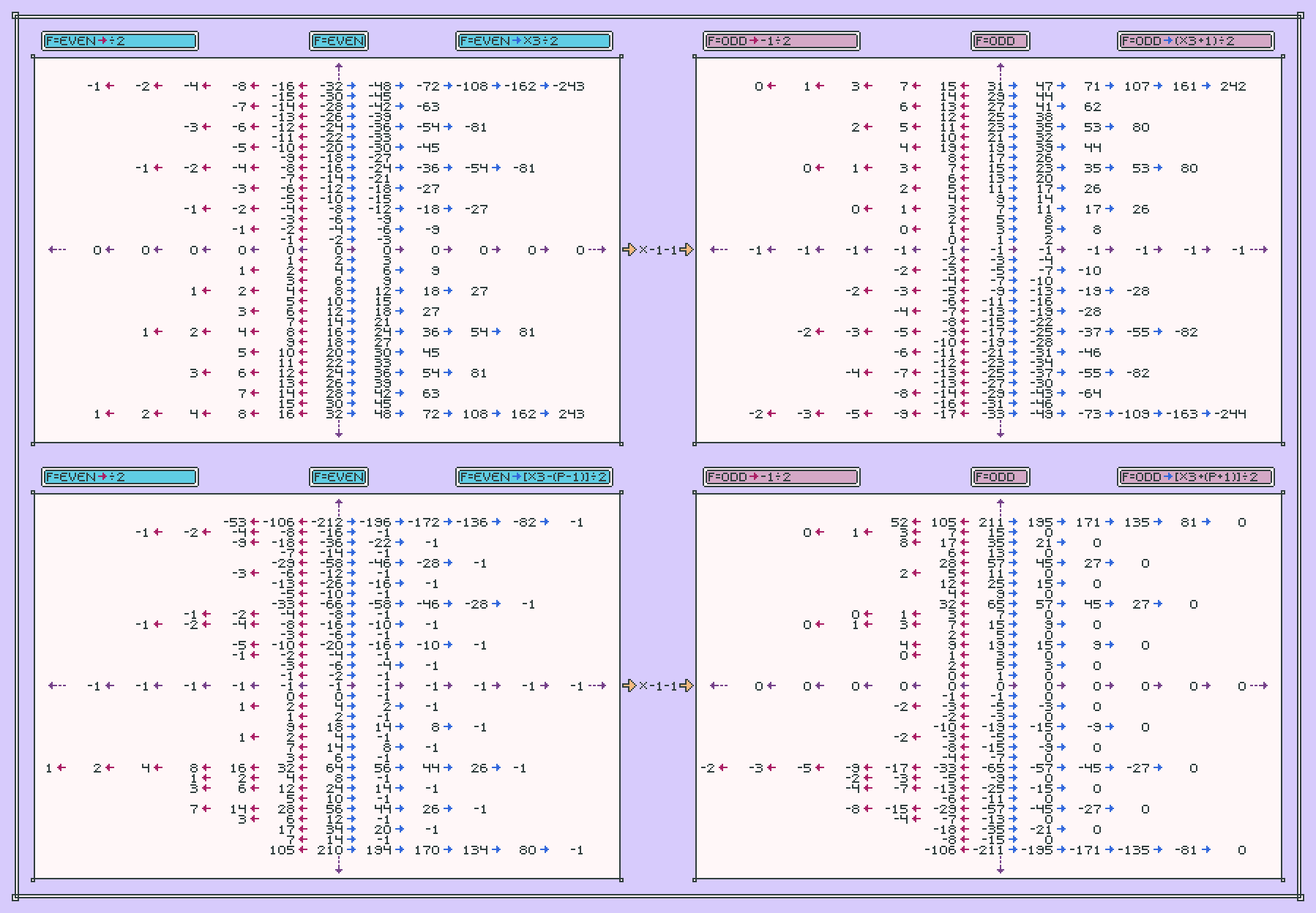
First we need to align the 3n+1 and her sister formula, because we will need Nully for this approach:
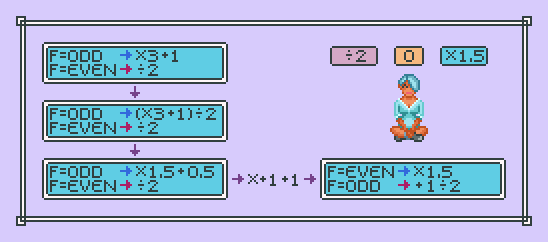
The 3n+1 / 2 formula rules are now split into a 1.5n+0.5 part for the uneven numbers and a /2 part for the even numbers. The calculations for the sister formula can be found in the Collatz inspired art topic. Big heart for Oros for explaining this very well!

Step 2 Some very important questions:

Question 1: What makes a Collatz Conjecture loop a loop?
The answer I came up with: All the numbers that are contained within the loop. Because it doesn’t matter which number you pick, it will always loop back into itself when using the conjecture rules.

Question 2: Does a loop have a starting number we can consider being the loop?
The answer I came up with: Yes, two! F = ODD (F Start) and F = EVEN (The first peak or P)
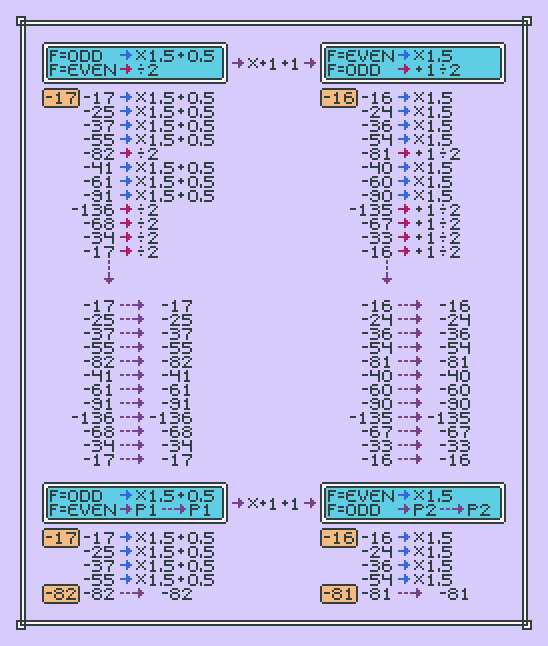
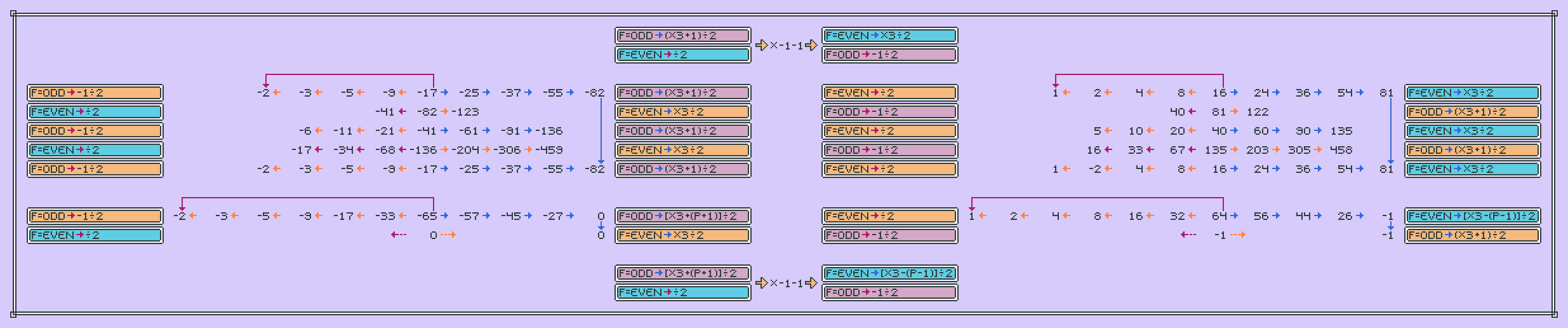
The loop has now been split into two parts. The predictable up part between the 2 start numbers -17 (F-Start) and -82 (P) and the unpredictable part after -82 which will eventually loop back into -82. I want the difference between the two so I can create a new predictable loop.
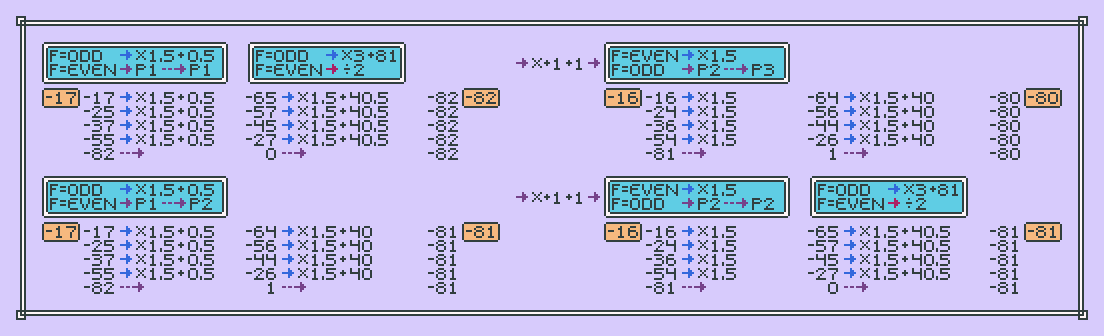
Method 1: The simple and thus my favorite way. Subtract the F start from F peak of the 3n+1 formula. Once the difference leads back to Nully, multiply everything by 1+1 to find the new peak and difference of the 3n+1 sister formula.

Now we can compare F Start and the difference for both formulas separately.

Method 2: The balanced way. Subtract the F start from F peak of the 3n+1 sister formula. Once the difference leads back to Nully, multiply only the difference by 1-1 to balance out the peaks of both formulas.

Now we can compare F Start of 3n+1 with the difference of the sister formula or vice versa. It will turn out the same comparisons as the previous method, but done cross wired.

Step 3 The result

This is Method 1 where I decided to compare the Difference of the sister formula with the F-Start of the sister formula. To complete the loops we have to divide the Difference and F-Start by 2 for all the even numbers. The base line gets divided by -1/2 for Nully because we are using the sister formula.
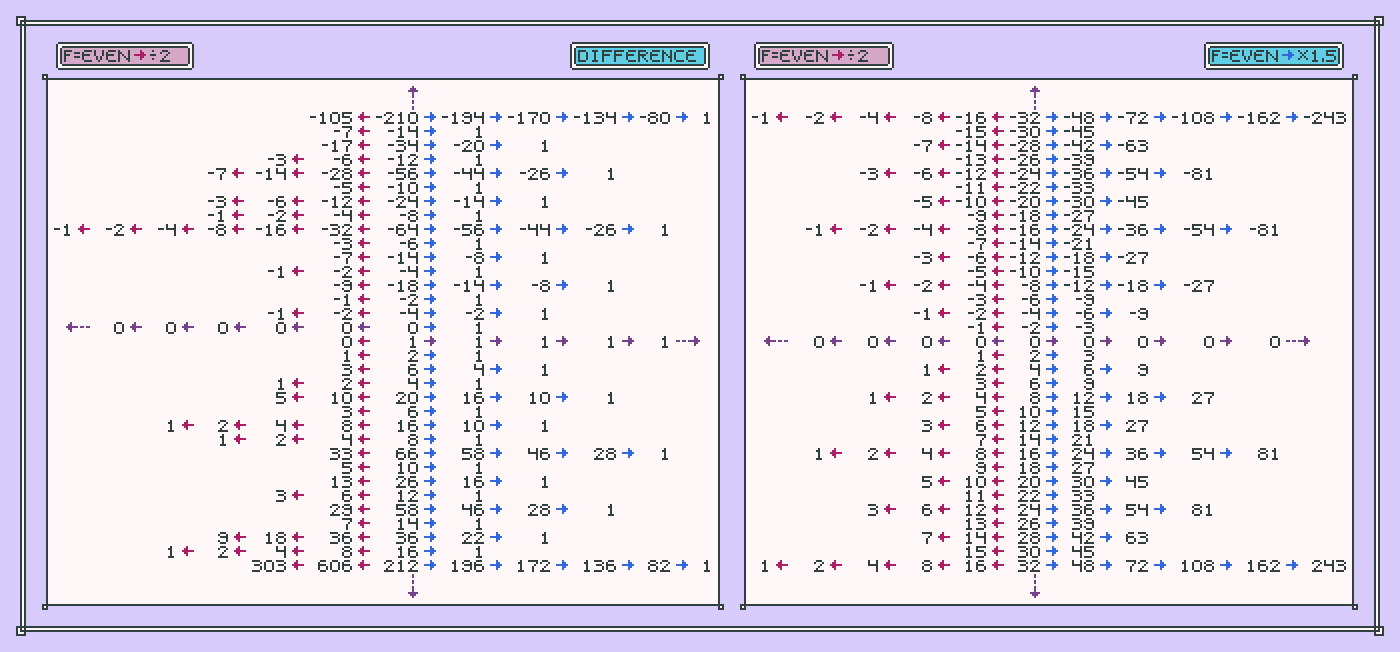
When comparing the Difference and F-Start of the 3n+1 formula divide all the uneven numbers by -1/2.

And that is it, super simple in my mind. Together with the sister formula we have successfully set a peak base line for all numbers and substituted the chaotic parts for the difference between the start number and that base line. If the start number isn’t able to form our new predictable loop with the base line there won’t be a loop at all.

The chaotic parts are in there, but the difference itself now isn’t chaotic anymore. For example any start number that goes straight down after the x1,5 part is +2/2 compared to the difference and will thus never loop.

I tried this same method with 5n+1, but felt a fool for doing so. Unlike the 3n+1 it unfortunately has no base line, so we can never trace the differences back to Nully.

Happy holidays!
1 Like

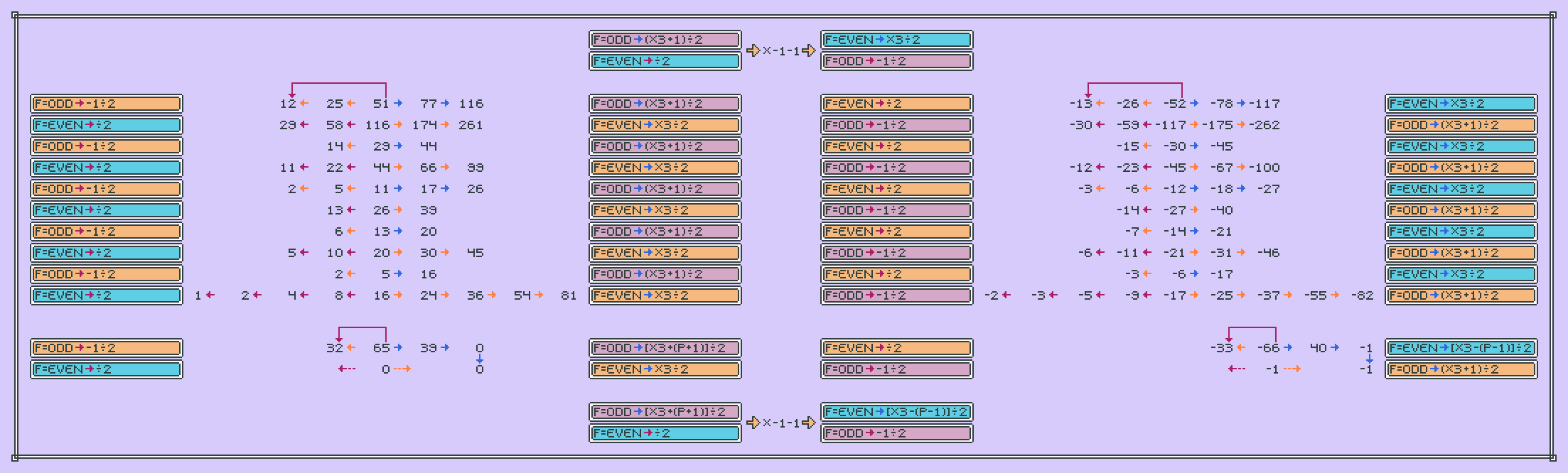
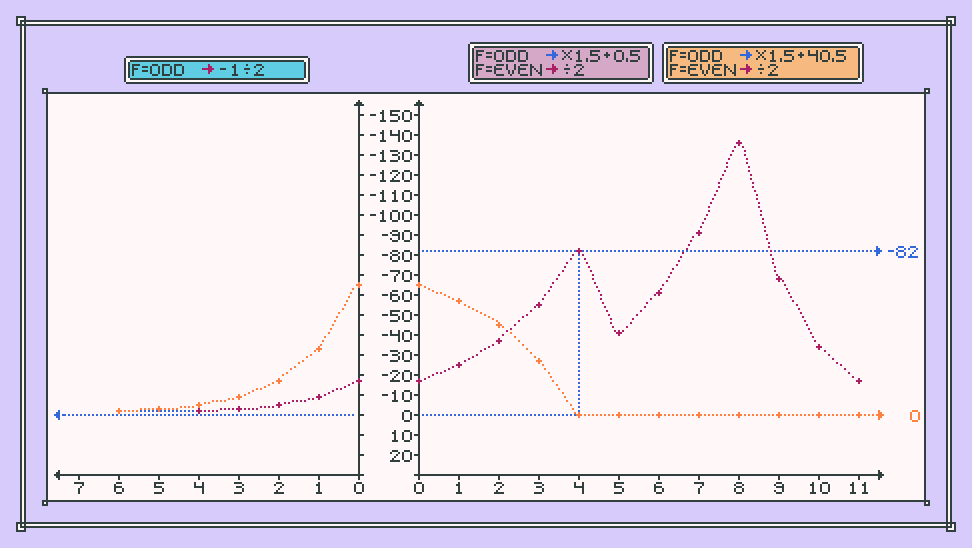
This is for those that think I am just being silly or have no clue what I am doing with the 2-Peak approach. Here is the visual representation of the -17 loop and the new predictable loop you create when using it:

As you can see the erratic behavior of the Collatz Conjecture has been replaced by the base line Nully which we can divide by 2 as many times as we like.

Numbers that are no loop will not connect with the F=ODD = -1/2 part. When you use the sister formula this part becomes the F=EVEN = /2 part.

I hope this helps show how weird my mind works.

Hey Stacey, this is weird!

So we can try to write it down in mathematical terms. As it turns out, a closely related property is that the Collatz function T is conjugated to infinitely many functions of the form
U(n) = \left\{\begin{array}{ll} \frac{3n-(p+1)}{2} &( n \text{ odd})\\ \frac{n+p}{2} &(n\text{ even}) \end{array}\right.
where p is a fixed even integer (positive or negative).

If we define T as follows,
T(n) = \left\{\begin{array}{ll} \frac{3n+1}{2} &( n \text{ odd})\\ \frac{n}{2} &(n\text{ even}) \end{array}\right.
then we have
U(p-n) = p - T(n)
and more generally
U^k(p-n) = p - T^k(n)
for any k.

In the particular case where n is the first term of an odd sequence of T iterates leading to an even peak value p after j steps, we obtain that
U^j(p-n) = p - T^j(n) = 0.

To get back to “Nully”, we can simply replace U by the function
V(n) = \left\{\begin{array}{ll} \frac{3n-(p+1)}{2} &( n \text{ odd})\\ \frac{n}{2} &(n\text{ even}). \end{array}\right.

The same goes with your second method based on the “sister” formula which is yet another conjugated function of T.

Note that it has nothing to do with the fact that n is inside a loop or not, unless I missed something. It also works with n=15 and p=80.

The cool thing is that if we make progress on the Collatz conjecture, then we also improve our understanding of the dynamics of infinitely many functions U.

1 Like

Reverse

The cool thing is that if we make progress on our understanding of the dynamics of infinitely many functions U, then we also improve our understanding of the Collatz conjecture.

Obviously a joke on my part. Your math feels like a Christmas present. Finally someone that can turn my confusing shenanigans into something that everyone on the site can understand!

I made this:

Because I think that any number we use for the Collatz conjecture is not just a random number. It is part of a sequence and that whole sequence is part of that number. We don’t use the whole sequence when we use the uneven numbers for 3n+1 formula, instead we only use the (3n+1 /2) part. And for the even numbers we only use the /2 part.

The -1/2 and *3/2 parts are forgotten and the yellow boxes and arrows represent them:

This is for the -17 loop, but you can do this for any other number. However, unlike other numbers besides 1, (-1 is our base line) -5 and -17 no other numbers seem to connect the F with the conjugated F. Here is a random number I picked to show this, number 51 has no match:

Comparing the /2 part of the F and conjugated F for all even numbers or -1/2 part of the F and conjugated F for all uneven numbers reveals a sequence I think mathematicians can predict and study. This unlike the unstable sequence mathematicians are trying to comprehend now.

If this has any merit I might take a shot at the 5n+1 formula even if it has no clear base line. The first offset can be done with -3/2 instead of the -1/2 I used for the 3n+1 and this could be the start of something beautiful.

Again, big heart for you Oros and to you or anyone else: feel free to prove me wrong on this experiment or use it for your own gain. My art and ideas on the website are free for anyone to use.