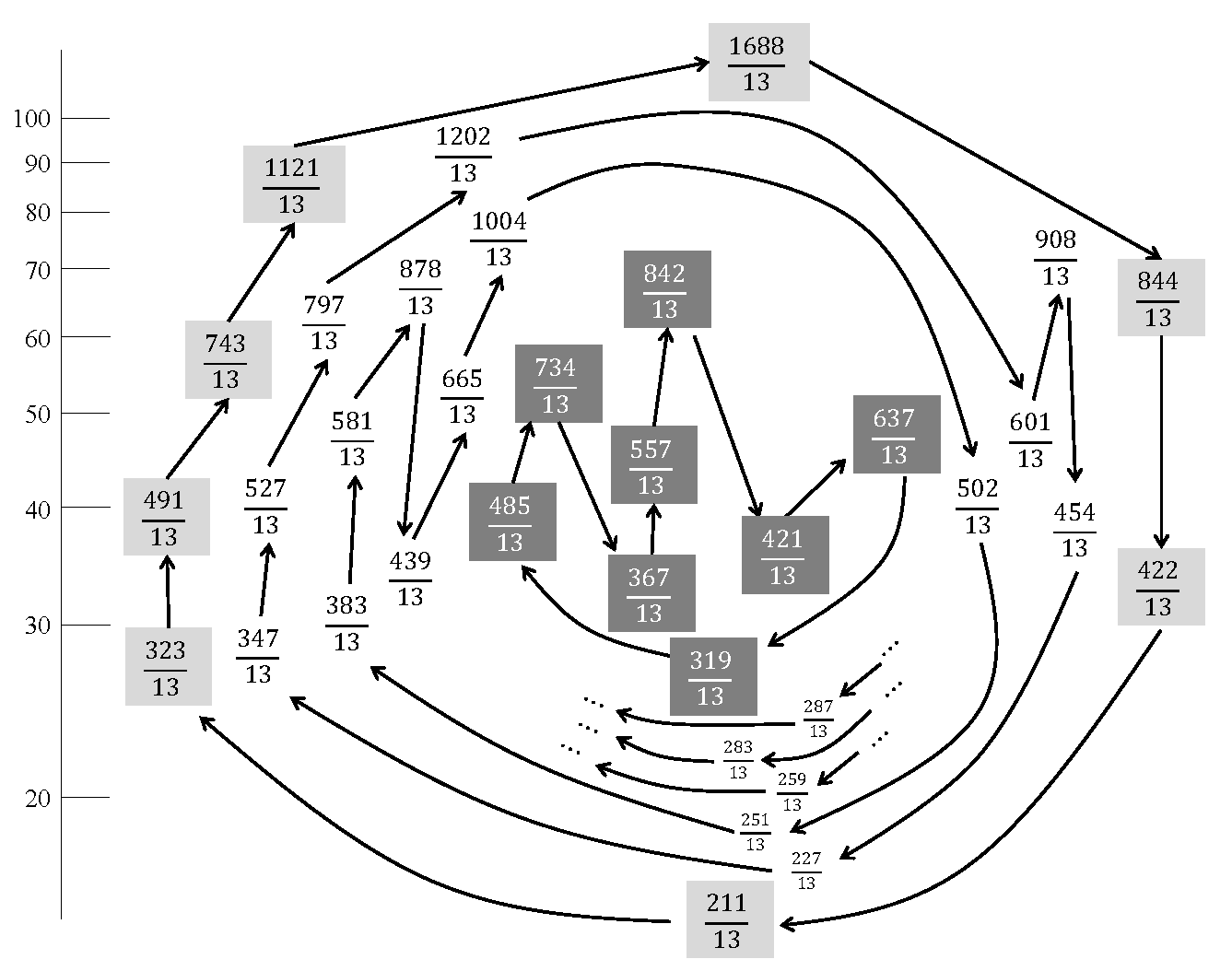
I read MathKook’s “Collatz High Cycles Do Not Exist” and wondered under what conditions a similar argument could produce pure power-of-3 numerator gaps, rather than the power-of-2 gap used there.
The underlying mechanism turns out to be a local 01↔10 swap between rotations of the same parity word. Such swaps occur precisely when the word contains a central (palindromic bispecial) factor in the Sturmian sense.
Primitive upper Christoffel words form a particularly rigid subclass of this situation, but the swap identity itself holds at the more general level of central words.
1. Parity vectors and affine form
Let s(v)=\#\{\text{ones in }v\}.
The composition associated with v is an affine map
T_v(x)=\dfrac{3^{s(v)}x + B(v)}{2^{l(v)}},
where B(v)\in\mathbb Z is the numerator constant.
The corresponding fixed point is
x_v=\dfrac{B(v)}{2^{l(v)}-3^{s(v)}}.
If an integer cycle existed with parity vector v, then every rotation w of v would correspond to another starting point of the same cycle. In particular,
(2^{l(v)}-3^{s(v)}) \mid B(w)\qquad\text{for every rotation }w\text{ of }v.
2. The local swap identity
Let A be any binary word, and define
r=s(A)
Consider the two parity vectors
w=01A,\qquad u=10A
They have the same length and the same weight.
Lemma (prefix swap)
B(w)-B(u)=3^{r}.
Proof (direct composition)
$T_{01}(x)=U(D(x))=\dfrac{3x+2}{4},;
T_{10}(x)=D(U(x))=\dfrac{3x+1}{4}.$
T_A(x)=\dfrac{3^{r}x+B(A)}{2^{l(A)}}.
$T_{01A}(x)=T_A!\left(\dfrac{3x+2}{4}\right)
=\dfrac{3^{r}(3x+2)+4B(A)}{2^{l(A)+2}},$
\Rightarrow\ B(01A)=2\cdot3^{r}+4B(A).
$T_{10A}(x)=T_A!\left(\dfrac{3x+1}{4}\right)
=\dfrac{3^{r}(3x+1)+4B(A)}{2^{l(A)+2}},$
\Rightarrow\ B(10A)=1\cdot3^{r}+4B(A)
\Rightarrow\ B(01A)-B(10A)=3^{r}
3. Terminal swaps and powers of two
If two parity vectors differ only by a terminal swap
w=A01,\qquad u=A10,
then the same local mechanism yields a pure power of two gap:
B(w)-B(u)=2^{t},
for an exponent t determined by the position of the swap.
Thus:
- power-of-two and power-of-three gaps arise from the same local swap 01\leftrightarrow10,
- the position of the swap determines whether a factor 2^t, 3^r, or a mixed 2^a3^b appears.
In particular, MathKook’s argument corresponds to the terminal-swap case of this general identity.
4. Central words and when prefix swaps occur for rotations
To exploit the prefix-swap lemma inside a cycle, the two vectors
01A\quad\text{and}\quad10A
must occur as rotations of the same parity vector v.
Equivalently, v must admit two rotations
A01\quad\text{and}\quad A10.
In combinatorics on words, this means that A is bispecial.
When A is also a palindrome, it is called a central word.
For an aperiodic upper Christoffel word, one has the classical decomposition
v=1A0,\qquad v^{R}=0A1,
with A central.
Left-rotating once gives
\rho(v)=A01,\qquad \rho(v^{R})=A10,
a terminal-swap pair.
Right-rotating once gives
\rho^{-1}(v)=01A,\qquad \rho^{-1}(v^{R})=10A,
a prefix-swap pair, hence
B(01A)-B(10A)=3^{s(A)}.
Thus, Christoffel structure does not create the swap identity, but it guarantees the existence of the required conjugate rotations within the same parity vector.
More generally, the relevant condition is central (palindromic bispecial) structure; Christoffel words form a particularly rigid, primitive subclass.
5. Consequence for integer cycles
Let v be a parity vector and w,u two of its rotations. If an integer cycle existed, then
(2^{l(v)}-3^{s(v)}) \mid (B(w)-B(u)).
- Terminal-swap rotations force a power-of-two divisor, contradicting the oddness of 2^{l(v)}-3^{s(v)} except in trivial cases.
- Prefix-swap rotations force a power-of-three divisor, but occur only when
vcontains a central factor.
Outside the central/Christoffel setting, swap-induced gaps are generally mixed
2^𝑎3^𝑏 , and do not force an immediate contradiction with the denominator (2^{l(v)}-3^{s(v)}) .
6. Example: central Sturmian word not yielding a Christoffel vector
Consider the palindromic Sturmian word A=0100010,
with s(A)=2.
Form the vectors
w=01A=010100010,\qquad u=10A=100100010.
Then
B(w)-B(u)=9=3^2.
This illustrates the local power-of-three identity at the level of central words.
However, the vector 1A0=101000100
is not a (primitive or non-primitive) Christoffel word, showing that central structure is strictly more general than Christoffel structure.
Closing remark
The local swap identity explains all known strong numerator gaps in Collatz parity vectors.
Christoffel words provide a canonical setting where the required rotations are guaranteed, but the underlying mechanism operates at the more general level of central (palindromic bispecial) Sturmian words.