I was trying to show something like:
“if v=11110111000 is an integer cycle, then its reverse v^R=00011101111 can’t also be an integer cycle.”
I didn’t get that far but I found some other interesting stuff.
Let f(v) be the number that returns to itself after following the pattern of ups (1) and downs (0) in v.
For example, f(11110111000)=-17 (integer cycle), while the reversed f(00011101111) = \frac{20632}{-139} (not an integer cycle).
The general formula is f(v)=\cfrac{\beta(v)}{2^l-3^s}, where l is the length of v, and s is its weight (total ones).
For positive cycles, we submit:
-
If v is an integer cycle but v^R isn’t, then the palindromic cycle v v^R isn’t an integer cycle either.
-
If v and v^R are distinct cycles (not mutual rotations), then v, v^R and v v^R can’t all be integer cycles simultaneously, for s \geq 97.
First show this interesting fact:
- f(v) + f(v^R) = f(v v^R) + f(v^R v)
The LHS is \cfrac{\beta(v) + \beta(v^R)}{2^l-3^s}, which matches the RHS:
f(v v^R) + f(v^R v)
= \cfrac{\beta(v v^R) + \beta(v^R v)}{2^{2l}-3^{2s}}
= \cfrac{2^l \beta(v^R) + 3^s \beta(v) + 2^l \beta(v) + 3^s \beta(v^R)}{2^{2l}-3^{2s}}
= \cfrac{(2^l+3^s) (\beta(v) + \beta(v^R))}{(2^l+3^s)(2^l-3^s)}
= \cfrac{\beta(v) + \beta(v^R)}{2^l-3^s}
This implies 1, because if v is integral but v^R is not, then the LHS is non-integral, and so is the RHS, so the concatenated palindromic cycle v v^R can’t consist of integers.
We actually don’t use anything about reverses – everything here still works if we replace v^R by any w whose length and weight matches v.
Proving 2 is takes a little more. Assuming wolog f(v) < f(v^R), we can show (further below) that
-
f(v) < f(v^R v) < f(v v^R) < f(v^R)
-
f(v^R) - f(v) < 2^l (for sufficiently large s)
4 and 5 are enough to prove 2 by contradiction:
If all three cycles are integral (v v^R and v^R v are in the same cycle), then f(v) and f(v v^R) follow the same initial l-step trajectory, so f(v) \equiv f(v v^R) \mod 2^l (Terras 76). Yet the distance between f(v) and f(v v^R) is less than 2^l, so there’s a contradiction.
We can show 5 by noting that f(v) is at least as big as f(1^s 0^{l-s}) = \cfrac{3^s-2^s}{2^l-3^s}, and f(v^R) is no bigger than f(0^{l-s} 1^s) = \cfrac{2^{l-s}(3^s-2^s)}{2^l-3^s}. With Rhin’s bound 2^l-3^s > 457^{-1} 3^s s^{-13.3}, the difference f(v^R) - f(v) < 2^l, for all s \geq 97.
The last step is to show 4. The idea is to relate f(v v^R) to f(v) by following each through the same first l steps, using the general formula
T_v(n) = \cfrac{3^s n + \beta(v)}{2^l} = \lambda n + \cfrac{\beta(v)}{2^l}
where \lambda = 3^s/2^l.
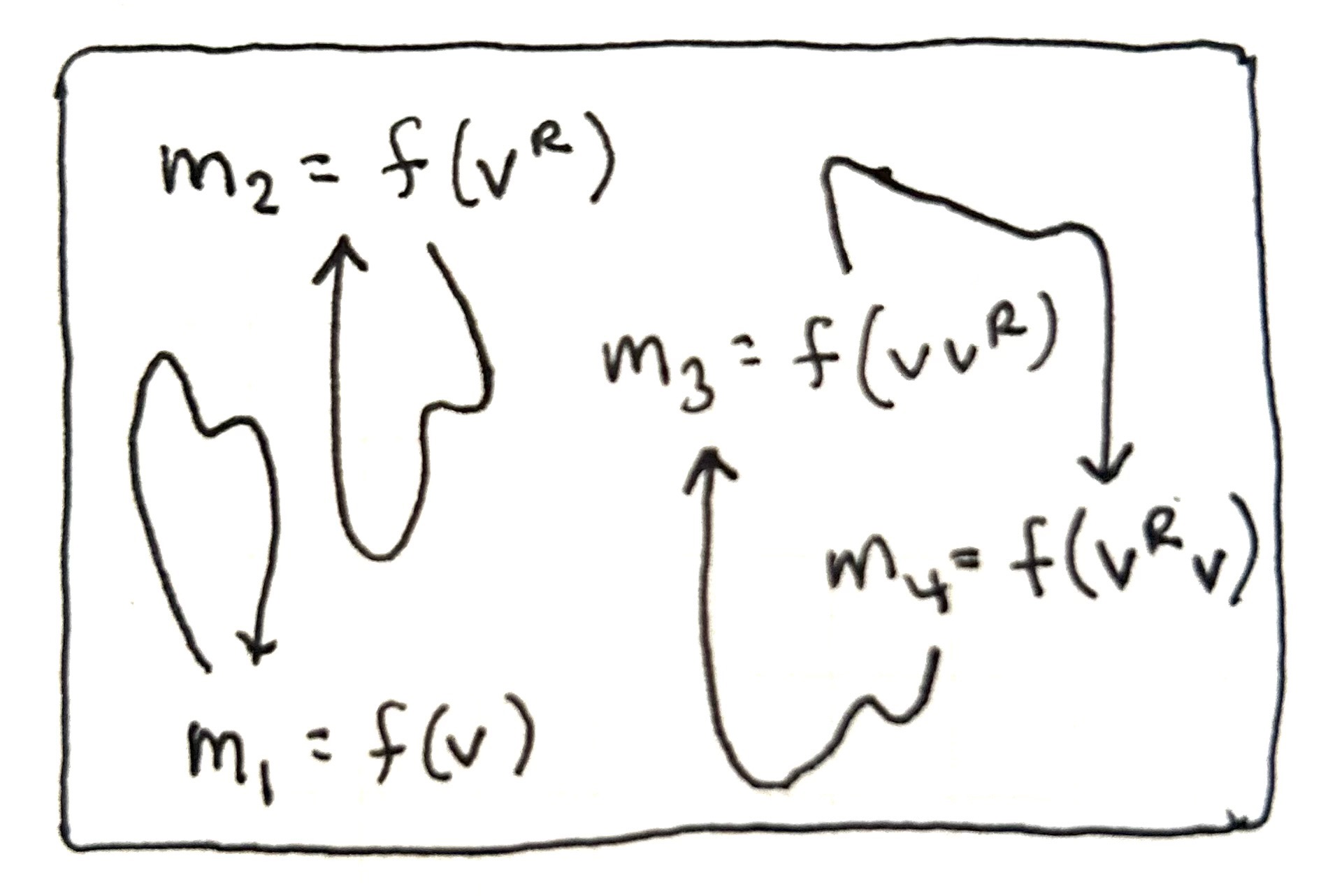
First abbreviate
m_1 = f(v)
m_2 = f(v^R)
m_3 = f(v v^R)
m_4 = f(v^R v)
Then
T_v(m_1) = m_1
T_v(m_3) = m_4
T_{v^R}(m_2) = m_2
T_{v^R}(m_4) = m_3
m_1 = \cfrac{\beta(v)}{2^l-3^s}
So, \beta(v) = m_1 (2^l-3^s)
m_2 = \cfrac{\beta(v^R)}{2^l-3^s}
So, \beta(v^R) = m_2 (2^l - 3^s)
And
T_v(m_3) = \lambda m_3 + \cfrac{m_1(2^l-3^s)}{2^l}
m_4 = \lambda(m_3-m_1) + m_1
T_{v^R}(m_4) = \lambda m_4 + \cfrac{m_2(2^l-3^s)}{2^l}
m_3 = \lambda(m_4-m_2) + m_2
Plugging the m_3 value into the m_4 formula,
m_4 = \lambda(\lambda(m_4-m_2)+m_2-m_1)+m_1
= \cfrac{\lambda m_2 + m_1}{1+ \lambda}
Given m_1 < m_2 (wolog),
m_4 < m_2 and m_4 > m_1
Likewise, m_1 < m_3 < m_2.
Finally, we have to figure out which of m_3 and m_4 is bigger.
m_4-m_3 = ... = \cfrac{1-\lambda}{1+\lambda}(m_1-m_2)
which is negative. So, overall, m_1 < m_4 < m_3 < m_2.
Any corrections, extensions welcome, and/or any related or overlapping work. Tyty
