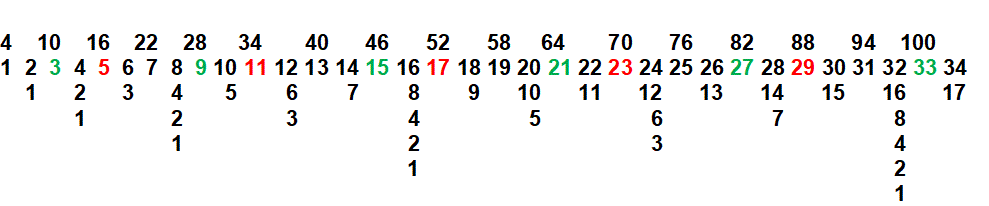
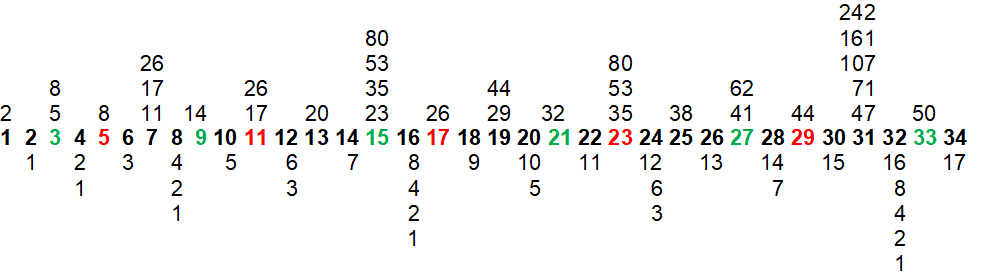
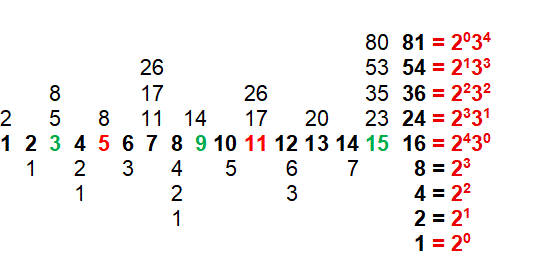
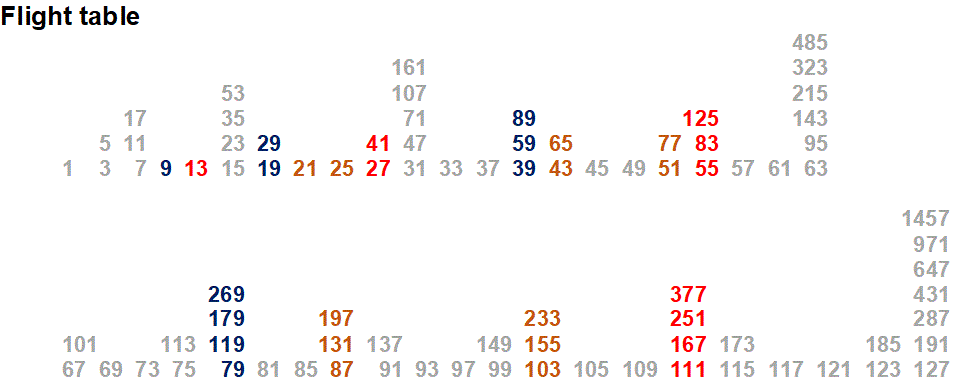
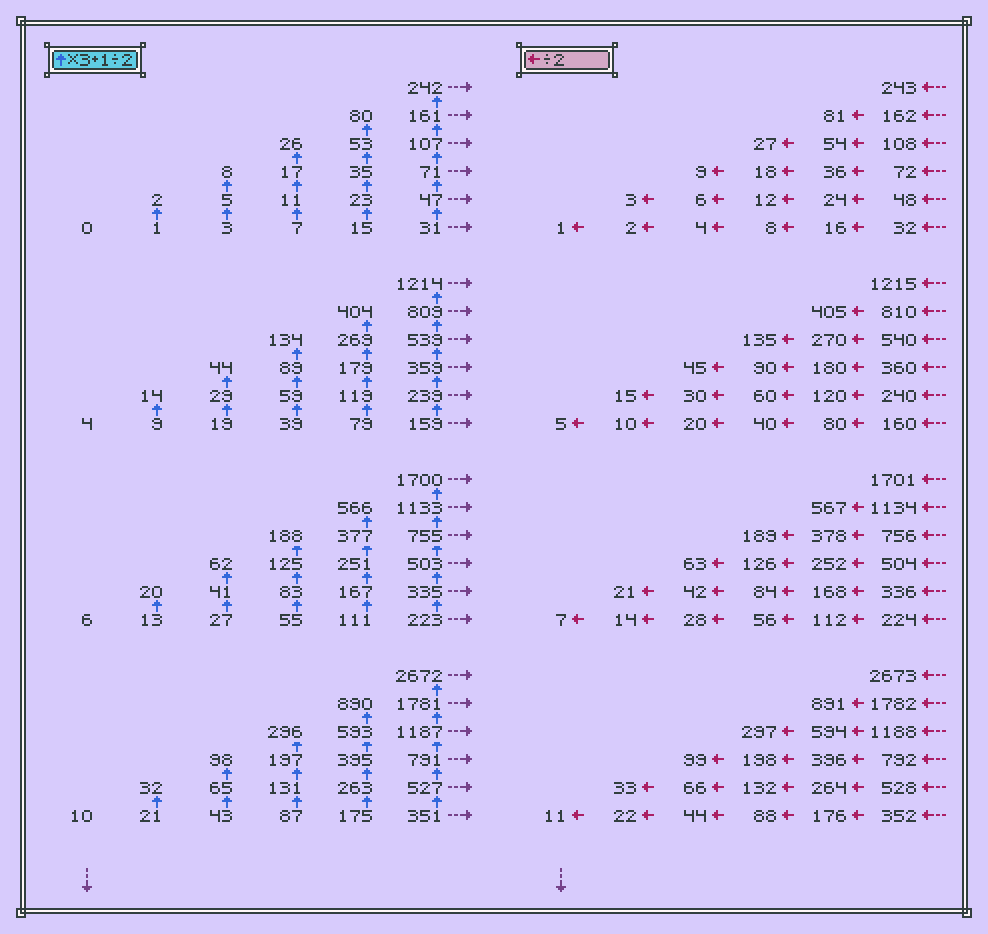
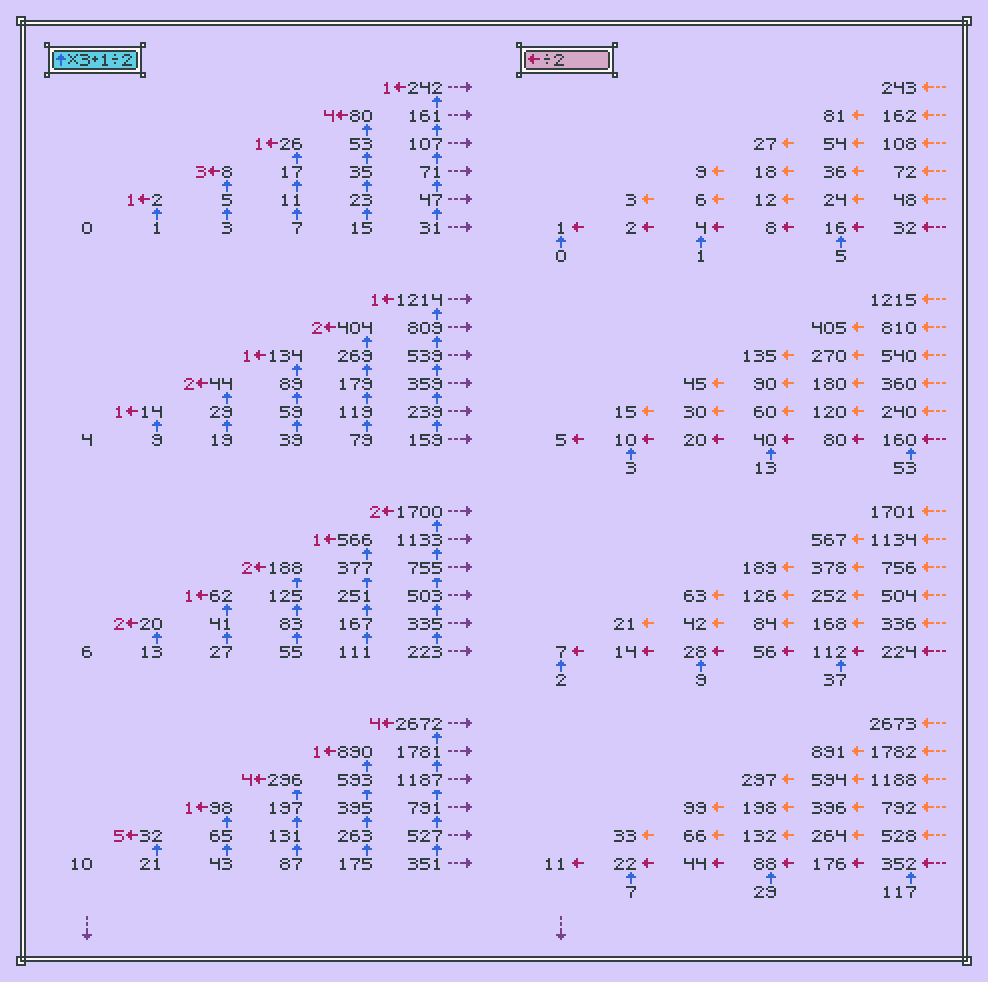
One of a way to write a number in a binary compact format is
Y2^{n+1}+2^n-1 where Y belong to N_0
In this case n=0 stand for pair numbers. For other positive various values of n the equation will generate all odd numbers.
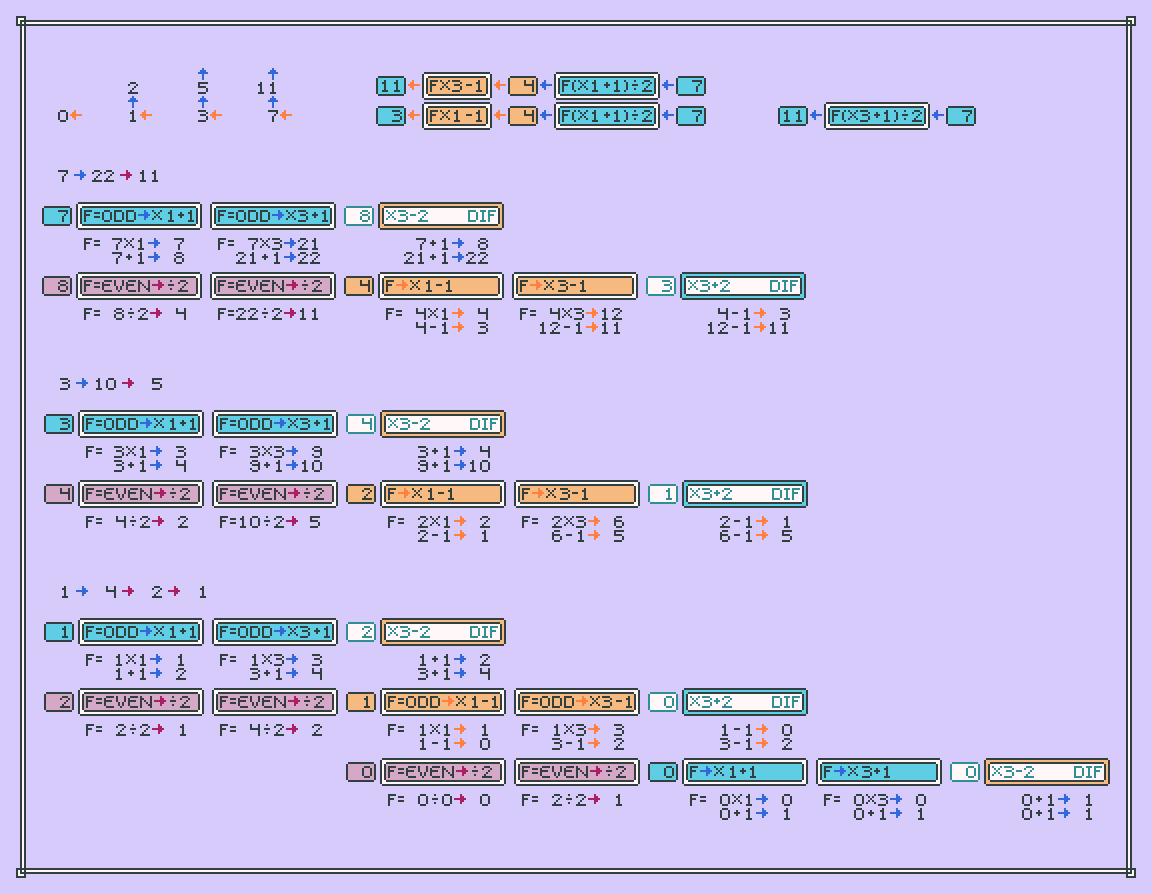
This is very useful way suggest by **Cadogan ** to extract info to know how many numbers of steps are part of a unique upward sequence perform by a repeat Crandall function with e=1. Below, we will use upper suffix to indicate how many times the C_1 function can be applied.
C_1^{n-1}(Y2^{n+1}+2^n-1)=Y2^23^{n-1}+2^13^{n-1}-1
where n is equal or greater than 2. Why? Remember the parametric equation for e odd. We rewrite it here
C_{2m-1}(2^{2m}r+2^{2m-1}+\sum_{j=0}^{m-1}2^{2j})=6r+5
if we set m=1, we get
C_1(2^2r+2+1)= 6r+5 where r belong to N_0. Since
2^2r+2+1=Y2^{n+1}+2^n-1
we get r=Y2^{n-1}+2^{n-2}-1
in order to reach r=0, we will have Y=0 and n=2(the lowest permit value of n).
Going back to our main topic, we say we reach the top of the upward sequence at
Y2^23^{n-1}+2^13^{n-1}-1\equiv1(mod4)
because
C_2(4m+1)=\frac{12m+4}{2^2}=6m+1
Not only this formula provides the number of steps of the sequence, it jump right away to the top number of the sequence and give as well as a relative (and potentially the absolute) maximum of the trajectory in one shot, such avoiding computation at each step!
In fact, if restricted to congruence in mod 12 as did Puddu, it can be shown that start numbers are some of the 3(mod12), 7(mod12) and 11(mod12) and upper sequences will always end with a 5(mod12). Intermediate values in between the start and the end are all 11(mod12).
For reference
**Cadogan, C. C.**A note on the 3x+1 problem, Caribb. J. Math. 3 (1984), p. 67-72.
Puddu, S., The Syracuse Problem, Notas Soc. Mat. Chile (1986), p.199-200.