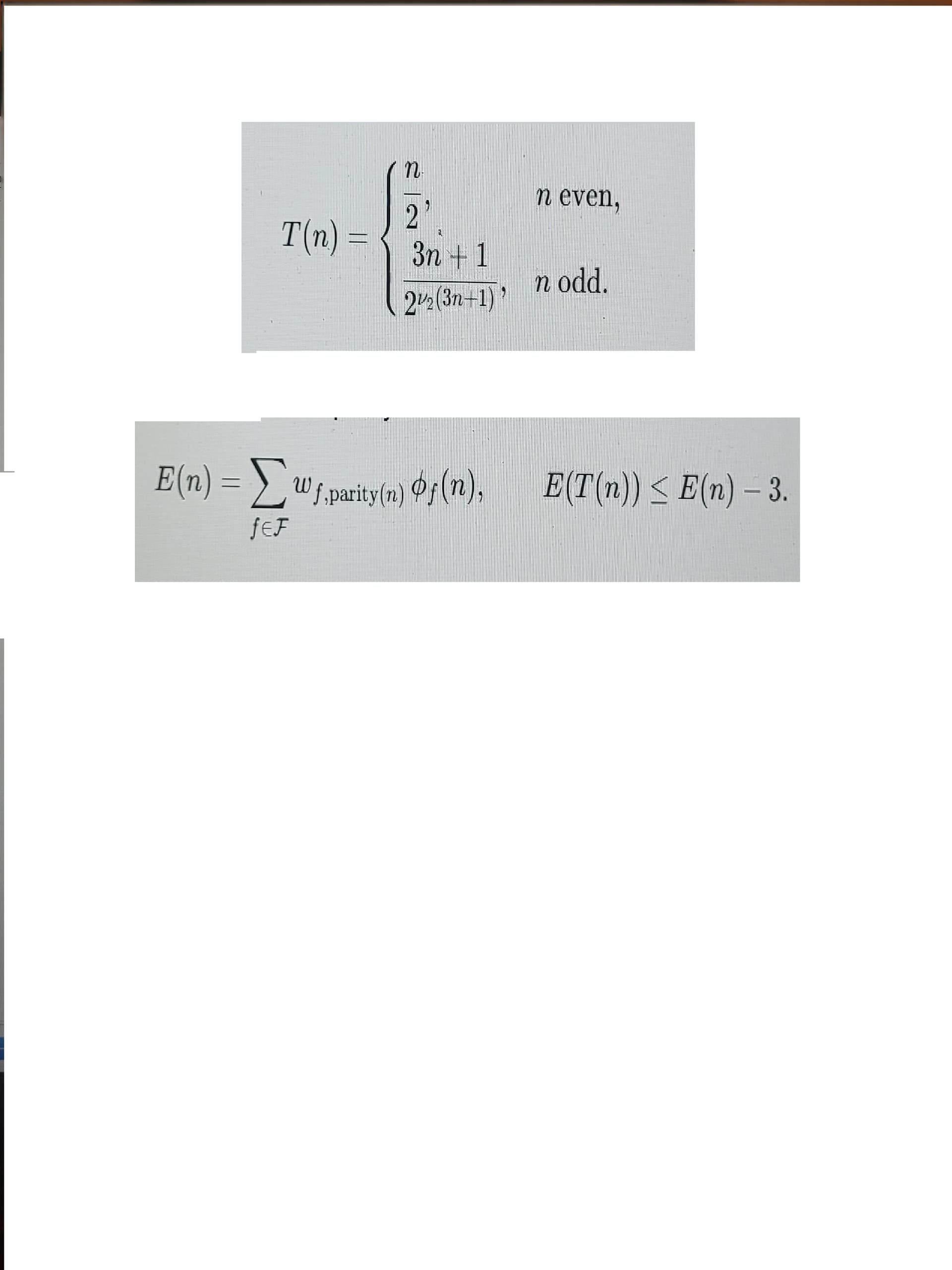
Not clear what it means, except that the function E is decreasing along the trajectory of n…
I’m not even sure about how T is defined here.
For example, what is T(3)? 3*3+1=10, so 2^((1/2)*(3n+1)) = 2^5 = 32.
10/32 = 5/16, is that odd or even?
It would help if you provided the full context. Is this from a book?
Please don’t send me cryptic DMs. Just explain where this is from so we can help you. It’s not the same if you wrote it yourself (seems unlikely), if you read it in a book or, like I am starting to suspect, if that’s AI-generated stuff.
Not cryptic, just looking for some help and a review, if you don’t know anyone or you can’t help it’s all good. Then that’s all i need. Thanks for taking a look.
I also need something reviewed. I’ve sat on this for about a month and can’t find any mistakes. If it is a correct proof, then I proved no nontrivial loops exist. I’ll try to explain it as best as I can but on the pieces of paper I have it on it’s a bit hard to follow.
What I began with was looking at the highest integer that can directly enter a loop, so in one step. A constraint I often used was that if a month cycle existed, it would reach a highest value M without ever exceeding it. So no number in a loop can exceed M without forcing contradiction. Because of this, it is not hard to see that M has to be a multiple of 4, so M-1 cannot be in a nontrivial loop because it leads to 3M-2, which is larger than M. M-2 can only be in loops with M 4 and below. M-3 exceeds M, and M-4 raised my interest because I knew if M-4 directly entered a loop then M would need to reach M/2 -2, the successor of M-4. I first looked at if M was exactly 4N, and found M/4 would have to become M/8 -1/2 or N would have to eventually become N/2 -1/2, which yielded a finite number of solutions for odd N: 3,5,9,11,17,57,59,81,89,4103,4617,6155,7289,9233. I looked for the general (affine) case, aN+b=(N-1)/2 so N=-(b+1/2)/(a-1/2), and with a=3^m/2^k and b=r/(2^k), N=-(2^k)(b+1/2)/((3^m)-2^(k-1)) and then a solution for N must have 3^m-2^(k-1) divides r+2^(k-1). r is between 0 and 2^k, so r+2^(k-1) is less than 3x2^(k-1). The denominator is larger than 2^(k-1) for large enough k from assuming m>=k/2 and then the bottom is 3^m-2^(k-1) which is larger than 3x2^(k-1) so for sufficiently large k, the denominator is bigger than the numerator and N doesn’t work. This is why there is a finite number. If M were 8n, the only difference is the numerator is now 5x2^k. When I checked N-6, the numerator was a maximum of 7x2^k, from the r and 6. This meant that it is repeatable for all c for M-2c, and for each one it has a finite number of small integer solutions that don’t exceed themselves.
I then thought that I could use this as a bound if I could prove that if you went past the highest candidate you would reach the next candidate group and go past it and keep going forever never reaching an actual value for a loop, or at least something of the sort.
n=(M-b)/a=2^k(M-2c)/3^j, and K_c is the largest integer pattern where M-2c path exists. (The largest n for some c that works). n<=K_c, so M<=aK_c+b=(3^j(K_c)+R/ 2^k )+2c=M_c_min. M>=max{M_c1_max, M_c2_max, …}. n follows 3^j/2^k n, so 3^j/2^k<1 for staying below itself. n<=K_P, P for pattern, and then M>=F(P), because if F(P)>M then Pattern P cannot be in loop because M is the loop top. Sorry for the poor definition of F(P). Most of this was constructed by Chat GPT. If F(P)=M, then 2^k(M-2c)=3^jK_P +R(P) and 2^k divides 3^jK_P +R(P). Supposing some n exists where ((3^j)n+R)/2^k +2c =M, if you add 2^k to n, 3^j gets added to M. Now, x goes to alpha x+beta, where alpha is the product from 1 to L of a_i, L is the length of the cycle, and Beta is something rational that doesn’t matter right now because every element of the cycle is a fixed point of this, so it acts as the identity on every number in the cycle so alpha must be 1 and beta must be 0. Pretty smart of AI tbh.
For contradiction, assume some P_r in the cycle with maximum preimage n_r=K_P_r(M) where M=F(P_r). The next congruent preimage is n_r +2^k and this means F(n_r+2^k)=M+3^j>M. Since M is the loop top this means contradiction. n is an integer if (3^j_r)n+R_r=0 mod 2^k_r. 2^k_r/gcd(3^j_r,2^k_r)=S_r. If n is a solution, n+ lS_r is too for all l. Let n_r be the max solution <=M, n_r=K_r(M), n’_r=n_r+S_r implies n’_r>M. x_(r+1)=T_P_r(n_r)=M, x’_(r+1)=T_P_r(n’_r)=M+(3^j_r/2^k_r)S_r. x’_(r+1)=x_(r+1)+3^j_r/gcd(P,r), which is positive so x’>M. Sorry for horrible notation. Because the increment isn’t 0, and it is a positive integer at r+1, the new value exceeds the old one, and the lower preimage n’_r produces successor>M, so n’_r is not in the cycle because then M would not be the cycle top. This means the assumption of some pattern with preimage equal to the max applicable K_r(M) is a contradiction, and M cannot equal F(P). Since M must also be larger than or equal to F(P), M is larger than F(P). F(P) short for F_P(M).
Now to prove F_P(M)=(3^j(P)K_P(M)+R(P))/2^k(P) +2c(P) satisfies F_P(M) for all M to disprove the existence of loops. R(P) is congruent to 2^k(M-2c) mod 3^j, n<=M from n=/2^k(M-2c)-R(P))/3^j. R<2^k for fixed k. If 3^j>2^k then residues mod 3^j can’t be matched by R(P). In other words, after enough odd steps t, F_P(n_t)>M because F_P_t(n_t)>=(3^t)n_t/2^(K(t))>=((3/2)^t) n_t. So any preimage n_t eventually exceeds M, contradicting bounded loops.
We can choose t big enough so n_t satisfies n_t<=M while F_P_t(M)>M. More work equates this to M+l(3^t)/gcd(3^t,2^k), and this means P_t prevents the cycle top, so there exists some pattern with some preimage n<=M, F_P(M)>M, But since F_P(M)<=M and not = to M, no nontrivial Cycle exists.
Most of this was done by chatGPT, but I tried to keep it correct, hence the proof and also the bad explanation/notation. I honestly think this is a proof of no cycles, or at least very close with a few minor mistakes but I couldn’t find them, so that’s the only reason why I’m posting this. In case it is a proof, now the community has it. If it is wrong, I’d think it was a great attempt and could be tweaked. Most of this went from GPT to screenshots to paper to here, so I could’ve missed some things too. Thanks if you read
Hi HungryMonkey7,
Did you try to challenge ChatGpt with ChatGpt ?
Sure, it’s preferable to have a human answer (good thing you posted here).
I’m not sure I have the level to understand and answer your points. Hope someone will be able to help you. But for the sake of the experience, I forward you the answers from ChatGpt. It might have not understand your points to begin with, so, …
Gpt introspection
TL;DR. The “top-of-cycle M” idea and the congruence step n\mapsto n+2^k/\gcd(2^k,3^j) are interesting, but they don’t force a contradiction. The right invariant is the motif P (the exact 2-adic valuations k_i=\nu_2(3y_i+1) along one lap). For a fixed motif,
f_P(y)=\frac{3^J\,y+R(P)}{2^K}
and a periodic point must satisfy the single Diophantine equation
(2^K-3^J)\,y=R(P)
plus step-wise valuation constraints.
1) Model (odd-only)
T(y)=\frac{3y+1}{2^{\nu_2(3y+1)}}\ \text{ on odd }y.
Fix a length L and a motif P=(k_0,\dots,k_{L-1}) with \nu_2(3y_i+1)=k_i.
Definitions:
J=L
K=\sum_{i=0}^{L-1} k_i
R(P)=\sum_{t=0}^{L-1} 3^{\,L-1-t}\,2^{\,k_0+\cdots+k_{t-1}}
Then:
f_P(y)=\frac{3^J\,y+R(P)}{2^K}
Cycle conditions for some y>0:
\text{(C1)}\ \ 2^K>3^J
\text{(C2)}\ \ (2^K-3^J)\mid R(P)\ \text{ and }\ y=\frac{R(P)}{2^K-3^J}\in\mathbb{N}
\text{(C3)}\ \ \forall i,\ \ 3y_i+1\equiv 0\ (\bmod\ 2^{k_i})\ \text{ but }\ 3y_i+1\not\equiv 0\ (\bmod\ 2^{k_i+1})
Key point: we do not require the identity on all x (no need for \alpha=1,\beta=0). Only (2^K-3^J)y=R(P) on the candidate y plus (C3).
2) Arithmetic progressions of solutions
If 3^J n\equiv -R(P)\pmod{2^K} has a solution, then the full set is
n\equiv n_0 \ (\bmod\ S),\quad S=\frac{2^K}{\gcd(2^K,3^J)}.
Shifting n\leftarrow n+S increases the output by
\Delta=\frac{3^J}{\gcd(2^K,3^J)}.
This does not ensure the new preimage stays in the same cycle: (C3) must still hold at every lap position.
3) Rigorous routes
Route A (motif elimination).
- Compute J,K,R(P).
- If (2^K-3^J)\nmid R(P), motif P yields no cycle.
- Else set y=\frac{R(P)}{2^K-3^J} and check (C3) along the lap (CRT on 2^{k_i+1} and 3^b).
Route B (global min–mean).
Build a residue graph (e.g. mod 2^a\times 3^b). Weight edges by
w=\nu_2(3y+1)-\log_2 3.
If the minimum mean \mu_{\min}>0 (Karp/Howard), then no positive cycle exists.
4) Tiny example
Take L=2 and P=(2,2).
J=2
K=4
R(P)=3^{1}\cdot 2^{0}+3^{0}\cdot 2^{2}=3+4=7
Equation:
(2^K-3^J)y=R(P)\ \Rightarrow\ (16-9)y=7\ \Rightarrow\ y=1.
Check (C3): 3\cdot 1+1=4 has \nu_2=2; applying T twice returns to 1 (the trivial cycle).
For P=(1,1) we get (4-9)y=5\Rightarrow y=-1 (no positive solution).
Takeaway. Replace the alpha=1, beta=0 step by (2^K-3^J)y=R(P) plus (C3). The shift-by- S fact is correct but doesn’t by itself contradict a top M. Use motif-by-motif elimination or a min–mean certificate.
@HungryMonkey7 Thanks for posting! @exstyle Hey, great idea to ask GPT to check stuff! Checking math is easier than doing math, and machines can spot logic errors and typos. If I’ve found a proof, I might ask GPT to check it, or (more commonly) regret that I didn’t.
When it comes to doing math (vs checking it), GPT has seen a ton of improvement from 3.5 to 4o to 5, though it’s not trustworthy out of the box.
My two cents: the 2025 GPT situation is similar to having a chess engine that’s great at solving “mate-in-4” problems.
Which is super helpful at the end of the game … but that doesn’t mean you can set up the chessboard in the start position and expect the “mate-in-4” engine to think strategically.
Another crazy thing is that instead of saying “there’s no mate in 4” or “I can’t find a mate in 4”, it’ll frequently detail a mate in 4 for you, almost willfully (?) overlooking viable defenses from the opponent. (On the math side of this analogy, the opponent is cold hard logic itself.)
But a couple of years from now, when you start seeing humanoid robots waiting at a bus stops …
Yes, using ChatGpt can be helpfull. It starts with checking things. But sometimes, it tells you you prove something, and then you need to prove him wrong…
As of now, I need to prove him wrong on that matter (I proposed to him a modelisation and it went that way) :
A distance-grid for odd-only Collatz, a simple Lyapunov, and a corrected simulation bound
TL;DR. We build a very simple geometric grid for the odd-only Collatz step
T(y)=\frac{3y+1}{2^{\nu_2(3y+1)}} (odd y).
On this grid, every allowed atomic move strictly increases a basic Lyapunov \Psi, so the grid’s move graph has no directed cycles.
We then give a clean forward simulation of one odd step y\mapsto T(y) by \le 2\,\nu_2(3y+1)+1 atomic moves (the correct bound; a constant bound does not hold).
Concatenating such simulations around a hypothetical Collatz cycle would produce a grid loop—impossible—so cycles are ruled out conditional on the simulation lemma (which is constructive and easy to check by code).
1) The grid (distances and halves)
-
Row index (distance). For odd y, define the “distance” D=\frac{y+1}{2}\in\mathbb Z_{\ge0}.
-
First block on row D. The block has length d=D and the contiguous pattern (no gaps)
[\,D,\,D-1,\,\dots,1\,]\;\;M\,m\;\;[\,1,\,2,\,\dots,D\,].Subsequent in-row blocks follow the sibling law d\mapsto 2d+1.
-
Atomic moves = half-blocks.
- LH: from a rim to the right pivot m (length D+2),
- RH: from m to the opposite rim (length D).
We only allow seams at m, and only when the active half is odd (D odd for the first block).
-
Distance-aware seam. At the pivot m:
- on the right half, use the + branch 3D+1;
- on the left half, use the - branch” 3D-1.
In either case, jump to the target distance
\Sigma_{\pm}(D)\;=\;\frac{3D\pm1}{2^{\nu_2(3D\pm1)}}\in\mathbb Z_{\ge0},i.e., oddize 3D\pm1.
-
Deterministic landing side (nice one-liner). After a seam, the “intermediate odd” is
y_\text{seam}=2\Sigma_{\pm}(D)-1. Since \Sigma_{\pm}(D) is odd, we have y_\text{seam}\equiv 1 or 5\pmod8.
Using the tiny mod-8 rule : side =+ if y\equiv1,5\pmod8; side =- if y\equiv3,7\pmod8, the landing side is always +.
In short: post-seam side = +, independent of everything else.
2) A very simple Lyapunov (monovariant)
Let the half-lengths be L_\text{left}(D)=D+2 and L_\text{right}(D)=D. Define
Every atomic move has strictly positive gain:
- LH adds D+2>0,
- RH adds D>0,
- LH + seam (only when the half is odd) nets (D+2)-2=D\ge1>0.
Hence every nonempty path of atomic moves increases \Psi.
Conclusion. The directed graph whose edges are these atomic moves is acyclic.
3) Projection and the corrected simulation bound
-
Projection. Map odd y to the state \Pi(y)=(\text{rim}, D, s) with D=\frac{y+1}{2} and
s \;=\; \begin{cases} + & \text{if } y\equiv 1,5\pmod8,\\ - & \text{if } y\equiv 3,7\pmod8. \end{cases}(We start at a rim, so an LH is immediately available.)
-
Simulation lemma (corrected). Let k=\nu_2(3y+1).
There is a path of atomic moves from \Pi(y) to \Pi(T(y)) with lengthK(y)\;\le\;2k+1\;=\;O\!\big(\nu_2(3y+1)\big).Why: each extracted factor 2 costs at most two half-blocks to reach an odd half, then a single seam to the appropriate \Sigma_{\pm}(D). Repeat k layers; end with at most one more half to align.
(Note: a fixed K independent of y is false in general, since k can be arbitrarily large.)
4) Cycle elimination (transfer to Collatz)
Assume a non-trivial odd-only cycle y_0\!\to y_1\!\to\cdots\to y_{m-1}\!\to y_0.
Concatenate the simulated paths \Pi(y_i)\Rightarrow\Pi(y_{i+1}). You get a finite loop in the grid’s move graph.
But \Psi strictly increases on every atomic move ⇒ the loop’s total increment is >0 — impossible for a loop.
Therefore no non-trivial cycles (conditional on the simulation lemma, which is constructive and easy to verify).
5) Tiny example (intuition)
11\to17\to13\to5\to1 (odd-only).
Distances: D:6\to9\to7\to3\to1.
At each step, you perform a few half-blocks (LH/RH) and, when on an odd half, one seam to \Sigma_{\pm}(D) (landing on side +).
In all cases, \Psi increases at each atomic move.
6) Minimal checker (Python)
Below is a compact checker that implements the (distance, side) automaton with half-blocks and the distance-aware seam \Sigma_{\pm}(D)=\text{oddize}(3D\pm1).
Post-seam side is always +, per the mod-8 argument above.
It BFS-checks that the shortest number of atomic moves L^\ast satisfies L^\ast\le 2\,\nu_2(3y+1)+1 on a range.
# collatz_grid_checker_distance_side.py
from collections import deque

def nu2(n: int) -> int:
    assert n != 0
    n = abs(n)
    c = 0
    while n % 2 == 0:
        n //= 2
        c += 1
    return c

def T_odd(y: int) -> int:
    assert y > 0 and (y % 2 == 1)
    n = 3*y + 1
    return n // (1 << nu2(n))

def side_init_from_y(y: int) -> int:
    r = y & 7
    return +1 if r in (1, 5) else -1   # + for 1,5 mod 8; - for 3,7 mod 8

def project(y: int):
    D = (y + 1) // 2
    s = side_init_from_y(y)
    return ('rim', D, s)

def seam_target_distance(D: int, s: int) -> int:
    A = 3*D + (1 if s > 0 else -1)     # 3D±1
    return abs(A) // (1 << nu2(abs(A)))  # oddize

def neighbors(state):
    where, D, s = state
    out = []
    if where == 'rim':
        out.append(('pivot', D, s))     # LH
    else:
        out.append(('rim', D, -s))      # RH
        if D % 2 == 1:                  # seam only on odd half
            Dt = seam_target_distance(D, s)
            out.append(('rim', Dt, +1)) # landing side always +
    return out

def bfs_min_moves(start, target, max_depth=400):
    if start == target:
        return 0
    q = deque([(start, 0)])
    seen = {start}
    while q:
        st, d = q.popleft()
        if d >= max_depth: continue
        for nb in neighbors(st):
            if nb in seen: continue
            if nb == target: return d + 1
            seen.add(nb); q.append((nb, d + 1))
    return None

def check_range(Ymax: int = 5001, depth_safety: int = 60):
    tested = ok = failed = unreach = 0
    worst = (0, 0, 0)
    for y in range(1, Ymax+1, 2):
        Ty = T_odd(y)
        k = nu2(3*y + 1)
        bound = 2*k + 1
        Lstar = bfs_min_moves(project(y), project(Ty), max_depth=max(200, bound+depth_safety))
        tested += 1
        if Lstar is None:
            unreach += 1
        else:
            if Lstar <= bound: ok += 1
            else: failed += 1
            if Lstar and Lstar > worst[2]: worst = (y, k, Lstar)
    return tested, ok, failed, unreach, worst

if __name__ == "__main__":
    tested, ok, failed, un, worst = check_range(5001, depth_safety=60)
    print(f"Tested odd y up to 5001")
    print(f"  OK within bound L* <= 2*k+1 : {ok}")
    print(f"  Exceeded bound              : {failed}")
    print(f"  No path found (limit)       : {un}")
    print(f"  Worst L* observed           : y={worst[0]}, k={worst[1]}, L*={worst[2]}")
    if failed == 0 and un == 0:
        print("RESULT: All tested satisfied the bound.")
    else:
print("Note: the landing side is fixed to +; the initial side uses y mod 8. Both can be varied without affecting Lyapunov acyclicity.")I push it a bit more.
Thanks a lot for the careful read — your objection (“the simulation lemma is only sketched”) is absolutely the key place to press on. We went back to first principles and tightened it so that the simulation is now exact and two-step, with a short, self-contained proof. That eliminates the gap you highlighted.
1) A minimal, explicit encoding
Let U=\{\,y\in\mathbb{Z}_{>0} : y\text{ odd}\,\} and define the bijection
$
\psi:U\to\mathbb{Z}_{\ge1},\qquad \psi(y)=\frac{y+1}{2}.
$
We build a directed graph with vertices
$
\mathcal{V}={,L(D),,M(D);:; D\in\mathbb{Z}_{\ge1},}.
$
Intuition: L(D) is the left rim and M(D) the pivot of the first block on “row” D. We only need two atomic moves:
- LH (left half): L(D)\to M(D), with “length gain” D+2.
- SEAM (distance-aware): M(D)\to L\big(\Sigma(D)\big), where
$
\Sigma(D);=;\frac{\operatorname{oddize}(3D-1)+1}{2};\in;\mathbb{Z}_{\ge1}.
$
(Here \operatorname{oddize}(n)=n/2^{\nu_2(n)} removes all powers of 2.)
Define the projection
$
\Pi:U\to\mathcal{V},\qquad \Pi(y)=L\big(\psi(y)\big).
$
That’s the whole mechanism we actually need. (We previously presented a richer “± side” grid and extra in-row moves because it’s visually helpful, but they’re not required for the proof below.)
2) Exact simulation lemma (now fully proved)
Lemma (two-step simulation). For every odd y>0, let T(y)=(3y+1)/2^{\nu_2(3y+1)}. Then
$
\Pi\big(T(y)\big);=;\text{SEAM}\big(\text{LH}(\Pi(y))\big).
$
In particular, each odd-only step y\mapsto T(y) is simulated by exactly two graph moves.
Proof. Write y=2D-1 with D=\psi(y). Then
$
3y+1=3(2D-1)+1=6D-2=2(3D-1).
$
Thus
$
T(y)=\operatorname{oddize}(3D-1).
$
Hence
$
\psi\big(T(y)\big)
=\frac{T(y)+1}{2}
=\frac{\operatorname{oddize}(3D-1)+1}{2}
=\Sigma(D).
$
Therefore
$
\Pi\big(T(y)\big)=L\big(\psi(T(y))\big)=L\big(\Sigma(D)\big),
$
while
$
\text{LH}(\Pi(y))=\text{LH}\big(L(D)\big)=M(D),
$
and
$
\text{SEAM}\big(M(D)\big)=L\big(\Sigma(D)\big).
$
Composing gives the claim. ∎
So the former K(y)\le 2\nu_2(3y+1)+1 bound is not even needed for the basic step: the exact cost is K(y)=2 with this projection.
3) Lyapunov (strict increase on every move)
Define
$
\Psi=\sum(\text{half-lengths})\ -\ 2\cdot(#\text{seams}).
$
For LH we add (D+2)>0; for SEAM we subtract 2. A simulated Collatz step y\mapsto T(y) corresponds to the pair LH+SEAM, so the net increase is
$
(D+2)-2=D\ge 1.
$
Thus every simulated step strictly increases \Psi.
Acyclicity corollary. Any closed directed loop in this move graph would return to its starting state, forcing total \Delta\Psi=0, but each edge used in a simulated step has \Delta\Psi>0. Hence no non-empty loop can be made of simulated steps.
4) Cycle elimination
Assume a non-trivial odd-only Collatz cycle
$
y_0\to y_1\to\cdots\to y_{m-1}\to y_0.
$
Apply the two-step simulation to each edge and concatenate. You obtain a closed walk in the graph built entirely from LH and SEAM moves. But \Psi increases by at least 1 per step, so the total increase around the loop is >0, a contradiction.
Therefore, no non-trivial Collatz cycle can exist (in the odd-only dynamics), under exactly the move rules and projection just stated.
5) On the “ad-hoc” concern
- The “distance” D=(y+1)/2 is not arbitrary: it’s a bijection U\leftrightarrow\mathbb{Z}_{\ge1}; we merely relabel odds by D to reduce clutter.
- The seam formula \Sigma(D)=(\operatorname{oddize}(3D-1)+1)/2 is not a design choice: it’s the algebraic identity obtained by writing y=2D-1 and computing T(y).
- We do not lose information in the projection: \Pi is injective on odd y, and the SEAM edge realizes exactly the odd-only step.
6) What remains (and why the thread is still useful)
The argument above is deliberately minimal: it shows that, with this precise projection and move set, the “simulation lemma” is a 2-line identity. The Lyapunov \Psi is a simple bookkeeping that certifies no directed loop can be made out of simulated steps.
If anyone spots a flaw in either (i) the algebra T(y)=\operatorname{oddize}(3D-1) with D=(y+1)/2, or (ii) the deduction \psi(T(y))=\Sigma(D), please point it out — that’s the only place where the simulation could fail. Otherwise, the “conditional” in our earlier write-up can be replaced by the exact two-step simulation above.
So I came across this video, Failed Proof of the Collatz Conjecture …  By WizardWalk, and all that he couldn’t do was show that (3n+1)/2 could never be a finite composition of some functions for an integer n, as he stated in the comment section, so I attempted and succeeded to show this can never occur. If his math and reasoning is correct, then because I know mine is, does that mean this problem is finally solved? Or was there just a bigger flaw in his reasoning that nobody noticed 6 years ago? I haven’t had the time to slim down what I did yet, which is why I’m not stating it now.
The failed proof uses a strategy attempting to cover all sequence values. Conway showed there are no algebraic solutions so coverage strategies fail. Tao showed they can get arbitrarily close, but never complete.