Is the Collatz tree complete and connected?

I have a very simple proof of the Collatz conjecture. It only uses basic high school math. How can this be so, for a problem that has resisted a proof for nearly 90 years? I can only conclude that there must be some flaw but I can’t see a problem with it. Please point out any issues that you can find.

Much work has been done to research possible cycles of integer values that follow the Collatz rules. If such a cycle exists apart from the termination loop 1 > 4 > 2 > 1 then the conjecture would be false. Absence of such a cycle offers hope that the conjecture may be true but will never prove the conjecture true if tested for finite ranges. To prove the conjecture is true we must show that cycles are absent for all positive integers and that divergent growth is also absent for all positive integers.

We will build a tree of all possible orbits or paths to 1 as a topological directed graph. This will be shown to a) contain all positive natural numbers and b) be fully connected using a proof by induction. A simple proof exists for the Collatz conjecture. (several, in fact) These proofs avoid Baker’s theorem and prove a connected tree, and the absence of cycles and divergent growth follows. There are four main parts to the proof.

Outline

Part 1 Branch properties, branch types, completeness, terminal loop, type 3 bare branches, nodes on type 1 & 2 branches, spaced with fillers, uplinks and downlinks, branch types cycle. A general development of properties of branches.

Part 2 Colinked branch sets (a set of branches that link to all nodes on a single branch) connect only to type 1 & 2 branches, 4k+1 separation of terms, branch types cycle within a colinked set.

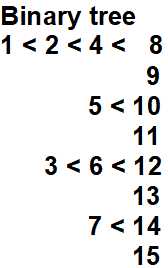
Part 3 The Binary tree has the same branch structure as the Collatz tree, as it also has the division rule, but connects by N-1 in place of the 3N+1 link that Collatz uses. Proof by induction is possible using monotonicity by term value and grid position. It Is a simple model for the Collatz system.

Part 4 Induction. Compressing a tree of type 1 and 2 branches, isomorphism with a binary tree, proof by induction using binary tree grid as a monotonic path, inflating the tree, Proof complete.

Please tell me to stop if I am out of order or not relevant. I do not want to takeover the site, but this approach seemed so obvious to me, and I cannot see any flaw in the argument. Once this is complete, I have two other different approaches by other methods. It seems to me that this is a very easy problem and I do not understand why no proof has appeared to date.

Definition of terms

1 Rule 1 is the division rule for even numbers. N/2.
2 Rule 2 is the tripling rule for odd numbers. 3N+1.
3 Rule 3 is the binary tree’s linking rule. N-1.
4 A branch is an odd positive integer followed by an unbounded set of doubling even numbers.
5 A root is the odd first term on a branch.
6 A node is the result of applying rule 2 or rule 3 to an odd root. 3N+1 for the Collatz system or N-1 for the binary system.
7 A tree is a set of branches connected by either the Collatz rule or the binary rule.
8 A filler is an even number that is not a node. They are 3N or 3N+2 in the Collatz system.
9 A branch type is the root mod 3 value of a branch but root ≡ 0 are labeled type 3.
10 A colinked branch set is a set of branches that link to all the nodes on a type 1 or type 2 branch in the Collatz system. They have a separation of 4k+1 and cycle branch types.

Defining branch structure for a tree.

Theorem 1: The division rule generates a branch structure.
Proof:
An even number on a branch has a form R2^k where R is the root of the branch.
Each use of rule 1 will remove one factor of 2.
No other odd factors are removed.
After k applications of the rule, all factors of 2 are removed and the odd root is reached.
All terms on a branch are a multiple of the root.
Application of rule 1 provides an orbit down a branch to the root.
Q.E.D.

Theorem 2: The set of branches contains every positive integer exactly once.

Proof:
Every positive odd number is the root of a branch with unique prime factors by the fundamental theorem of arithmetic.
If we multiply the set of all positive odd numbers by the set of all integer powers of 2, we may generate each positive integer in one unique way.
{1, 3, 5, 7, 9, 11, 13 …} * {1, 2, 2^2, 2^3, 2^4, 2^5, 2^6 …}
Every odd integer is represented as the root of a different branch.
Every even number has the format R2^k where R is the product of an integer’s odd prime factors and k is a count of the number of factors of 2.
Every integer is represented and has one specific location k on one branch.
No integer can appear in more than one location.
Q.E.D.

A termination loop exists.

Theorem 3: Branch 1 links to itself with a termination loop.

Proof:
In the Collatz tree the 3N+1 rule links a root of a branch to an even node.
The root R is odd.
The following two terms on a branch are 2R and 4R.
Tripling an odd root will give an odd result with a value between 2R and 4R.
Adding 1 will give an even number on the same branch only if:
3R+1 = 4R
Solving gives R = 1.
Only branch 1 can link to itself.
Q.E.D.

Theorem 4: Type 3 branches have no connection nodes.

Proof:
In the definition of a branch each term was double its predecessor.
Each term on the branch contains all the prime factors of the root.
Branches of 3N format have terms that are all a multiple of 3.
Therefore, they have no terms of 3N+1 format and are node free.
Q.E.D.

Theorem 5: 3N+1 nodes alternate with 3N+2 even filler numbers.

Proof:
A term of 3k+1 format on a branch, when doubled gives a result 6k+2.
This is equal to 2 modulo 3.
Doubling 3k+2 again gives 6k+4 which has a modulo 3 value of 1.
The root of the branch will follow the same mod 3 format but will be odd.
Q.E.D.

Corollary:
Any branch with a 3N+1 node has infinitely many such nodes, separated by a 3N+2 filler even number that is not a node and must be on a branch with a 3N+1 or 3N+2 root type as this is doubled to get the first even term.

Theorem 6: Type 1 branches have only downlink nodes.

Proof:
A type 1 branch has a root of 3N+1 format. The root mod 3 value is 1.
The first even number is a 3N+2 filler and is not a connection node.
The second even number is a 3N+1 node as type 1 and 2 branches alternate these values.
The branch linking to a node at the second even number by a 3N+1 link will have two rule 1 divisions by 2 that will reduce the value to (3N+1)/4 to reach the root. The result is a term about 75% of the linking branch root.
All higher nodes will have more rule 1 options and all following links to nodes are also downlinks.
Q.E.D.

Theorem 7: Type 2 branches have one uplink node.

Proof:
A type 2 branch has a root of 3N+2.
It will be followed by an even number of 3N+1 format, and the first node is immediately following the root.
A branch linking to this first node by 3N+1 will require only one rule 1 division by 2 to reach the root.
The connecting child branch has reached a parent branch with a root value of (3N+1)/2 which is an increase of about 50%. It is an uplink to a branch of higher root number.
All following nodes will have at least three rule 1 divisions available and will be downlinks.
Type 2 branches have one uplink site immediately following their root and all other connections are downlinks.
Q.E.D

Uplinks and downlinks

The only uplinked connections to a higher branch number are branches of 4k+3 format that link to the first node on a type 2 branch. A 4k+3 format branch links by 3N+1 to a 12k+10 node. A single division by 2 reaches a 6k+5 odd branch root. All other nodes have at least two division rule links that reduce the node to a value that is 4 times smaller than the node, and this is less than the 3N+1 increase except for the termination loop on branch 1.
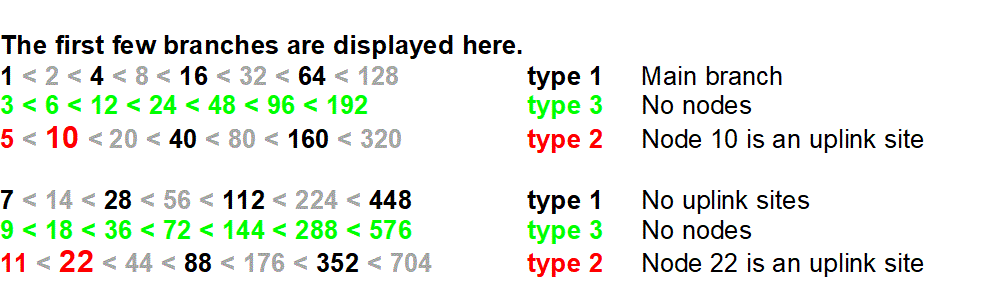
All connection nodes exist on type 1 and type 2 branches. No nodes exist on type 3 branches as all terms are multiple of 3. Consecutive branches cycle as triplets of type1, type 3, and type 2 branch types.

This completes part 1, the structure of branches and node distribution. Part 2 looks at connections to nodes.
Using your definitions, a Collatz node is exactly an even number x with x\equiv4\pmod6, which is a fancy way of saying x=3N+1 when N odd. E.g. 16 is a node (it has odd parent 5), but 14 is not, since (14-1)/3\notin\mathbb Z. But then, under Rule 3 (the binary system) you map every odd to an even N-1, which means every even x has an odd parent x+1. So there’s a mismatch between the Collatz system and the binary system. That mismatch means the binary isomorphism isn’t actually isomorphic.

I saw that too and asked my self “Is this a dead end?”. The Collatz tree is a stretched out binary tree, it has nodes at only one third of the even values and has some padding of filler even numbers of 3N+2 format on type 1 and type 2 branches. It also has type 3 branches that are completely node free. The solution is to compress the Collatz tree to a form that is isomorphic to the binary tree.

But first

Theorem 8 Branch types 1 and 2 have colinked branches with a 4k+1 separation.

Proof:
Nodes are separated by a factor of 4 on a branch of type 1 or type 2.
The two branch types are out of phase with respect to each other.
A branch with a node N will have a previous node P and a filler separates them.
N = 4P
A branch B linking to P has a relationship:
3B+1 = P
A subsequent branch S linking to N will have a relationship:
3S+1 = N
S in terms of B is
3S+1 = N
= 4P
= 4(3B+1)
= 12B+4
S = 4B+1
Each connecting branch to a set of nodes on a single type 1 or type 2 branch will have a separation value between terms of 4k+1.
We will call this set of linking branches colinked branches.
Q.E.D.

Theorem 9 Colinked branches cycle between the three types.

Proof:
Starting at a type 3 branch of 3N format the type is 3 with root mod 3 ≡ 0.
The next colinked branch has a mod value of 4x0+1 mod 3 or 1 and is type 1.
The next colinked branch has a mod value of 4x1+1 mod 3 or 2 and is type 2.
The next colinked branch has a mod value of 4x2+1 mod 3 or 0 and is type 3.
This is the reverse of the order for consecutive branches.
Q.E.D.


The binary tree is monotonically connected. The binary tree has the same division rule for even numbers and generates the same set of branches. All links of N/2 or N-1 reach a smaller value that is a positive integer. All paths must eventually reach 1.

Theorem 10 A binary tree has a proof by induction of a path to 1 for all terms.
Proof:
The connection rule for binary trees is N-1.
Every odd branch root connects to a lower node value that is even.
This has a path by rule 1 (N/2) to a lower root of the new branch and the process continues.
All links are to a lower value.
By induction all paths must reach 1.
If every number has a path to 1 the tree must be fully connected.
Q.E.D.

The binary tree is monotonically connected. The binary tree has the same division rule for even numbers and generates the same set of branches. All links of N/2 or N-1 reach a smaller value that is a positive integer. All paths must eventually reach 1.

Theorem 10 A binary tree has a proof by induction of a path to 1 for all terms.

Proof:
The connection rule for binary trees is N-1.
Every odd branch root connects to a lower node value that is even.
This has a path by rule 1 (N/2) to a lower root of the new branch and the process continues.
All links are to a lower value.
By induction all paths must reach 1.
If every number has a path to 1 the tree must be fully connected.
Q.E.D.

Part 4 Resolution of the Collatz conjecture

We have all the necessary elements to prove this conjecture.

The Collatz tree is a binary tree in disguise. Both use the division rule to create the same branch set, that are connected by two different rules N-1 and 3N+1.

The Collatz tree is no longer monotonic by term value as the filler even numbers push connection nodes to higher values. The Binary tree was more compact with downlinked connections. It was also monotonically downward linked by row and column of the grid locations of the tree. If the Collatz branch roots and connection nodes could be compressed down to a compact form, the orbits would not be monotonic by term value but may become monotonic by grid location in imitation of the compact format of the binary tree.

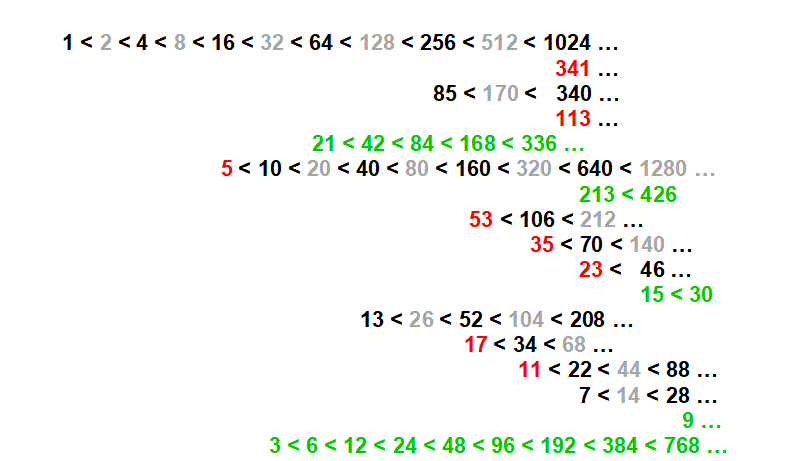
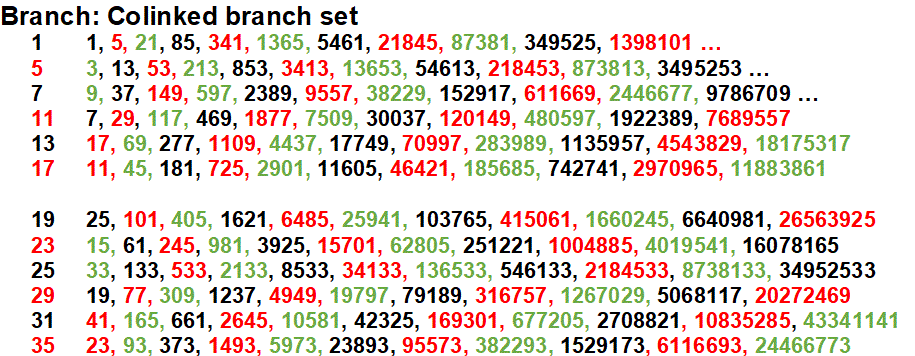
The Collatz tree shows a set of colinked branches, cycling by branch type (e.g. 5, 21, 85, 341) attaching to a branch and rising to the right. Flights of steps are a rising set of type 2 branches (e.g. 15, 23, 35, 53) rising to the left and attaching at their top.

All branch connections in the Collatz tree are by sets of colinked branches linking to type 1 and type 2 branches. (5, 21, 85, 341 and 3, 13, 53, 213). Where a chain of type 2 branches connects, a flight of increasing branch numbers occurs. (7, 11, 17) But each term in this set is the start of individual colinked sets that connect to the next branch in the flight of steps.

The tree is infinite in size. We take a small sample for demonstration purposes.
From a starting sample tree:

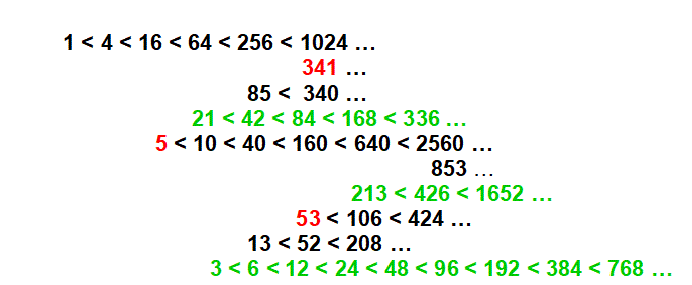
We then remove type 3 bare branches and the nodes they connect to. Node 4 is part of the termination loop, and we may ignore it temporarily. It will not affect the continuity of the tree.

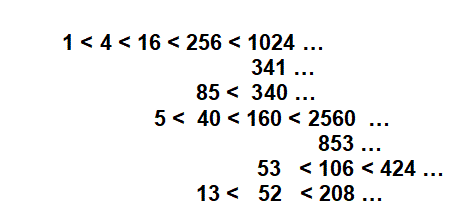
All Collatz nodes are on type 1 and 2 branches. The nodes for type 3 branches and the type 3 branches themselves are removed. Only type 1 and 2 branches and their connection nodes remain. Each original type 1 or 2 branch connected cycling branch types. The compressed form will contain alternating type 1 and type 2 nodes on each remaining branch. All fillers are removed. Every type 1 and 2 branch will connect to a node and every node will connect a type 1 or 2 branch. The termination loop exception is also removed to show more clearly the isomorphic relationship between binary and compressed Collatz trees.

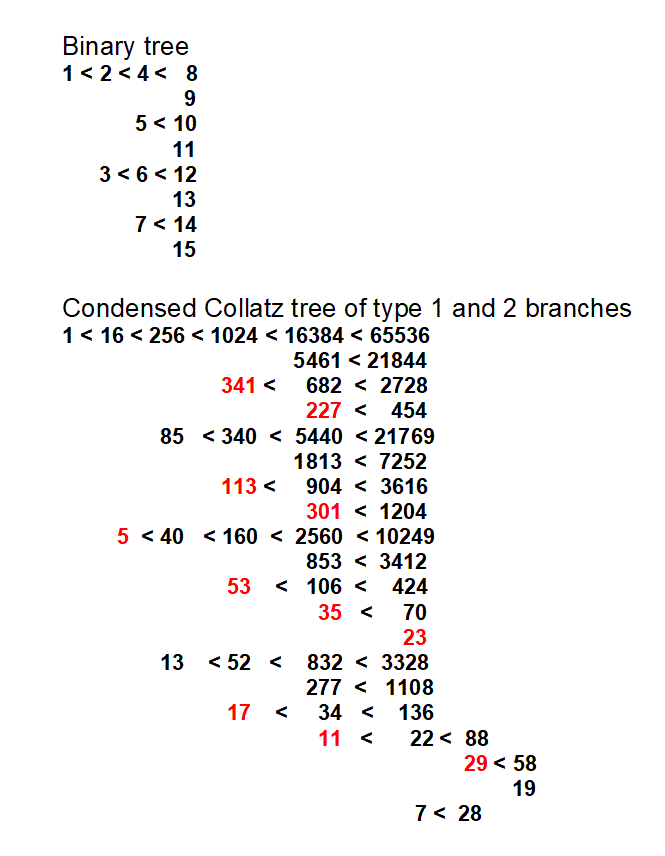
The only even values remaining are connection nodes for type 1 and type 2 branches. Like the binary tree, when assembled, it will have the binary tree’s iconic standard indentation pattern. Building upward from the root, each new column will have an even node on an existing branch from the previous column. The even extension may be 2 or 4 or 8 or 16 times the value in the prior column due to the deletion of fillers and / or type 3 connection nodes. Each will attach a new branch by its root. There is a bijection between the branch roots and the remaining even nodes. The column sizes double at each stage. Each new column will alternate odd and even values. See below.

Comparison of binary tree and a condensed Collatz tree.

Paths are not monotonic by term value but are by grid position. Each 3N+1 link will be up to a node located in the same column as the branch root, reducing the row number. Each division by 2, or a second, third or fourth power of 2 will reach the node or branch root in the prior column.

The condensed type 1 and 2 branch Collatz tree contains all type 1 and 2 branches and their connection nodes and no other nodes or fillers or type 3 branches. It is fully connected with a monotonic downward connection measured by grid position. All orbits are monotonically up and left in the diagram. This proves connectivity of the condensed type 1 / type 2 Collatz partial tree. This cannot contain a cycle or divergent growth. There are no right links to higher columns to close a loop or grow to unbounded values. Every branch root links to a node in a lower row number and every node links left down a branch. The term values are irrelevant, and the grid location is a monotonic index that shows all steps on the path are to a lower row number or a lower column number. Each link reduces the row or column value. By induction both values must eventually reach 1 and a path exists to grid location (1, 1).

Inflating the tree adds all the missing fillers and nodes and branches to create a Collatz tree. Inflation destroys the isomorphic relationship between the binary tree and the Collatz tree that was used to prove connectivity of the type 1 and 2 branches. After inflation, the type 1 and 2 branches are still fully connected, and the addition of type 3 nodes connects all the missing type 3 branches. A path from a type 3 branch will reach a type 1 or type 2 branch as they have the nodes, and all following links remain on the connected type 1 and 2 branch set. It maintains connectivity during the inflation process as the topology of the connections is not altered. The full Collatz tree is connected.

Cycles and divergent growth are not possible in a fully connected tree.
No need to even look for cycles or disprove them. No reference to Baker’s theorem or to 2^k-3^x is needed. No reference to proposition A or proposition B is required. The proof is not “Baker Hard”. I have independent proof of the finite length of all flights but as the conjecture is proved this becomes a consequence of truth of the conjecture.

The conjecture is true.

I have another proof by a totally different aproach if you are interested. It involves sorting colinked branch sets.

This is not a difficult problem.
I have a third proof by a hybrid tree structure.
I am working on further possible proofs by local modular relationships in a Collatz tree and one using tag systems. I have not yet investigated p adic number systems, and continuous fractions.

I repeat, this is not a difficult problem.

There are many other hidden structures in the Collatz structure including binary and ternary trees, infinite families of flights each with an infinite set of flights of all possible finite lengths, a hidden binomial structure, and a binary tree sieve process. The number of hidden structures seems endless. A depth of connection table generates infinite sets of linear increasing sequences. There is an infinite set of subtrees that are each downward connected and have a proof by induction like the binary tree. Their roots join to form steps on the flights that link upward. There is an explanation of the structure of the zigzags. And more.

You make me happy, finally something I can understand without having to look things up. I knew that if there was another loop out there it would not only be huge, but would also be deprived of any number dividable by 3. I had also found the uplinks and downlinks which helped me add uneven numbers between the /2 part of the conjecture to create my silly peak finder in fan art.

I would have never thought of comparing the sequences to the binary tree though. I love it and am looking forward to the other structures!

I think in order to say whether or not this problem is easy and you “solved it” you should first start by trying to have a more rigoreous proof than that cause here I don’t even see in any sort of way why your proof would show that the collatz tree contains EVERY natural numbers note that is the only way you can show that the conjecture is true using this collatz tree reasoning. To do that you should ask yourself if there is any path of true mathematical statements that would sove the conjecture while being as critical as possible about it knowing that examples will never be a proof of the collatz conjecture.

My original proof that I developed included an abstract and an appendix and ran to 90 pages. It described many more structures than this shortened outline. It contained 39 theorems and 75 figures. I was simply presenting the outline for comment. I did not wish to burden the site with a very long proof.

I thought that theorem 1 effectively showed that removing factors of 2 from a finite starting number must eventually reach an odd value. Since the set of all possible odd positive integers act as branch roots it seemed to me that theorem 2 established every possible integer exists on at least one branch. I can only conclude that the issue must be the inclusion of every branch in the tree.

The remainder of the proof was a construction that attempted to show that every branch was included in the Collatz tree. This was broken down into several stages.
1 All connection nodes of 6k+4 format exist on branches with a root mod 3 value of 1 or 2. Type 3 branches have no nodes but connect to the type 1 or 2 branch. So we must show all type 1 and 2 branches are connected.
2. Type 1 and 2 branches have nodes alternating with filler numbers of 3k+2 format. Removing the fillers required two division rule steps between nodes but does not alter the topology of the orbit. The compressed branch still has a path to the root.
3. Disconnecting the type 3 branches and their connection nodes left only type 1 and 2 branches and their connection nodes. These link in a manner that is isomorphic to the binary tree and shows all type 1 and 2 branches connect to a single tree without loops or divergent growth.

Expanding the tree attaches the the type 3 branches to their nodes and inserting the fillers completes the tree. The connectivity of the tree is not disturbed by the expansion.

I do not have the technical skills to present it in a formal proof and was simply asking if the method had any merit.

It’s not because you have a much longer paper that uses this same method of sentences/example without real mathematical proof that it is correct. Indeed, If your paper uses this same method of argumentation, I am sorry to inform you that it is not a mathematical proof of the collatz conjecture. To me, your binary tree “isomorphism” with the collatz tree seems to be very weird and convoluted as for example if you look at 27 you need more than 100 steps to get to 1, how would that correspond to the binary tree that makes 27 only take like 4 steps to reach 1, the collatz tree is known to be very unpredictable and chaotic and saying it is simply isomorphic to the binary tree would only be the case if the collatz conjecture is true. And in my opinion with what I currently know about the conjecture, it is impossible to proove that it contains every numbers without even talking about the congruences of 2^p modulo 3^n , as I think that you need a close to perfect understanding of how they behave to fully proove the collatz conjecture with this collatz inversed method and it is known that those congruences are behaving almost randomly explaining the difficulty of the collatz conjecture as a whole and why it is for the moment completely out of reach of current’s methods and why we can only hope for better partial results than we currently have.

Note : I tried to read more, and I can now say that the part about the branchs is indeed true but showing that all those branches are connected at some point to a branch having a smaller number in a said path resulting in the truth of the collatz conjecture by induction, is the hard and non-trivial part where everything you said was insufficient to show that. Instead your approch seemed to be of showing that the collatz tree was including every numbers but it seems like to me your main point was that the collatz tree is expanding infinitely and creating bigger numbers everytime, thus having an infinite amout of numbers and thus proving the collatz conjecture but this reasoning is false as it doesn’t mean that every natural numbers no matter how small they are must be in it. And again, your argumentation is not precise enough at all to show this even as idea.

Finnaly, I think this is where you’re mistaken what we want to show in the collatz conjecture is that every numbers in any interval [1;N] has the property of going to 1 in a finite amount of steps for every N natural number. The term values of the collatz tree are not irrelevant as we need them to know that.