Engineered or discovered start numbers?

In the spirit of Conway’s Game of Life system, where Life-engineers have invented and/or discovered start patterns that “do things” … does anyone have any 3n+1 start numbers that do things?

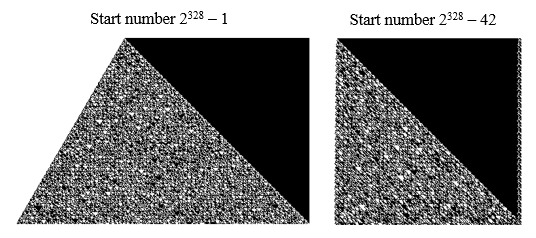
Here’s one: 2^{328}-42.

Its trajectory is shown below, sitting to the right of a more well-known pattern.

2^{328}-42 just sort of hangs steady for 328 steps, neither increasing nor decreasing by much. Wonder why it does that. Afterwards, of course, comes the usual chaotic descent to 1:

Any other interesting start numbers?

1 Like

I can explain the right side (perhaps already known) but not the left. On the right, the trailing n bits after k steps depend only on the trailing n+k bits from start. So since the trailing 328 bits at start are equivalent to -42, the right side shows the trajectory of -42 which quickly enters the -17 cycle (T^6(-42) = -17). So that’s why the right side cycles (and doesn’t grow).

But no idea why the left side doesn’t move, that does seem very strange …

Where is the 2^{328} - 1 pattern known from? Are the exponents here important? Or do others have similar behavior?

Oh, I think this explains the left side too. Since the right side is in the -17 cycle, it is repeating exactly the parity sequence 11110111000 until the left side collides. This has 7 up and 4 down transitions, so it sends large n \to \frac{3^7}{2^{11}} n + \epsilon which is \frac{2187}{2048} \approx 1.068. So the size won’t change much until cycle is broken.

Whoa, I picked 42 kinda at random, not knowing it enters the 17-cycle. Thanks, that makes sense.

2^{328}-1 is just a case of 2^k-1, which always leads to an odds run of length k (initial parity sequence 1^k), hence the steady growth. Terras showed every start number between 0 and 2^k-1 has a unique initial k-length parity sequence, but AFAIK, it’s generally unpredictable which start number goes with with parity sequence – modulo exceptions like 2^k-1 reliably going to 1^k.

I think this means that the exponent wasn’t really important, this should work for any 2^n - 42 (or 2^n - 17).

1 Like

Yeah, 2^k - 1 having k odds in a row corresponds to the -1 cycle. So every cycle (on all integers) should lead to a predictable sequence. 2^k - 17 will cycle through 11110111000 for first k steps. 2^k + 1 should cycle through 10 for first k steps, etc. I suppose since -17 is the largest known cycle it will lead to the smallest increase in large numbers over time?

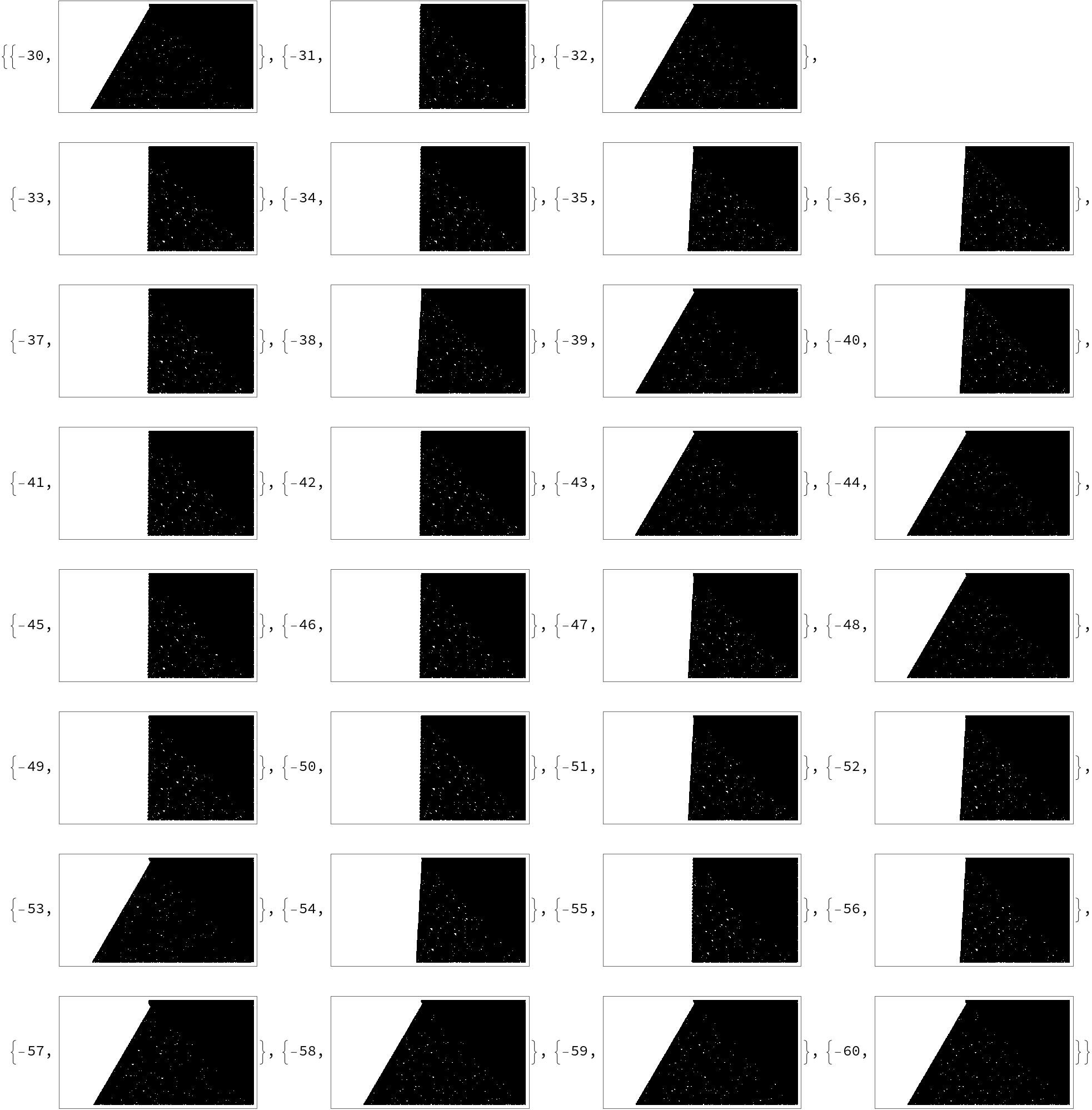
Here are 2^{328}-30 through 2^{328}-60 … (and pretty sure the 328 had something to do with the width of my screen)

Yeah, this theory seems to work for 2^k + 1

>>> a = 2**30 + 1
>>> for n in range(40):
...     print(f"{n:3d} {a:20d} {bin(a):>50s}")
...     if a % 2 == 1:
...         a = 3*a+1
...     a //= 2
...
  0           1073741825                  0b1000000000000000000000000000001
  1           1610612738                  0b1100000000000000000000000000010
  2            805306369                   0b110000000000000000000000000001
  3           1207959554                  0b1001000000000000000000000000010
  4            603979777                   0b100100000000000000000000000001
  5            905969666                   0b110110000000000000000000000010
  6            452984833                    0b11011000000000000000000000001
  7            679477250                   0b101000100000000000000000000010
  8            339738625                    0b10100010000000000000000000001
  9            509607938                    0b11110011000000000000000000010
 10            254803969                     0b1111001100000000000000000001
 11            382205954                    0b10110110010000000000000000010
 12            191102977                     0b1011011001000000000000000001
 13            286654466                    0b10001000101100000000000000010
 14            143327233                     0b1000100010110000000000000001
 15            214990850                     0b1100110100001000000000000010
 16            107495425                      0b110011010000100000000000001
 17            161243138                     0b1001100111000110000000000010
 18             80621569                      0b100110011100011000000000001
 19            120932354                      0b111001101010100100000000010
 20             60466177                       0b11100110101010010000000001
 21             90699266                      0b101011001111111011000000010
 22             45349633                       0b10101100111111101100000001
 23             68024450                      0b100000011011111100010000010
 24             34012225                       0b10000001101111110001000001
 25             51018338                       0b11000010100111101001100010
 26             25509169                        0b1100001010011110100110001
 27             38263754                       0b10010001111101101111001010
 28             19131877                        0b1001000111110110111100101
 29             28697816                        0b1101101011110010011011000
 30             14348908                         0b110110101111001001101100
 31              7174454                          0b11011010111100100110110
 32              3587227                           0b1101101011110010011011
 33              5380841                          0b10100100001101011101001
 34              8071262                          0b11110110010100001011110
 35              4035631                           0b1111011001010000101111
 36              6053447                          0b10111000101111001000111
 37              9080171                         0b100010101000110101101011
 38             13620257                         0b110011111101010000100001
 39             20430386                        0b1001101111011111000110010

The parity (rightmost bit) alternates up until iteration 30 when the “wall” hits it.

1 Like

Also we could say it works for 2^k+0: the 0-cycle is the one with the most even numbers, and 2^k has the steepest decrease.

That whole observation is very nice.

1 Like

IMHO (1) the dichotomy is not really one: patterns are observed and other cases are engineered to see if generalization is possible; (2) observing single sequences seems less useful than tuples sequences in parallel.

1 Like

As sligocki pointed out, 2^k-17 will cycle through 11110111000 (or more precisely h\cdot 2^{11p}-17 where p is the number of time this pattern will repeat at the beginning of the parity vector)

There are some more patterns here: Starting number patterns

For 2^{328}-42, it reaches 216\cdot 2^{11\cdot 29}-17 after a few steps, and from there will repeat the pattern 29 times.

1 Like

@JapArthur it’s a great point – maybe observe something, modify it to fit some purpose, observe something else, modify, etc.

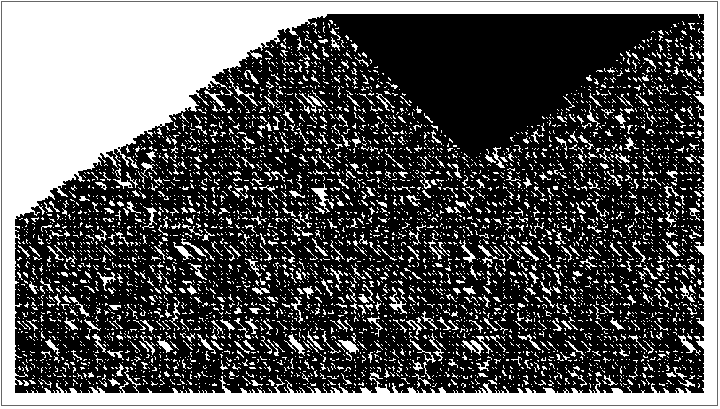
Right on, @Collag3n, several cycles are available to play with. And since 5n+1 also has a -17 loop, here is 5n+1 starting with 2^{328}-17, for grins: