First why considering working in mod 12? With parametric equations we conclude that after an initial operation by the Crandall function
C_e(X_n)=\frac{3X_n+1}{2^e}=X_{n+1}
(operating with odd integer only)
the result is X_{n+1}\equiv 1(mod6) or 5(mod6)
Also with any integer 3(mod4) as input in the C function will produce a greater integer for which C_{e=1} since
\frac{3(4m+3)+1}{2}=\frac{12m+10}{2}=6m+5
while integer 1(mod4) will give lower answer since
\frac{3(4m+1)+1}{2}=\frac{12m+4}{4}=3m+1 or lower if m is odd.
So combining both by mean of modulus 12 we get integers giving a rise 3(mod 12), 7(mod12) and11(mod12), while other odd integers 1(mod 12), 5(mod 12) and 9(mod 12), we will produce a lower integers.
Also using the substitution equation that is
when C_e(X_n)=\frac{3X_n+1}{2^e}=X_{n+1}
we can replace X_n by 4^kX_n+\sum_{j=0}^{k-1}4^j
C_{e+2k}(4^kX_n+\sum_{j=0}^{k-1}4^j)=\frac{3[4^kX_n+\sum_{j=0}^{k-1}4^j]+1}{2^{e+2k}}=X_{n+1}
And translating all these in mod12 we can display the following digraph:
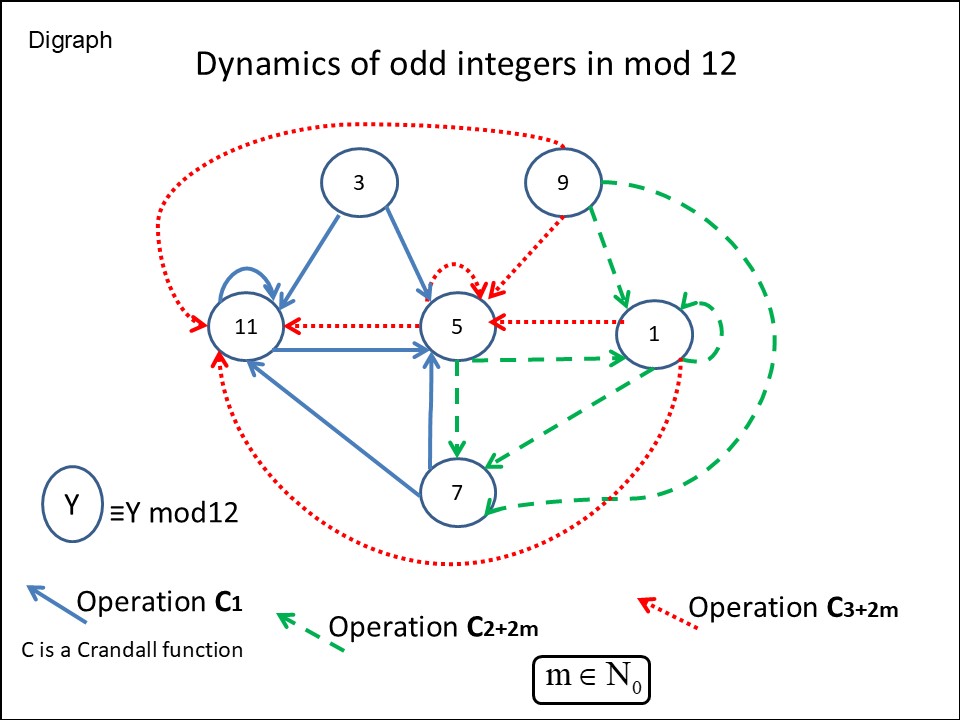
Notice that any rising trend end with a 5(mod12) which also have the highest number of links.
One last remark, any 3 or 9(mod12) can be remove without loss of generality because their output can be replace by coalescence using substitution equation with input from 1 or 5(mod12).