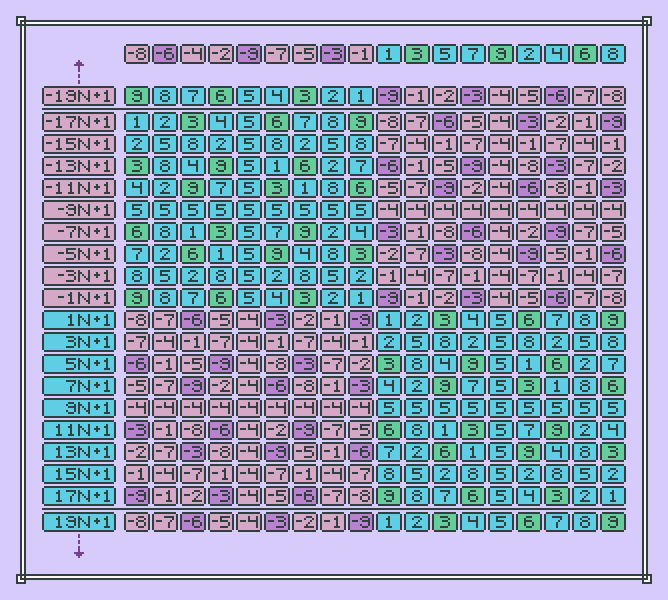
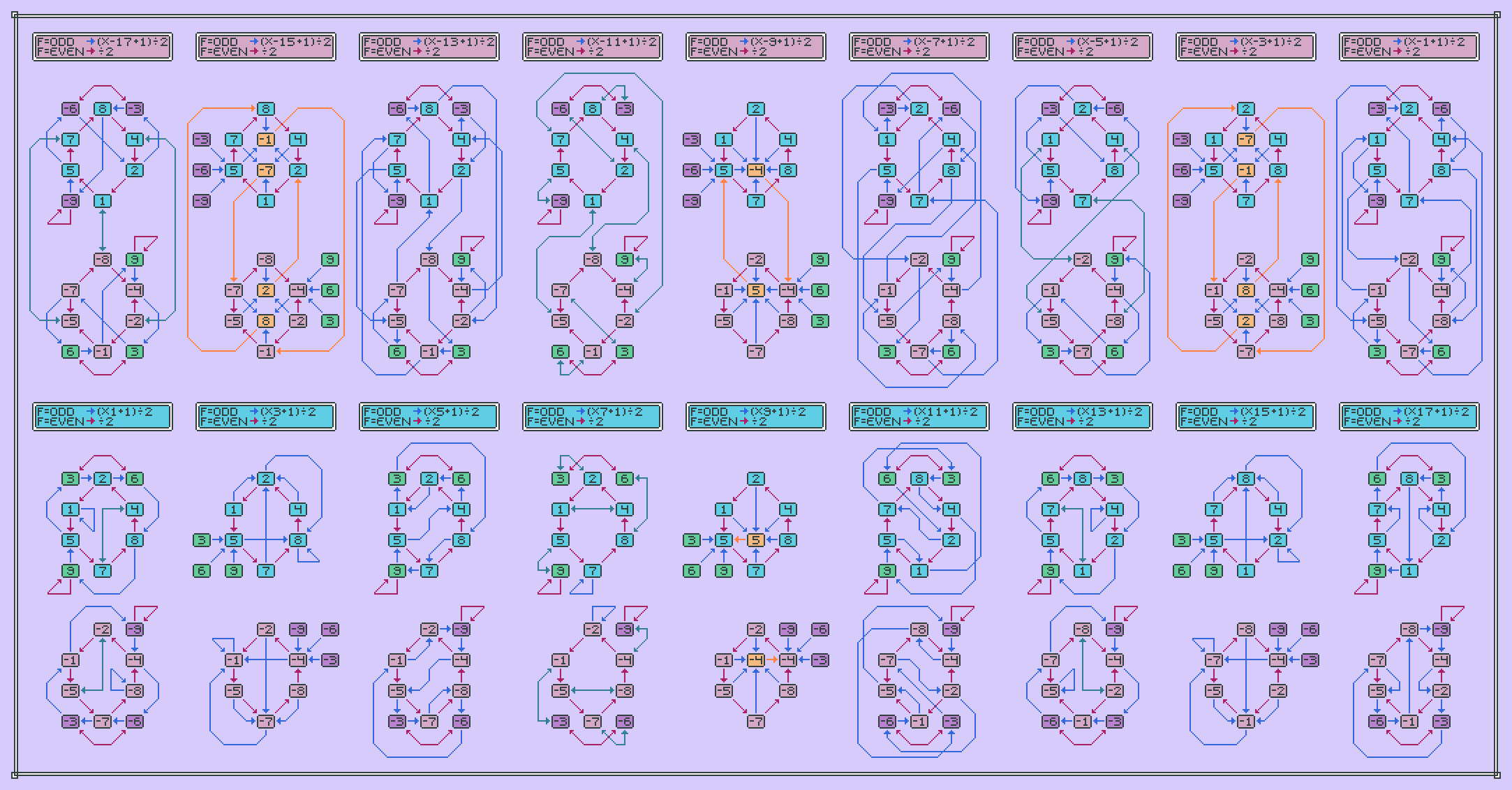
Just for fun, surely known, and possibly posted … consider a (putative) qn+1 cycle of length l, and consider its cycle members mod l.
3n+1, l=2
cycle: 1, 2
mod l: 1, 0
5n+1, l=5
cycle: 1, 3, 8, 4, 2
mod l: 1, 3, 3, 4, 2
5n+1, l=7
cycle: 13, 33, 83, 208, 104, 52, 26
mod l: 6, 5, 6, 5, 6, 3, 5
5n+1, l=7
cycle: 17, 43, 108, 54, 27, 68, 34
mod l: 3, 1, 3, 5, 6, 5, 6
3n-1, l=1
cycle: 1
mod l: 0
3n-1, l=3
cycle: 5, 7, 10
mod l: 2, 1, 1
3n-1, l=11
cycle: 17, 25, 37, 55, 82, 41, 61, 91, 136, 68, 34
mod l: 6, 3, 4, 0, 5, 8, 6, 3, 4, 2, 1
181n+1, l=15
cycle: 27, 2444, 1222, 611, 55296, 27648, 13824, 6912, 3456, 1728, 864, 432, 216, 108, 54
mod l: 12, 14, 7, 11, 6, 3, 9, 12, 6, 3, 9, 12, 6, 3, 9
181n+1, l=15
cycle: 35, 3168, 1584, 792, 396, 198, 99, 8960, 4480, 2240, 1120, 560, 280, 140, 70
mod l: 5, 3, 9, 12, 6, 3, 9, 5, 10, 5, 10, 5, 10, 5, 10
The 181n+1 cases are kinda structured-looking, though not entirely predictable.
Because 181 \equiv 1 (mod 15), we wind up with a simple residue sequence rule:
r \rightarrow 8r (mod l), for even n
r \rightarrow 8r + 8 (mod l), for odd n
So if n \equiv 5 mod 15, then its successor is either 10 mod 15, or 3 mod 15. Hence the repetitious-looking mod l sequences.