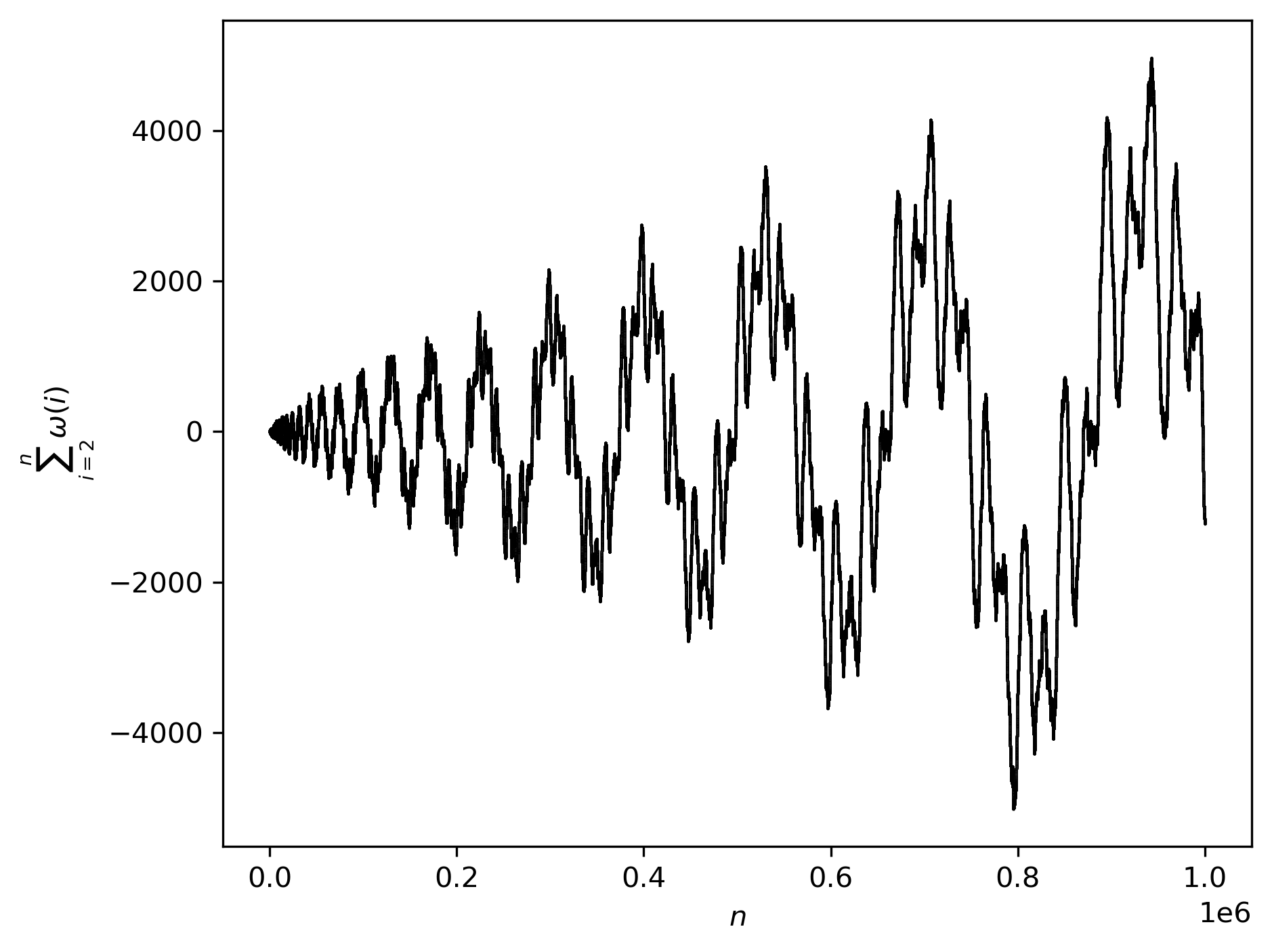
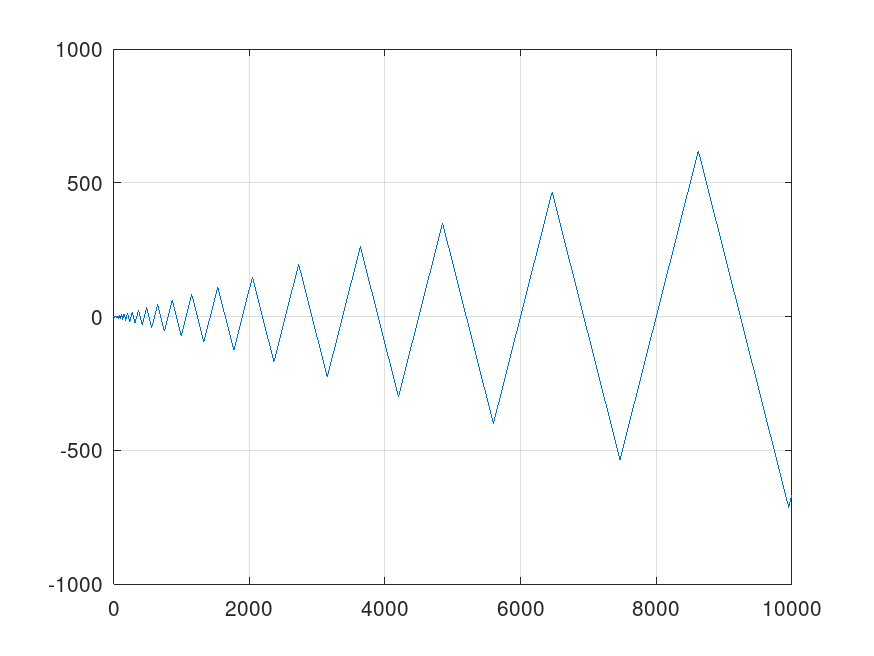
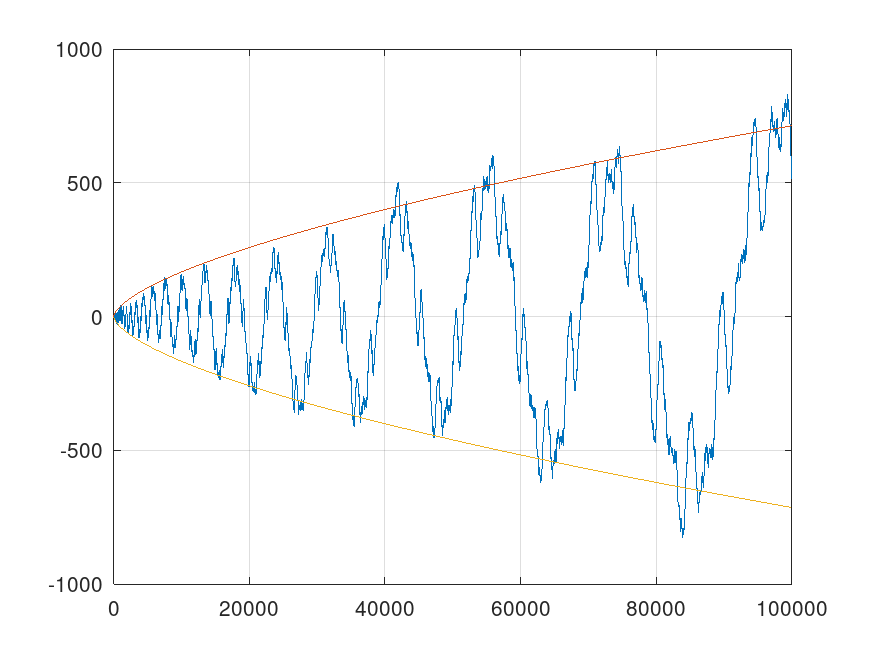
Interesting to understand what is going on with these partial sums. So I couldn’t resist to briefly investigate.
First, I assume that your definition of the stopping time is the number of steps needed to get to 1 when iterating the Collatz function, which is generally referred to as the total stopping time.
A well-known heuristic estimate for \tau(n) is given by a \log n with a =2/\log(4/3) \approx 6.952. This estimate is obtained by applying a multiplicative coefficient of \sqrt 3/2 at each step until getting below 1.
If we take the parity of \lfloor a \log n \rfloor instead of the parity of \tau(n), we can reproduce an oscillating behaviour with an increasing magnitude and a decreasing frequency.
However, the magnitude differs strongly from what you observed empirically when using the parity of \tau(n). In fact, we should also take into account the standard deviation of \tau(n)/\log n … More work is needed here …
Numerically, the peak values of \sum_{i=2}^{n} \omega (i) seam to follow two power laws of the form \pm n^{\alpha}/2 with \alpha \approx \log_3 (2) \approx 0.63.