Conjecture: all positive whole integers under these rules will return to one and remain at one
Rules for s
A.if s is even:s×1.5
B.if s is 1 mod4:(s×3+1)÷4
C.if s is 3 mod4:(s+1)÷4
notes:
*All (1 mod4×3)=3 mod4, so rule B could be s×3
*all even numbers exist in an isolated set leading to an odd multiple of 3, with even non multiples of 3 being the start of a isolated set (not resulting in an integer if divided by 1.5)
*non of these rules appear to result in a non integer
*the first 3 notes suggest a dynamic where odd numbers fall to a base at 1 or on an even number then continue to converge on/through 3 mod12
*rule C or iterations of rule C must fall to a base at either 1, even or 1 mod4.if you take any of these bases and reverse rule C (s×4-1) all integers produced will be 3 mod4, as 3 mod4 sit 1 below multiples of 4 and 1 mod4 sit 1 above.upon iterating this reversed procedure you will see a pattern of multiples of 3 appearing every 3 iterations after the first multiple of 3.
*if you take any 1 mod4 or even base and iterate s×4-1, then look at the difference between the resulting integers you will see an odd difference from the base to the result of the first iteration, all the differences after that will be that odd number ×4^x
*all rules B and C produce s’<s
*where (C+1)÷4=B….B×3=C’<C
…… just thought this might be a welcome change for anybody to try, ill note, these rules are derived directly from the collatz conjecture. I can prove equivalence for rule A. Im working on proving equivalence for rule B and C. Although this conjecture may be no easier/possible to prove than the collatz conjecture itself it does feel less chaotic.
1 Like
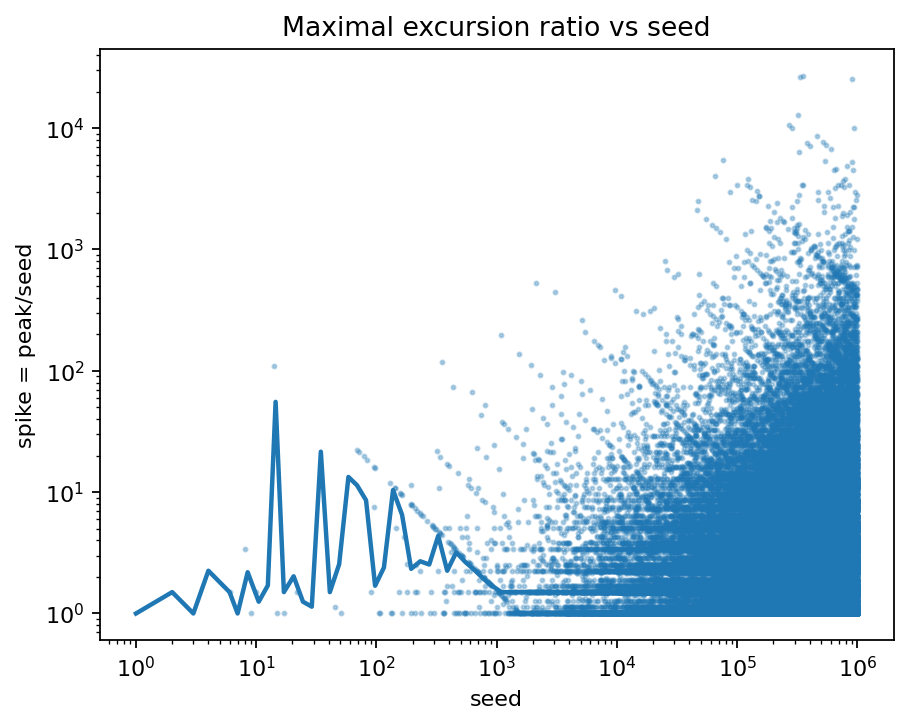
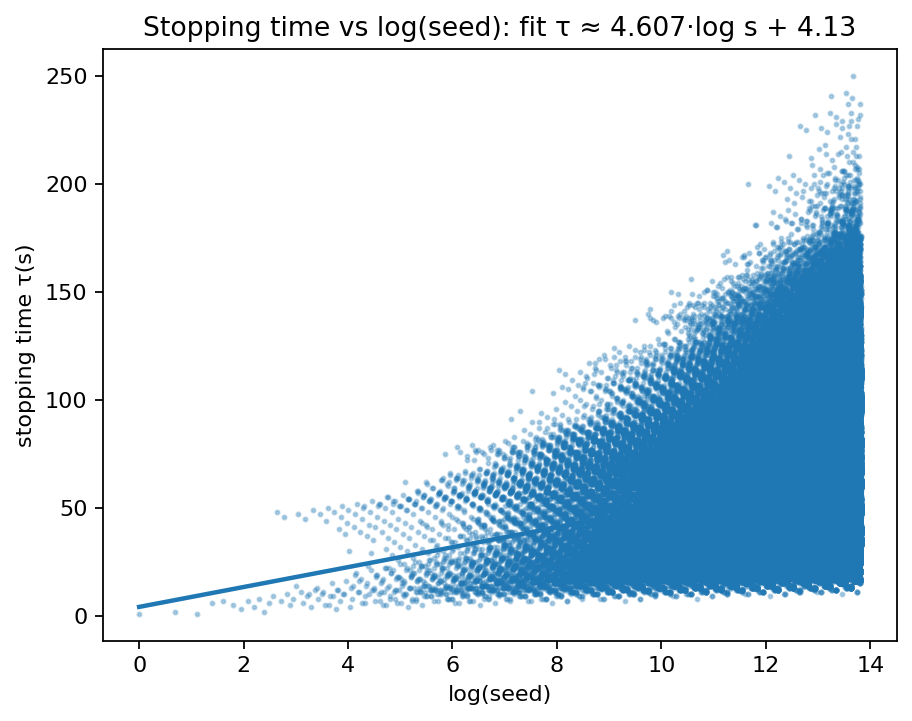
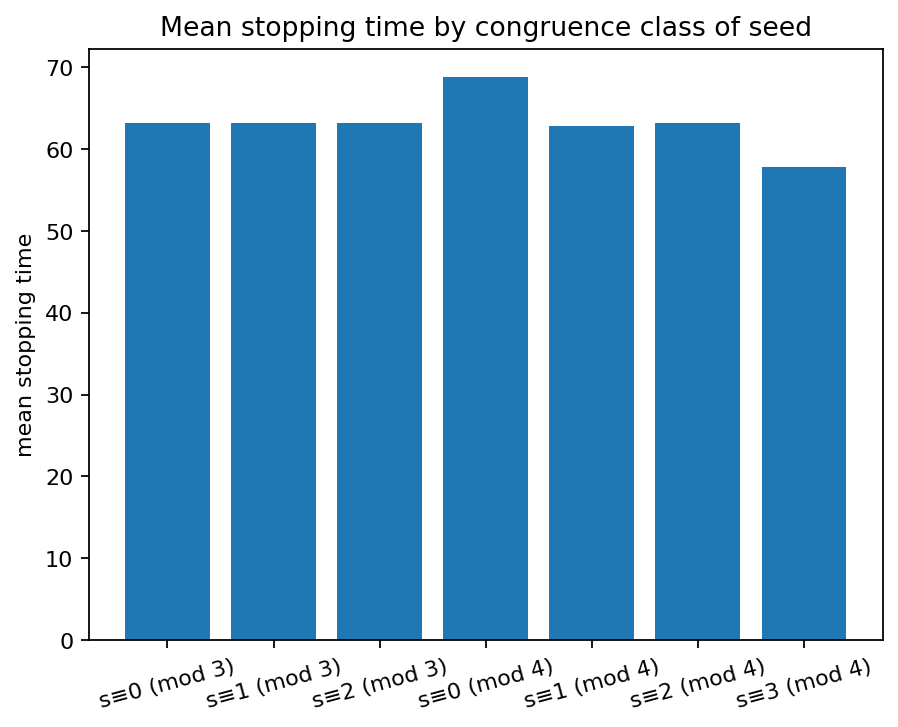
Much more contractive than Collatz, so stopping time grows slowly. Interesting imbalance in 0mod4.
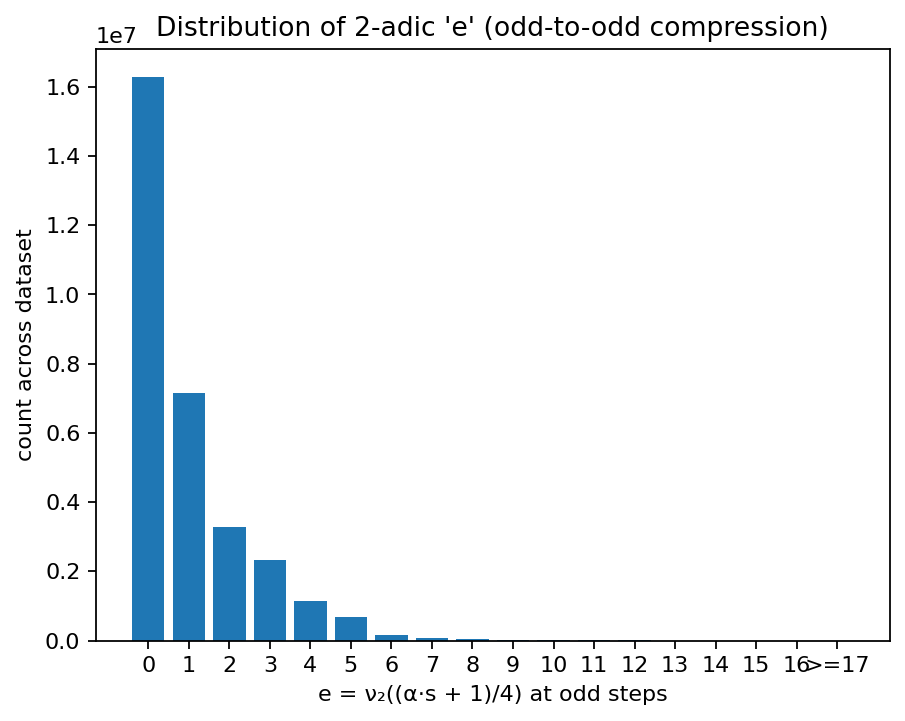
Per odd block the exact log‑change is \log(\alpha/4)+e\log(3/2). Without assuming 50–50 branches (actual data is pretty close, though), the expected drift is
\mathbb{E}[\log f]
= p\,\big(\log\tfrac14+\mathbb{E}[e\mid\alpha{=}1]\log\tfrac32\big)
• (1-p)\,\big(\log\tfrac34+\mathbb{E}[e\mid\alpha{=}3]\log\tfrac32\big),
where p=\Pr(\alpha=1) is the share of s\equiv3\pmod4 among odd states.
Under p=\tfrac12 and \mathbb {E}[e]=1 (classical), this is
\tfrac12\log\tfrac{1}{4}+\tfrac12\log\tfrac{3}{4}+1\cdot\log\tfrac32
= \tfrac12\log\tfrac{27}{64}\approx\boxed{-0.4315}.
Thanks for posting! I’ll be sure to reply with anything interesting that pops up.
2 Likes
If effectively mirrors collatz, mirroring odd to odd movements, where 3 mod4 mirrors falls through even numbers in collatz,but compressed to only even numbers that can be derived from an odd,keeping it true to odd to odd.any behaviour in this system if you say s×2-1 then follow collatz rules you will see the behaviour there ie. Loop or divergence. Im working with combinatorics and algebra as my approach as if you notice in s rules if you take any even or 1 mod4 and apply s×4-1, the additive sum from s to s’ is the same as the exponential fall it represents in collatz, so information is preserved in the transformation, ie. 1,3,11,43 represents 1,5,21,85 or 4,16,64,256
43-11=32
11-3=8
3-1=2
As per the inbalence on 0 mod4, I Think The closed sets when multiplied by 1.5 will increase inline with the v2 of the even number due to 2^n×1.5^n=3^n so
2,3
4,6,9
8,12,18,27
…..
as 2 is the lowest “start number” for any of these increasing sets, the large increases by the powers of two will always be denser in any sampled block of integers if they ar sampled from 1 too arbitrary x. So take the next base 10
10,15
20,30,45
40,60,90,125
Although the increases are larger, the base numbers ie. 10,20,40 quickly escape the base numbers from 2,4,8,16. Does this make sense? If not ill try harder.ì
1 Like
Another reformulation of the collatz conjecture
3 mod4=A
1 mod4=B
Even=C
Rules:
If A:A×3+1
If B:(B-1)÷4
If C derived from A or C:C÷2
If C derived from B:C×9+4
NOTE:if starting even either sub rule can apply as the starting point is arbitrary.
Simple reformulation but it feels like something subtle is going on that maybe reformulation can expose.
Note that A×3 always =B so A rule will find B and go +1 then begin dividing by 2, where as the B rule will go B-1.
1 Like
I forgot to mention these rules (refering to original s rules at the top of the page) either reduce straight to 1 or all others run through 3 mod12, when you just look at 3 mod 12 and apply the rules you see 50% produce a familiar pattern 4,10,16,22….the even numbers produced by odd numbers following collatz, also in the context of s rules all start numbers for closed sets merging on separate multiples of 3.if you take the other 50% you’ll see a portion of them after following the rules for another step produce 2,5,8,11….where the 2 mod6 integers are separate starting points merging on yet again separate multiples of 3. Interestingly 2,5,8,11…..are also the sequential positions of the multiples of 3 on the odd number line 2×2-1=3,5×2-1=9,8×2-1=15…..where s×2-1 is the bijection that connects s (the sequential position) to its odd number on the number line. Just curiosities but certainly not coincidence.
Another reformulation.
3 mod4=A
1 mod4=B
Even=C
Rules:
If A: A+((A+1)÷2)
If B:(B-1)÷4
If C:3C+1
Notes:
:Where A rule produces another A If A+Y=A’ then A’+(Y×1.5) will produce the next odd
:where B reduces to another B if B-Y=B’ then B-(Y÷4) will produce the next integer