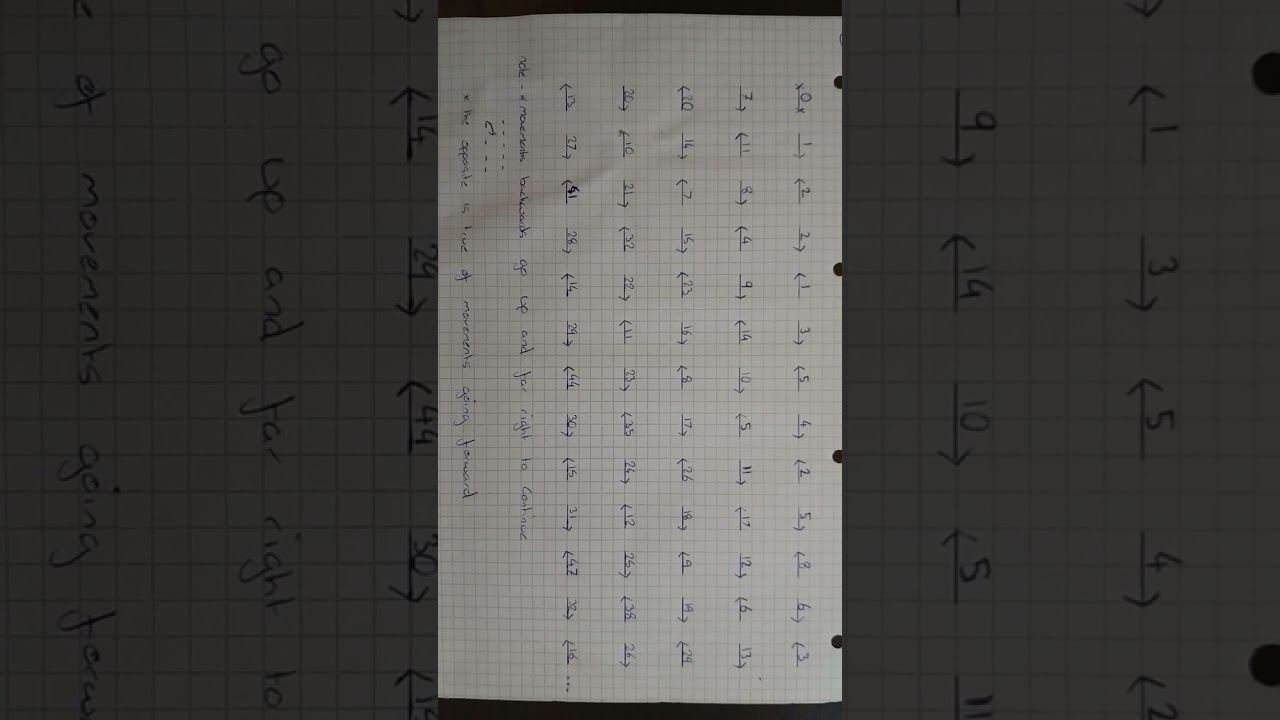
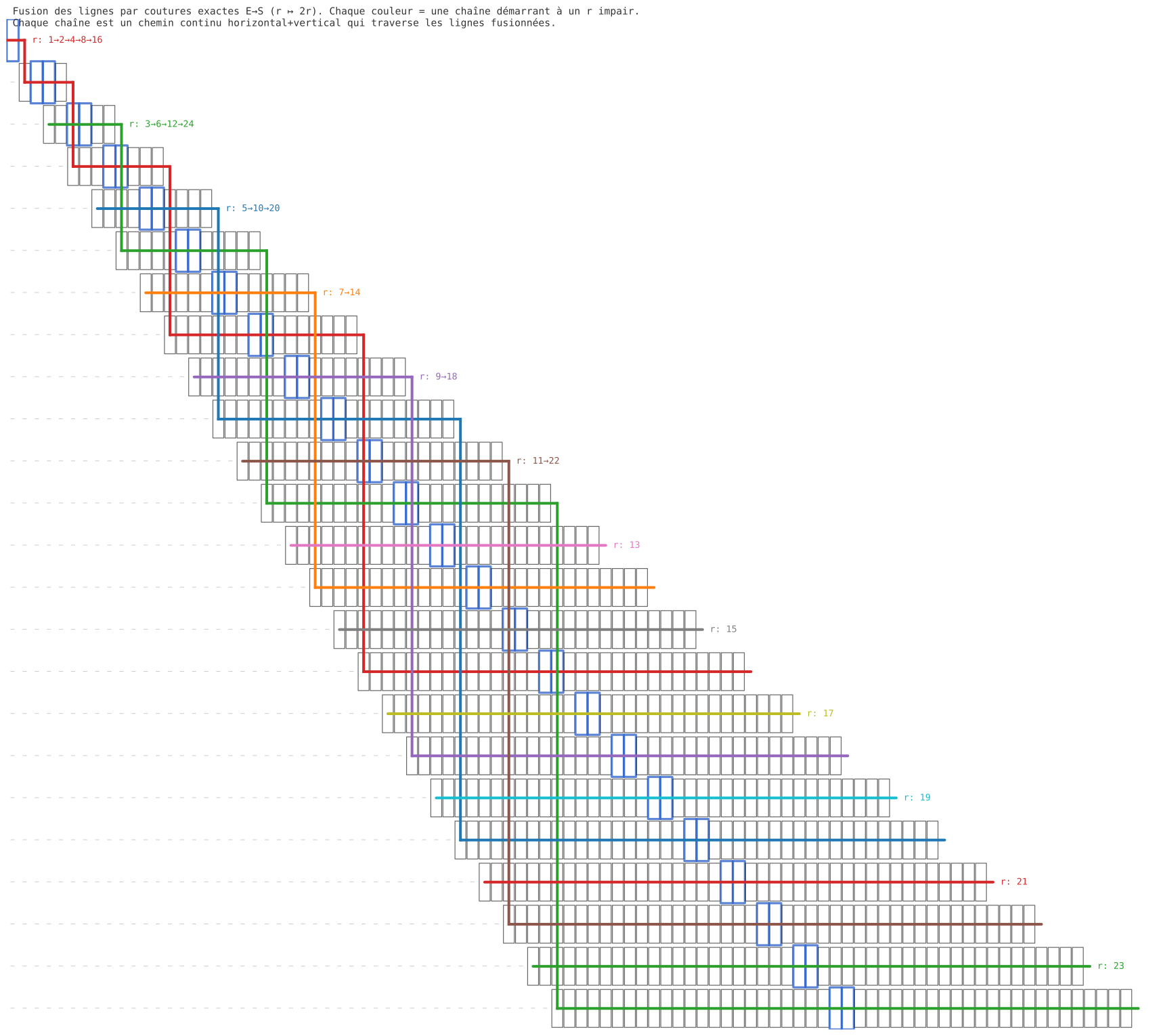
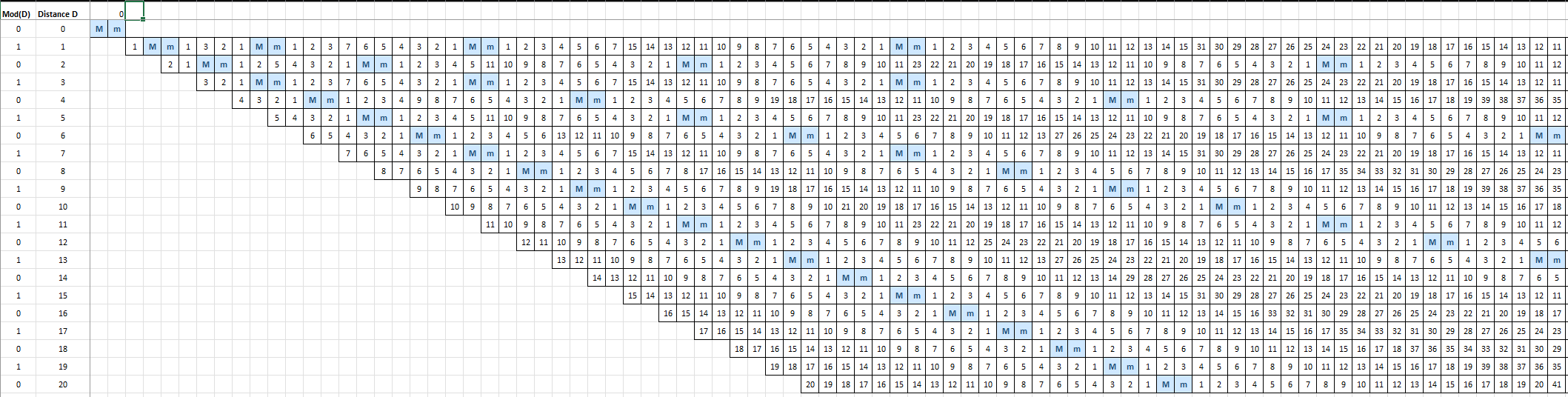
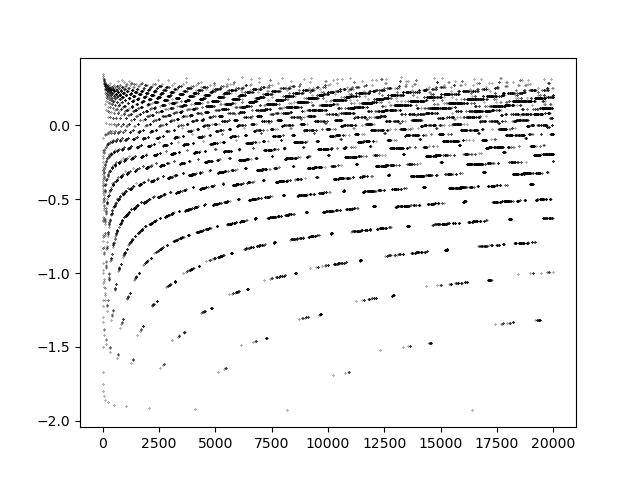
It’s fascinating !!! You could also represent this list by the distance between a number to the next. I’ve been working on that, and it seems I can apply my model with yours. As my english is still poor, I got assited by llc to form the answer.
A distance-to-next encoding that matches the (r^-,y^-,\mathrm{med},y^+,r^+) window
For each n\ge 1, define:
(r^-,\,y^-,\,\mathrm{med},\,y^+,\,r^+) = (2n-1,\,3n-1,\,3n,\,3n+1,\,4n+1).
Five-point window (r^-, y^-, med, y^+, r^+) with
(r^-, y^-, med, y^+, r^+) = (2n-1, 3n-1, 3n, 3n+1, 4n+1)
| n |
r- |
y- |
med |
y+ |
r+ |
| 1 |
1 |
2 |
3 |
4 |
5 |
| 2 |
3 |
5 |
6 |
7 |
9 |
| 3 |
5 |
8 |
9 |
10 |
13 |
| 4 |
7 |
11 |
12 |
13 |
17 |
| 5 |
9 |
14 |
15 |
16 |
21 |
| 6 |
11 |
17 |
18 |
19 |
25 |
| 7 |
13 |
20 |
21 |
22 |
29 |
| 8 |
15 |
23 |
24 |
25 |
33 |
| 9 |
17 |
26 |
27 |
28 |
37 |
| 10 |
19 |
29 |
30 |
31 |
41 |
| 11 |
21 |
32 |
33 |
34 |
45 |
| 12 |
23 |
35 |
36 |
37 |
49 |
One odd-only step sends the roots to their links:
3r^-+1=3(2n-1)+1=2(3n-1)\ \Rightarrow\ r^-\to y^-,
3r^+ +1=3(4n+1)+1=4(3n+1)\ \Rightarrow\ r^+\to y^+.
Signed “distance-to-next” picks a side:
d\,n\ \mapsto\ (r,l)=(2n-1,\ 3n-1),
d(-n)\ \mapsto\ (r,l)=(4n+1,\ 3n+1).
Examples:
d1\Rightarrow(1,2), d(-1)\Rightarrow(5,4),
d2\Rightarrow(3,5), d(-2)\Rightarrow(9,7),
d3\Rightarrow(5,8), d(-3)\Rightarrow(13,10),
d4\Rightarrow(7,11), d(-4)\Rightarrow(17,13).
| n |
(−) (r,l) |
(+) (r,l) |
| 1 |
(1, 2) |
(5, 4) |
| 2 |
(3, 5) |
(9, 7) |
| 3 |
(5, 8) |
(13, 10) |
| 4 |
(7, 11) |
(17, 13) |
| 5 |
(9, 14) |
(21, 16) |
| 6 |
(11, 17) |
(25, 19) |
| 7 |
(13, 20) |
(29, 22) |
| 8 |
(15, 23) |
(33, 25) |
| 9 |
(17, 26) |
(37, 28) |
| 10 |
(19, 29) |
(41, 31) |
| 11 |
(21, 32) |
(45, 34) |
| 12 |
(23, 35) |
(49, 37) |
We could also use the odd-only:
T(y)=\frac{3y+1}{2^{\nu_2(3y+1)}} and \mathrm{oddize}(m)=\frac{m}{2^{\nu_2(m)}}.
Then:
(r^-,\,Y^-)=(2n-1,\ \mathrm{oddize}(3n-1)),
(r^+,\,Y^+)=(4n+1,\ \mathrm{oddize}(3n+1)).
Sequence-walk ↔ Collatz (and the (r^-,y^-,\mathrm{med},y^+,r^+) window)
Let s(1),s(2),s(3),\dots=(1,-1,2,-2,3,-3,\dots).
Define the index map F(i)=i+s(i) (move right by s(i) if s(i)>0, left if s(i)<0).
Index/value dictionary:
- s(2n-1)=+n and s(2n)=-n.
- So from +n (at index 2n-1) you jump to index 3n-1.
- From -n (at index 2n) you jump to index n.
Now group indices by the “distance” D=n into a 5-point window
(r^-,\,y^-,\,\mathrm{med},\,y^+,\,r^+)
=(2n-1,\,3n-1,\,3n,\,3n+1,\,4n+1).
Two key identities (checked from the definition of F):
F(2n-1)=3n-1,\qquad F^2(4n+1)=3n+1.
These are exactly the Collatz-compressed left/right links:
3r^-+1=2\,y^- \quad(\nu_2=1),\qquad
3r^+ +1=4\,y^+ \quad(\nu_2=2).
In words: starting on the left root r^-=2n-1, one F-move lands on y^-=3n-1;
starting on the right root r^+=4n+1, two F-moves land on y^+=3n+1.
More generally, for any odd index u let k=\nu_2(3u+1). Then
\boxed{\,F^{\,k}(u)=\frac{3u+1}{2^{k}}\,}
(i.e., k steps of the walk perform exactly one odd-only Collatz step on u).
This subsumes both cases above: if u=2n-1 then k=1; if u=4n+1 then k\ge2 and
the first two steps give 3n+1, with extra steps if \nu_2(3n+1)>1.
So the “walk” on (1,-1,2,-2,\dots) is literally Collatz on odd indices,
read in the (r^-,y^-,\mathrm{med},y^+,r^+) windows:
- Left branch: r^-(2n\!-\!1)\xrightarrow{F} y^-(3n\!-\!1).
- Right branch: r^+(4n\!+\!1)\xrightarrow{F,F} y^+(3n\!+\!1).
- The middle anchor is \mathrm{med}=3n (first multiple of 3 in the window).
Small check with the example in the thread (starting at -3):
-3 sits at index 6. The walk is 6\to3\to5\to8\to4\to2\to1\to2\to1\to\cdots,
i.e. it falls into the 1\leftrightarrow2 index loop, whose values are +1 and -1,
matching the observed (1,-1) cycle.