The equation i gave here is what i use to transform a sequential position (s)to the even number produced by the odd (n) that s represents, as i know that when s is even it will increase ×1.5 and i know (2^n)×(1.5^n)=3^n which shows all increasing (possible diverging) sequences are converging to a number that will go below itself …of course this doesnt prove non divergence, it just shows that any diverging sequences are not simple ie all odd numbers in the sequence increase above themselves indefinitely. It does however show that there is no limit to how long a sequence can continuously increase , or appear to diverge before starting to fall. I imagine someone randomly picking one of these numbers and spending weeks thinking theyve found the counter example  , its funny because people pick out 27 as an interesting number, its actually 31 that sits in sequential position 16 which s=16×1.5 launches up to s=81 or 81×2-1=161
Also i say 2^y to keep it simple, powers of any even number will yield the same result’s take 6(14^y-1)+4 and you’ll see the same behaviour
- If we can rule out parity sequences A and B, can we somehow extend the ruling-out to sequence C (derived from A and B)? And keep extending until all parity sequences are covered?
In direct link to this question: if we can rule out A, then we can rule out any powers of A.
This result means that if you are looking for a positive integer cycle, you can ditch any sequence whose parity vector can be broken as the concatenation of smaller parity vectors. Interestingly, if you only consider cycles of prime length, you are assured to never encounter this issue (which made me realise that all known postive/negative cycles are of prime length (or of length 1, which can also not be broken in smaller pieces)).
The result is a direct consequence of x < 2^n and x < 3^k in a cycle of size n with k odd terms, I will examplify the proof on p = (q)^2
Concatenating your two qs you get:
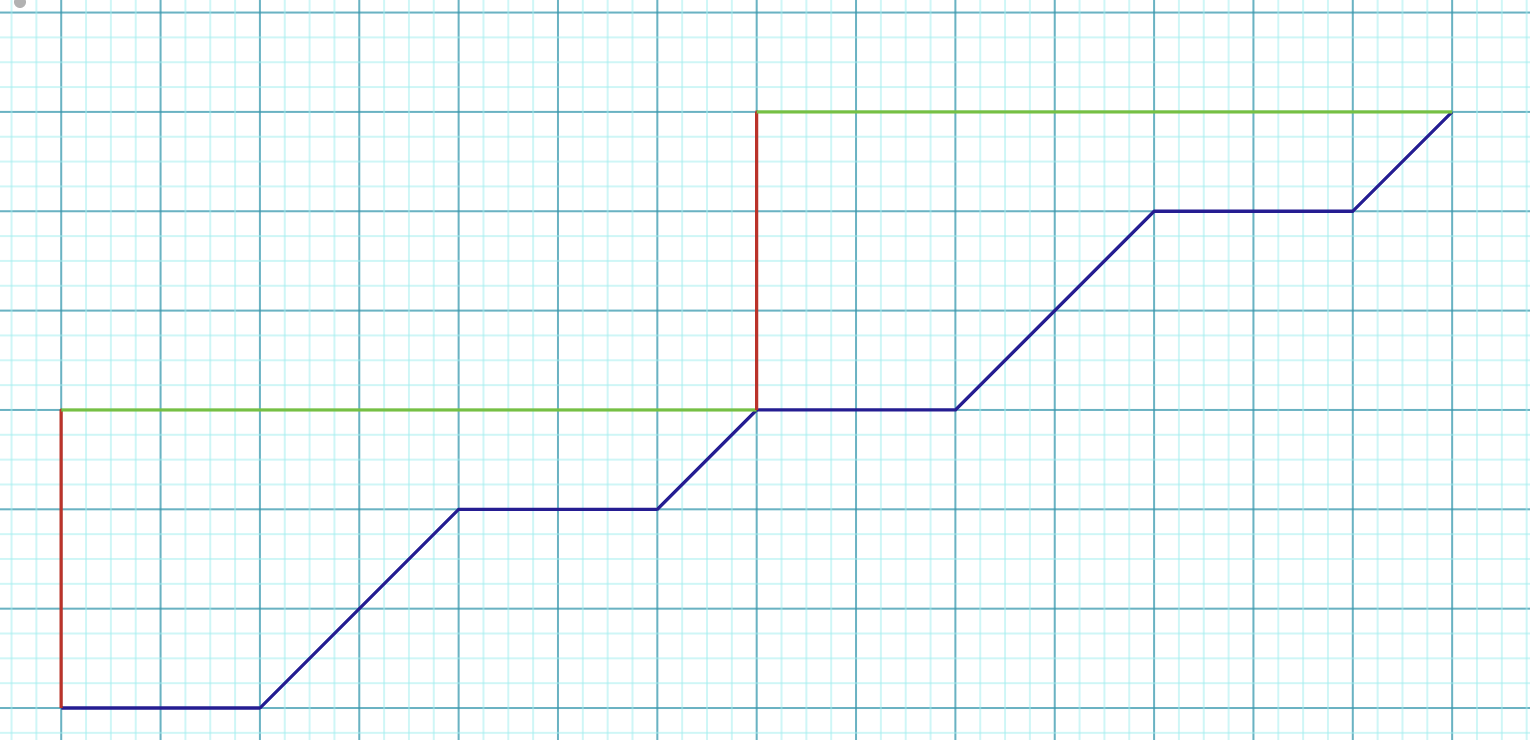
First by cyclicity, you deduce:
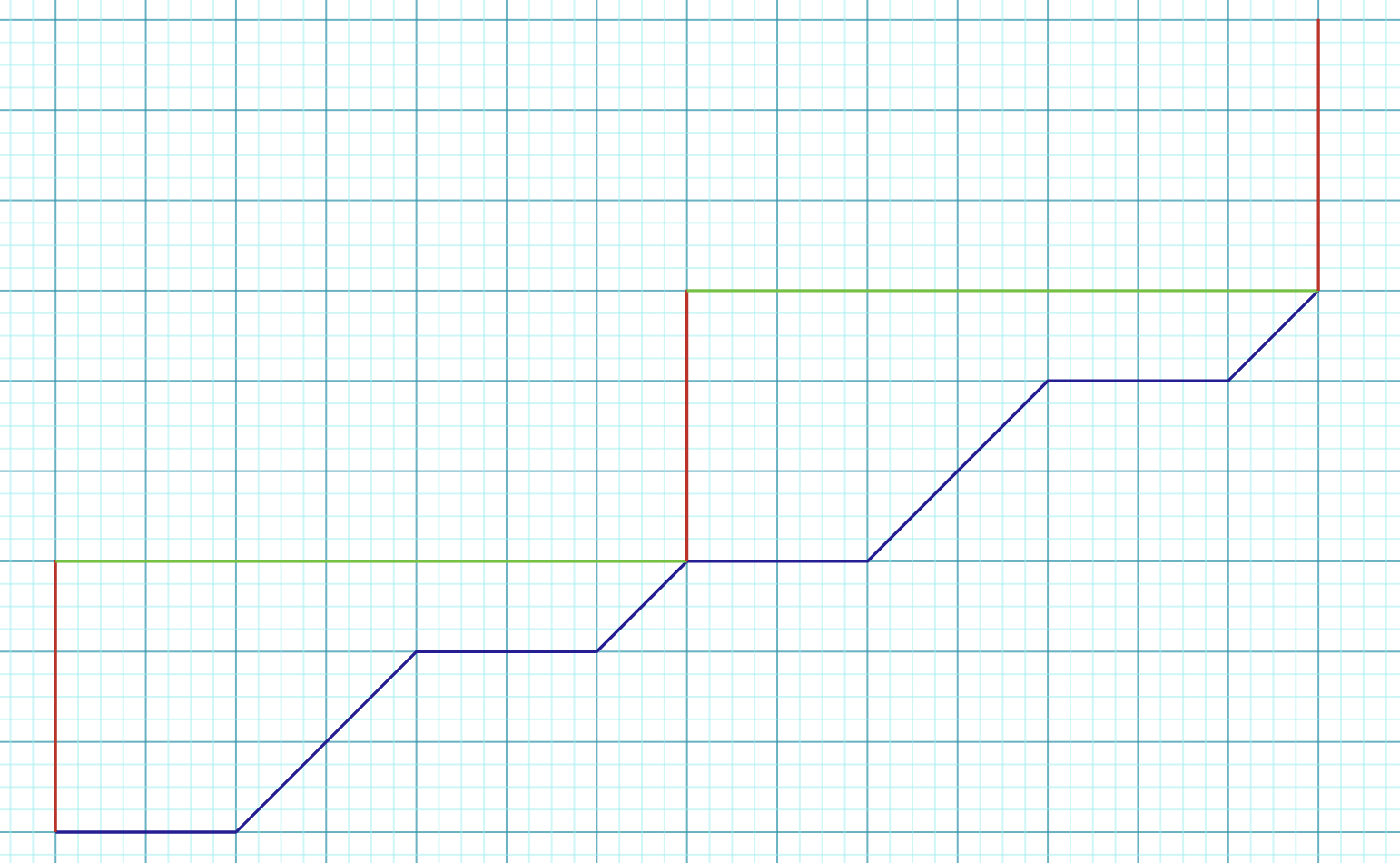
Then, you tile and you get the same black:
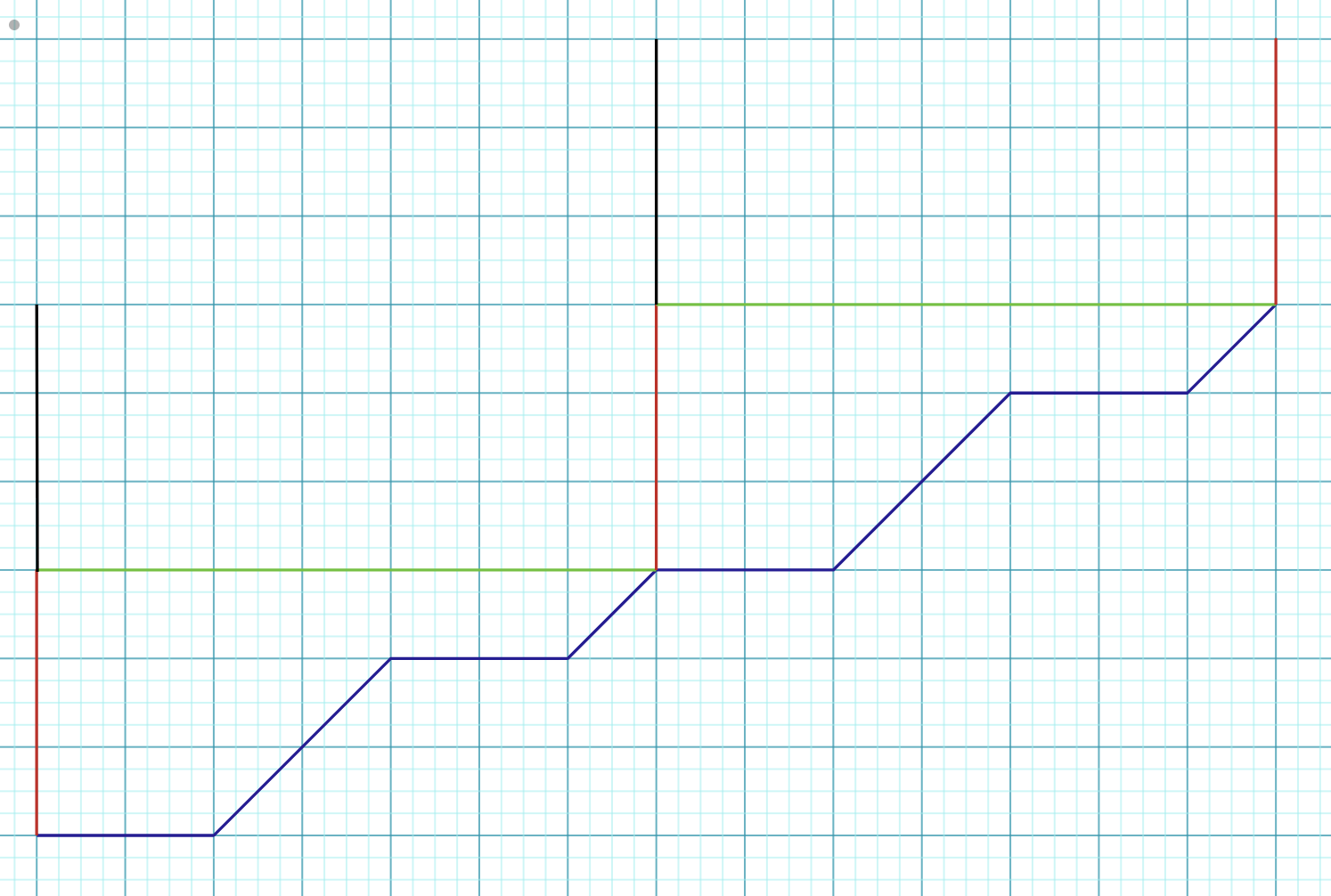
By cyclicity, you deduce:
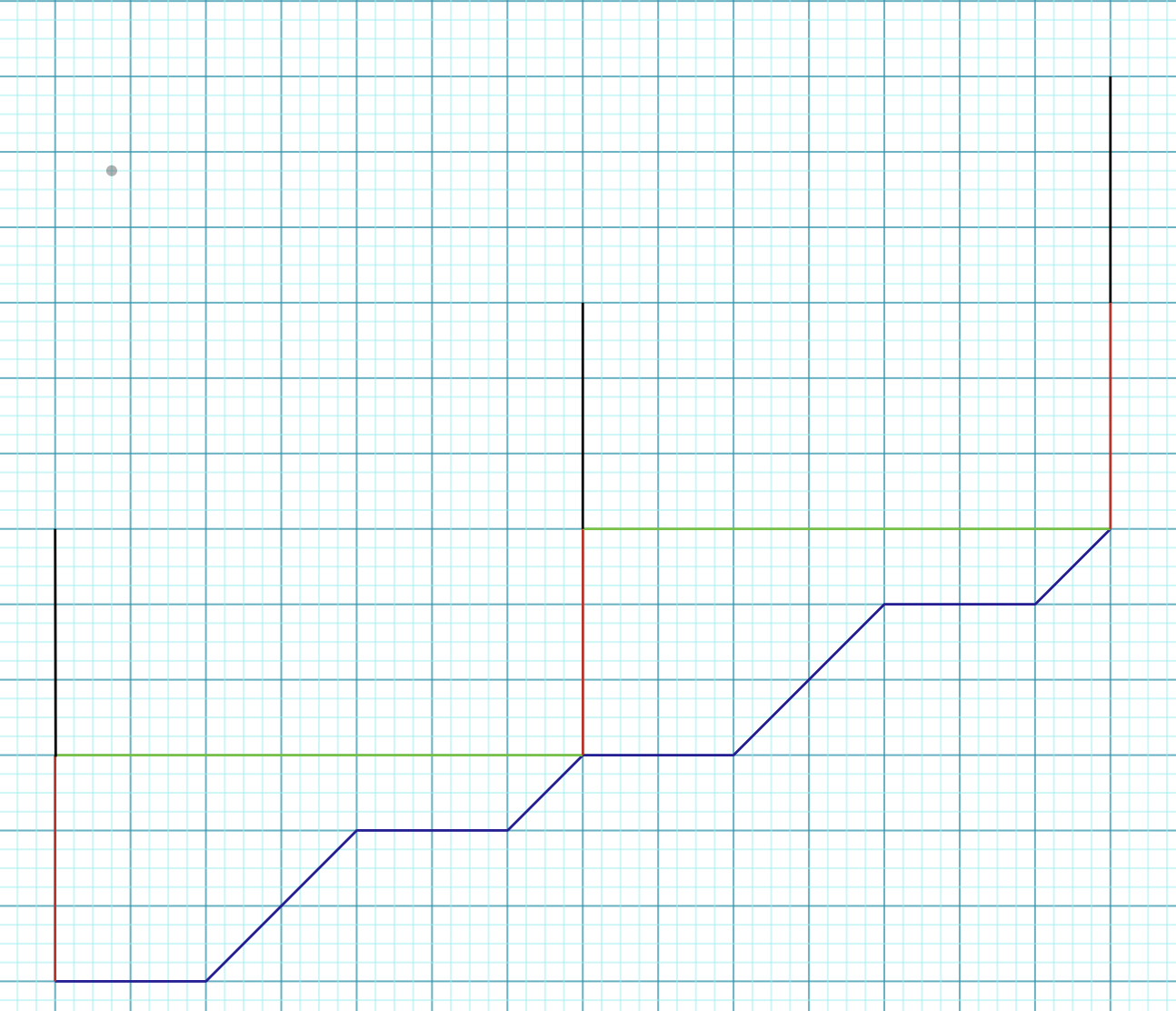
But now, if black is not 0, consider:
We get a cycle on q, but contradicting x < 3^k in a cycle with k odd terms, hence, all repetitions of q are actually bearing the same cycle, which is the one of q. From this we get the result.
I think that an easier way to say the above is just that the cyclic rational of parity sequence A (i.e. the rational that does a Collatz cycle following that parity sequence) is the same as the cyclic rational of A^n for all n.
Nice! This is called Conjecture P in the Math Kook book  It holds for all the 3n+1, 3n-1, and 5n+1 cycles, but not for the 181n+1 cycle, which is of length 15 (composite) with 2 odds. For your purposes (parity sequence A can’t be broken down into BB or BBB etc), it’s enough that the length be co-prime with the number of odds. That guarantees an aperiodic parity sequence … though an aperiodic sequence need not have those things co-prime. I’ve wondered on another topic whether co-primeness is required for all parity sequences associated with (putative) integer cycles, though.