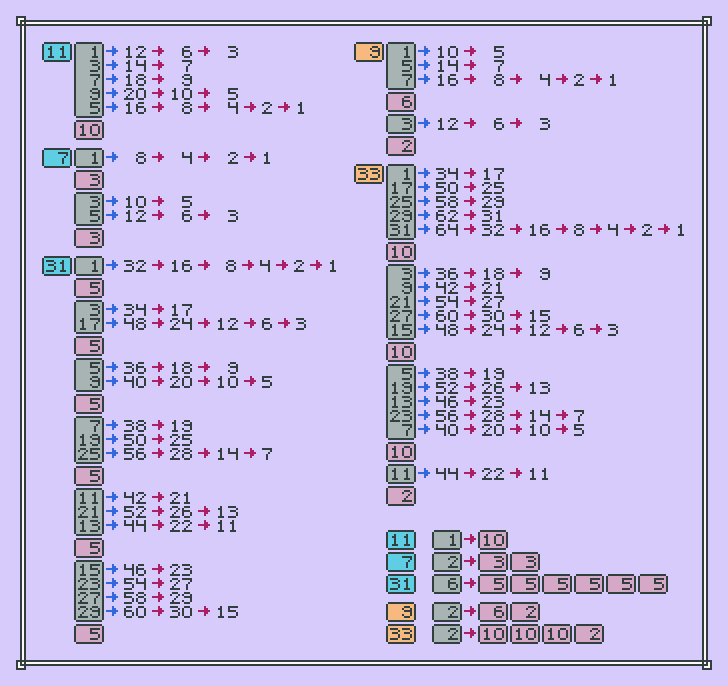
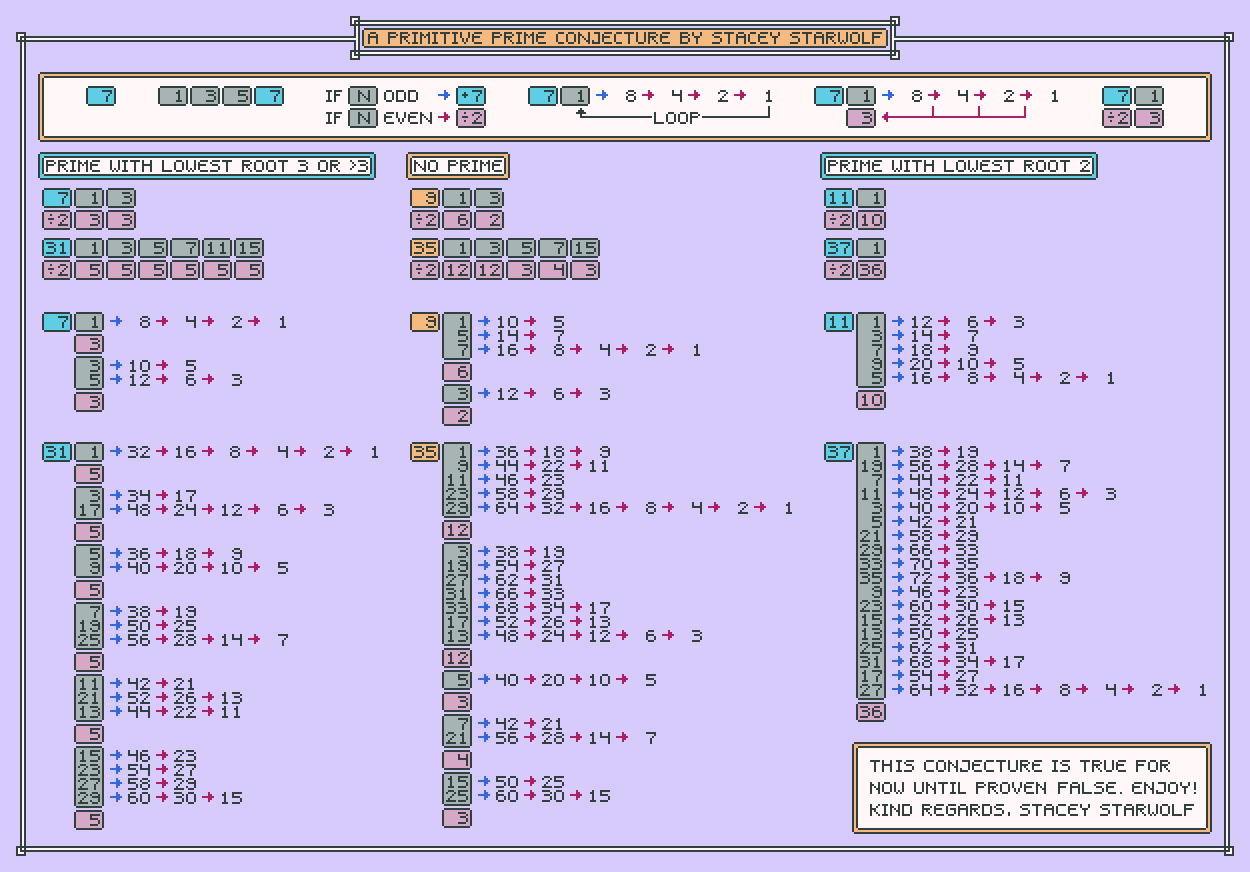
I have found the more complex prime numbers too! I thought I had to change the formula, but after awhile I found out the results will stay the same even when adding negative numbers and their loops into the mix.
How to find the complex prime numbers? If a number has multiple loops and within those loops numbers get divided by an equal amount of times by 2 it is a complex prime number. For example 7 has 2 loops each with 3 divides by 2.
It could use some more testing by someone with the proper programs, but I am pretty sure it is correct and you can (albeit slowly) calculate any prime number this way. Fun fact is that the roots are easier to find without the need for complicated modular calculations.
But is this useful for the Collatz Conjecture? Well parts are in here, for example number 11 has 5 (5+11 = 5 * 3+1 = 16 ). But they are also in non prime numbers like 35 which has 17 (17+35 = 17 * 3+1 = 52 ).
The 3n-1 loop 1 is the only loop for 1 (1+1 = 1 * 3-1 = 2) and the 3n+1 loop 1 is the only loop for prime number 3 (1+3 = 1 * 3+1 = 4)
Personally I don’t think this is very useful for the Collatz Conjecture though, but I will leave it up to you. I hope you like it.
Ok, let’s have a brief look at this new conjecture of @StaceyStarwolf .
Consider an odd integer n and apply the above algorithm (x \mapsto x+n for odd x, and x \mapsto x/2 for even x) to every odd integer smaller than n . Assume we get k cycles where the number of divisions by 2 is always d. An equivalent way to view this dynamical system is to consider the iterated function x \mapsto 2x in \mathbb{Z}/n\mathbb{Z}, which should have exactly k cycles of length d, plus the fixed point 0. Thus, n-1 = k\,d. When starting at x=1, we obtain the cycle 1 \rightarrow 2 \rightarrow 4 \rightarrow \ldots \rightarrow 1 of length d, so that 2^d \equiv 1 \pmod{n}. We obtain that
n divides 2^d-1;
d divides n-1, which implies that 2^d-1 divides 2^{n-1}-1 by applying the divisibility property between the Mersenne numbers.
It results that n divides 2^{n-1}-1. This property is always true when n is an odd prime number and is often used as a primality test. However, there are some composite numbers for which this property holds. They are called “Poulet numbers” or Fermat pseudo -primes (in base 2), and the smallest one is 341=11x31. A good point for @StaceyStarwolf is that there cannot be a counterexample below 341. Now, we are led to study the Poulet numbers. Another good point is that 341 is not a counterexample because x=1 leads to a cycle of length 10 whereas the cycle starting at 11 has length 5 (when using x \mapsto 2x).
I believe I reached something similar a while back with Mersenne numbers. I concluded that with A002326=a(x), ((2^(a((q+1)/2)))-1)/q is always an integer for odd q. I also proved that a(2^(v-1) -1)=v for all v. If we let n=a((q+1)/2) for clarity, we have (2^n -1)/q is an integer, and is the number of times you have to multiply a number that is (q+1) mod 2q by 2 to get another number of the same form.
I also had written down these equalities: n=a((q+1)/2)=a(2^(n-1) -1)=a(kn) and q=2kn+1 and k=(q-1)/2n. I reached this from changing q in qx+1, where you reached yours by changing n in x+n.
More can be said on @StaceyStarwolf 's conjecture by simply referring to other discussions in CollatzWorld:
What is claimed is that an odd integer q is prime if and only if the above dynamical system generates cycles with an identical number of divisions by 2. Call the latter property SSW and write SSW(q) whenever it is satisfied for q.
First, SSW dynamical system can be changed onto the map x \mapsto (x+1)/2 when x odd and x \mapsto x/2 otherwise, if we apply it to rationals with denominator q. A similar change has been suggested for variants of the Collatz map of the form (3x+q)/2 vs (3x+1)/2, but I couldn’t find back a relevant thread. This is quite obvious.
In fact, this new map is the same as @Failix’s tricot 2x+1 → x+1 and 2x → x already discussed in this thread. An argument was given in this post (with the help of chatGPT) for why all cycles have the same length when starting from a rational a/q with gdc(a,q)=1 and q fixed.
So prime(q) \Rightarrow SSW(q) as claimed.
I’m pretty sure the converse can be proved as well.
I have send this to the Mathematical Institute of the University Utrecht. Just for fun, see what they think. I’m not sure if they will ever reply, but one can always hope.
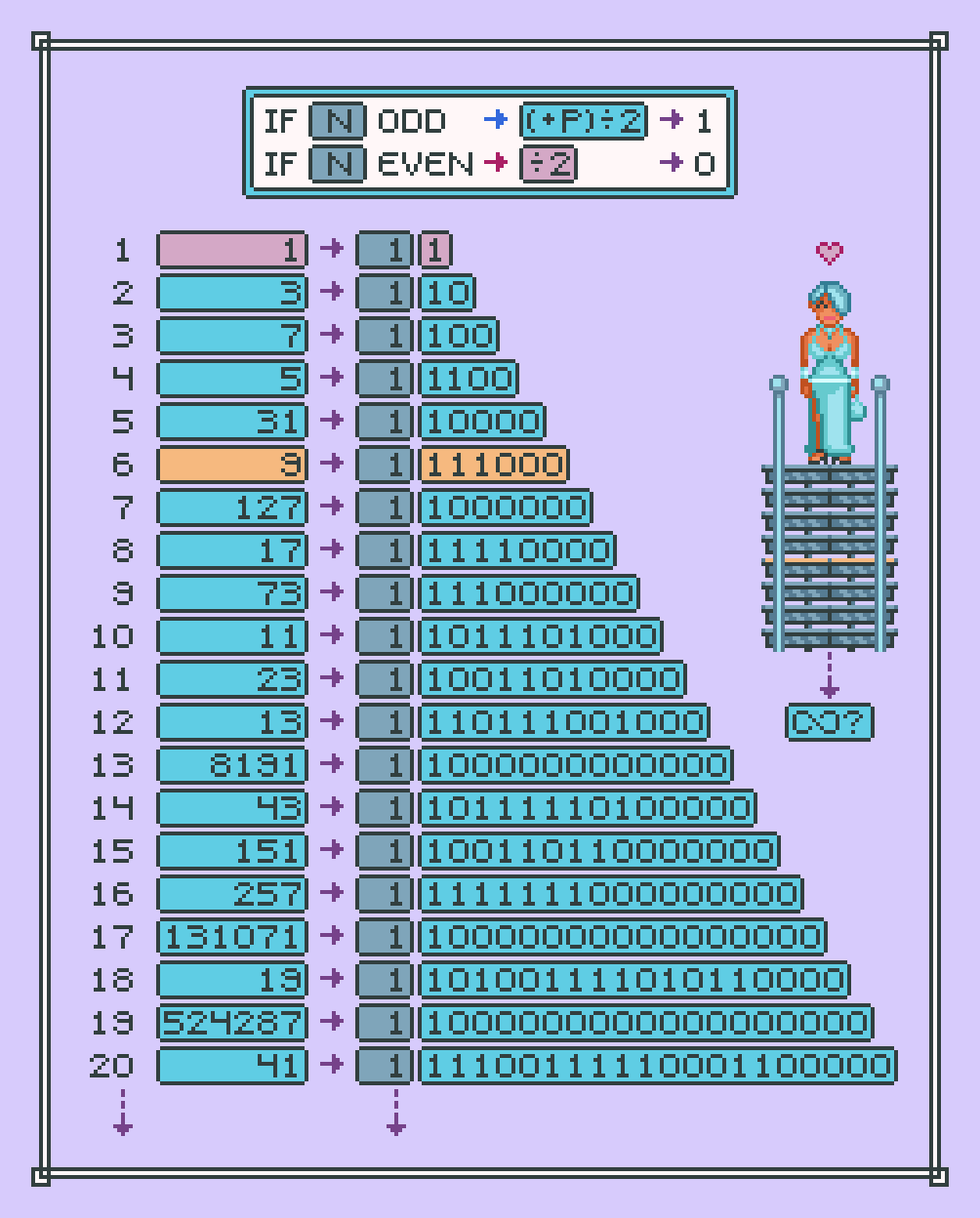
Correct, when making this I found those numbers all have the same binairy length. For example 23x89 = 2047 all have length 23 and they happen to be part of fake Mersenne prime 2^11-1. I have no doubt the others are too but for bigger fake Mersenne primes.
The grid used by the Primairy Prime Conjecture is still interesting for my point made in fan art, because besides 1x3 = 3 all other positive uneven numbers used by the Collatz Conjecture are multiples of 3 (3x3 = 9, 5x3 = 15, etc) within that grid.