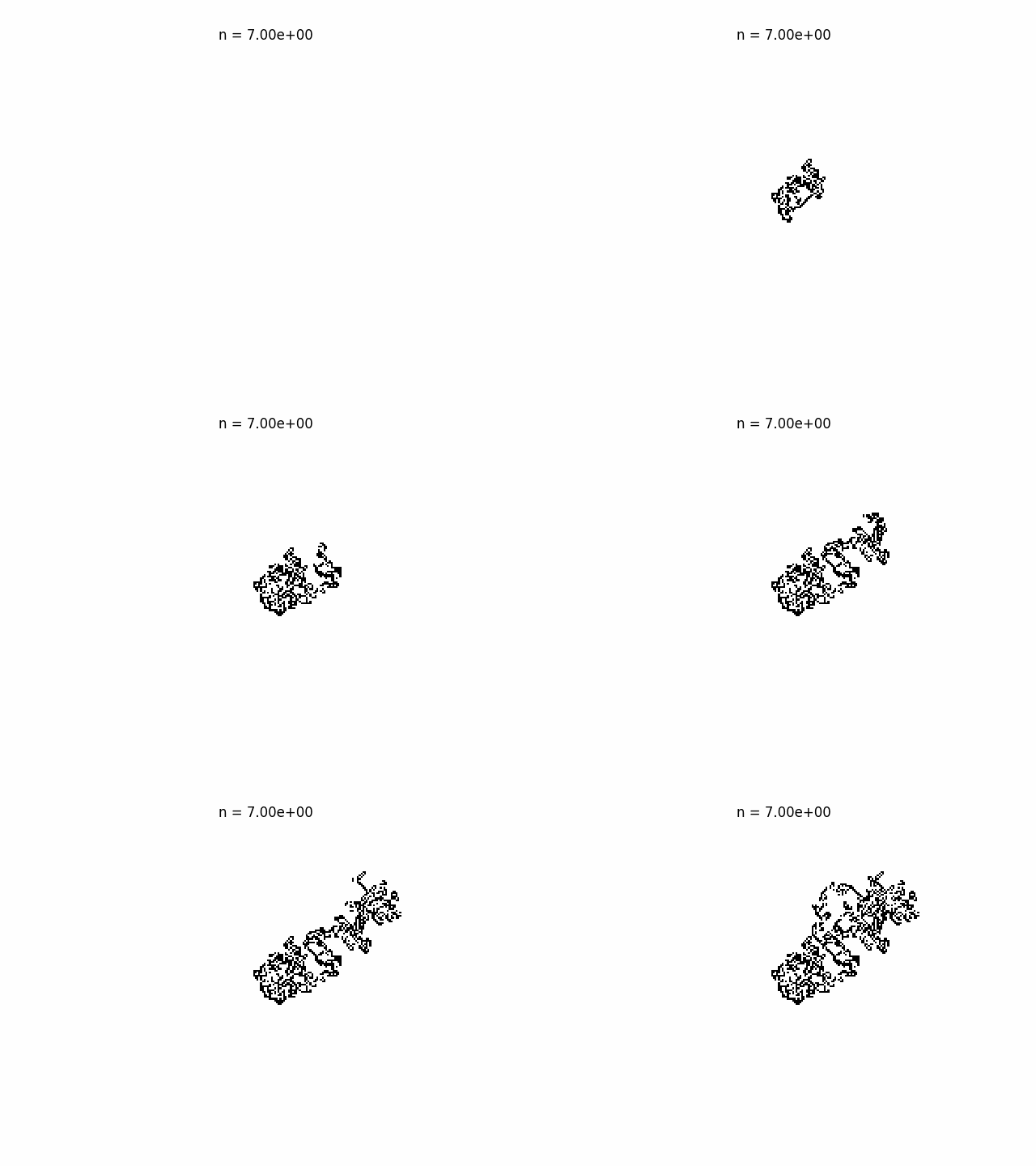
Thanks for the pointer – here’s start number 7 doing its thing under the 5n+1 rule. Go, little ant! (This is for classic 5n+1, where odd n → 5n+1, and not short-cutted 5n+1, where odd n → (5n+1)/2.)
1 Like
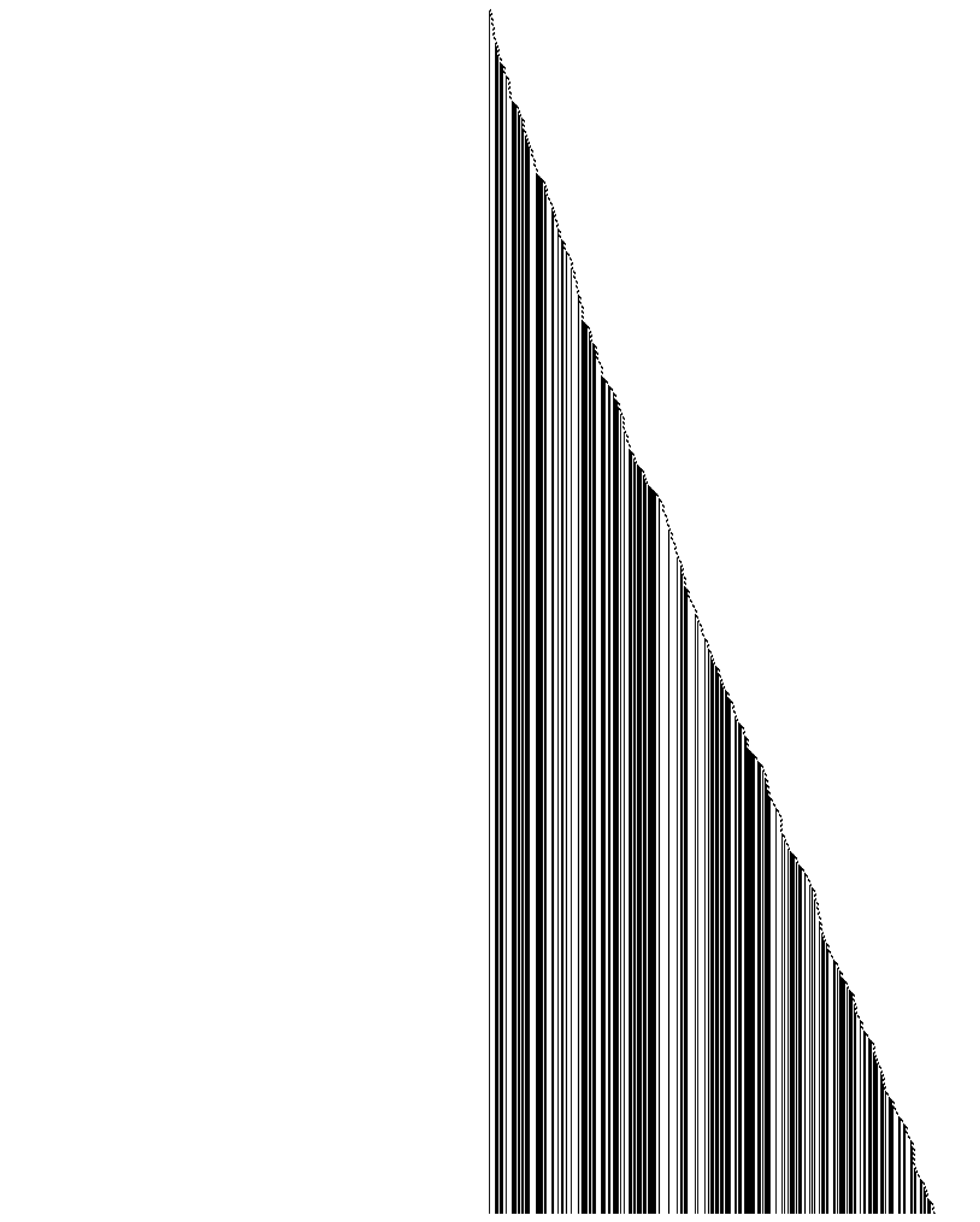

The 1D tape version is also somewhat interesting (here represented the first 1000 steps). Curiously enough, under this 5n+1 regime, if I happen to introduce an increment of 1 to n after the tape reading head shifts into a marked state (as discussed for instance here Collatz's Tape), it halts after a mere 10 steps:

1 Like
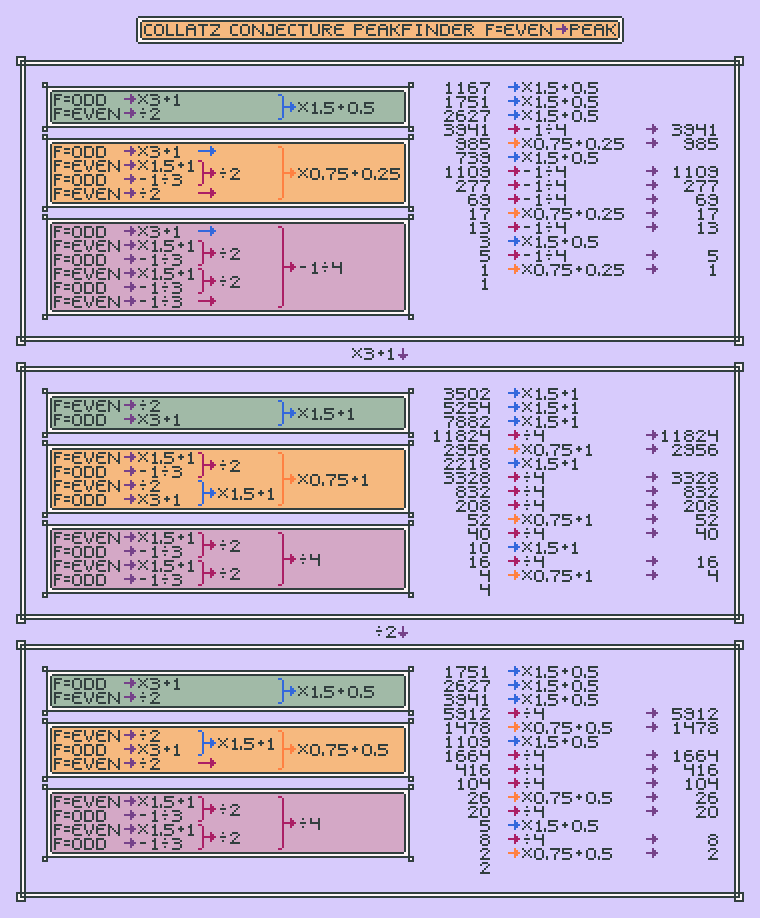
Feeling tired of dealing with all those uneven and even numbers at the same time? Bored with the 3n+1 / 2 routine? Or simply only want the peak numbers of your number? Well try this!
- Only uneven numbers!
- Only even numbers!
- F = Uneven. No peak, try and find the next one with *1.5 + 0.5
- F = Even. Peak! Try and find the next one with /4 or *0.75 + 0.5 when you can only /2

This is probably my final art piece for the Collatz Conjecture and this shows all loops of the 3n+1 and 3n-1 formulas. This matching trick unfortunately only works for these two formulas, because they are coincidentally being used on each other when we ignore the 1n+1 and 1n-1 formula rules. (See my topic: 3n-1: More than a mirror formula of 3n+1?)
The formula 3n+1 consist out of two parts: Two predictable parts: (3n+1)/2 and (3n+1)/4 and an unpredictable part: /2.
So instead of focusing on entire sequences, which become unpredictable due to the /2 parts, I only focused on the predictable parts of the 3n+1 formula and matched it with the predictable parts of the 3n-1 formula. When you put the results on a linear scale the unpredictable /2 parts can be neglected, because their results will fall back into the predictable parts of the formulas.
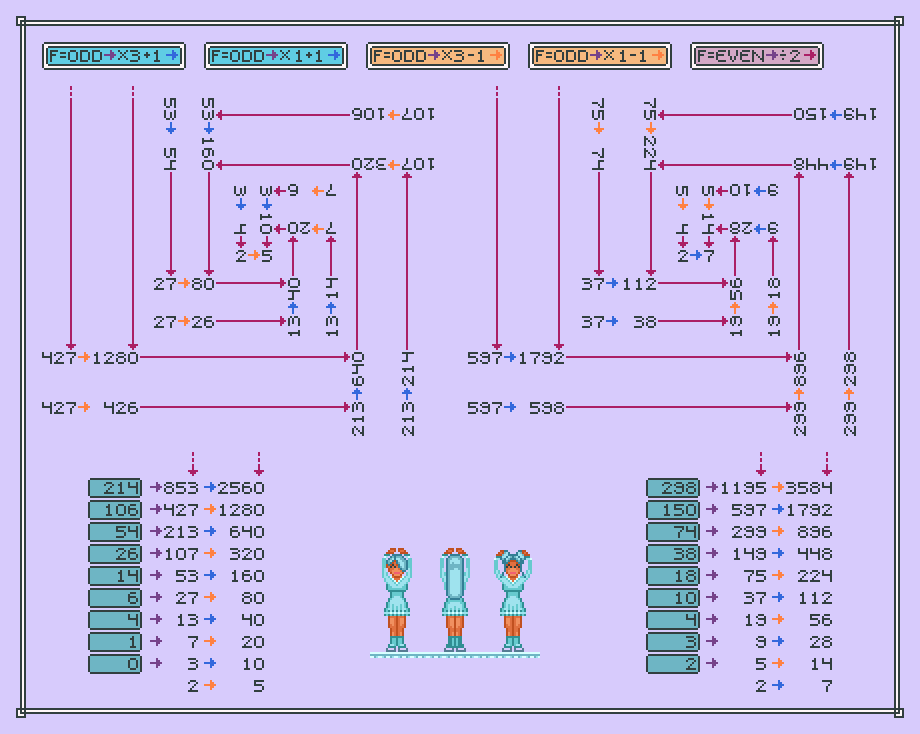

As you can see the matching results fan out, this makes new loops besides the ones we know impossible to form up again.
Unfortunately friends and family don’t like my art for being way too complicated. But I hope you guys being Collatz Conjecture enthusiasts enjoyed it and enjoyed my company on the website. My art has all been created by me by hand and is for free to use if you like it.

2 Likes
Perhaps already known, but it caught my attention when playing around. I feel like it shows more what the formulas do.
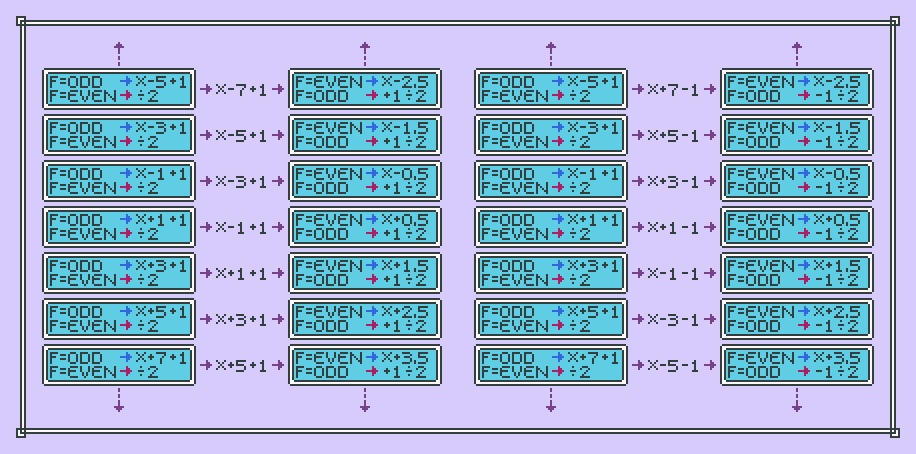
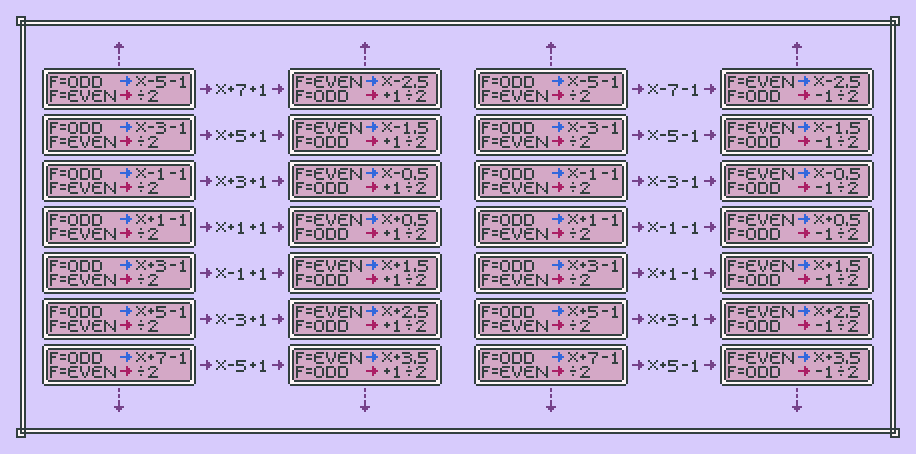
Just an example with x5+1/2 using number 3 and multiplying with x3+1:
3 – 8 – 4 – 2 – 1 – 3 becomes 10 – 25 – 13 – 7 – 4 – 10
1 Like
Ok, I start to understand. For the common reader on this site, it might help specifying that “x5+1/2” refers to the map n \longmapsto \cfrac{5n+1}{2}.
What you describe are conjugacies between functions of the form
T(n) = \left\{\begin{array}{ll} \frac{an+b}{2} &( n \text{ odd})\\ \frac{n}{2} &(n\text{ even}) \end{array}\right.
and
U(n) = \left\{\begin{array}{ll} \frac{n+b}{2} &( n \text{ odd})\\ \frac{an}{2} &(n\text{ even}) \end{array}\right.
where a,b are odd integers (except that, maybe for simplicity, you omitted the “short-cut” division by 2 for odd integers in T, with a few other discrepancies in the upper parts that are still unclear to me). The above functions indeed verify
T = H^{-1} \circ U \circ H
by using the conjugacy map
H(n) = (a-2)n+b
which is not obvious (at first glimpse). One has to perform careful calculations. Somehow, it’s a deep relationship between two distinct mathematical objects. In fact, I did research on this topic some time ago, so this led me to go back into it.
The case a=3 and b=1 is already well documented, but I’m not aware of a particular paper with the general formulation of the conjugacy map H. Maybe @Failix has a matricial formalism for it in terms of tricot.
1 Like
It turns out that the upper parts describe other conjugacies between functions of the form
T(n) = \left\{\begin{array}{ll} \frac{an+b}{2} &( n \text{ odd})\\ \frac{n}{2} &(n\text{ even}) \end{array}\right.
and
U(n) = \left\{\begin{array}{ll} \frac{n-b}{2} &( n \text{ odd})\\ \frac{an}{2} &(n\text{ even}). \end{array}\right.
for odd integers a,b fixed . As previously, they verify
T = H^{-1} \circ U \circ H
by using the conjugacy map
H(n) = (2-a)n-b
which is even more tricky to see!
1 Like
Okay its too late for me to get my head around this now so im going to drop this here, maybe its irrelevant but i think there may be some inequality to be noted causing n to reduce.
0 mod4=a
2 mod4=b
3 mod4=c
1 mod4=d
a×3+1=d
b×3+1=c
c×3=d
d×3=c
d+1=b
d-1=a…..so a,b,c or d×4+1=d
So consider n×3+1=(3(n×4+1)+1)÷4
If we change the collatz rules for d to (d-1)÷4 we get an odd to odd movement that always under shoots so to speak
9-1÷4=2
2×3+1=7
(9×3+1)÷4=7
So where d falls down to a,b or c we can correct course by ×3+1
Note that when d falls to a it will be ((a×3+1)-1)÷4=(a×3)÷4 so proposed new rules
If a:(a×3)÷4
If b:b×3+1 or (b×9+4)÷2
If c:(c×3+1)÷2
If d:(d-1)÷4
im to tired to bring this point home entirely but these seem really close to a hybrid between rules t(n) and u(n) is there some sort of inequality hiding in here? Or no relationship at all? I will of course try to answer my own question when i get time, but i thought id just put it out there.
I found out which formulas use the -7+1, -5+1 etc multipliers, it is the formulas themselves. I have adjusted my post so it can hopefully help you guys better with your calculations.
I made this to show the backwards tree for Collatz in a different way where instead of picking one branch it can show every branch at once by keeping the type of branch as extra info https://collatz-visualizer–dickinsonisaac4.replit.app
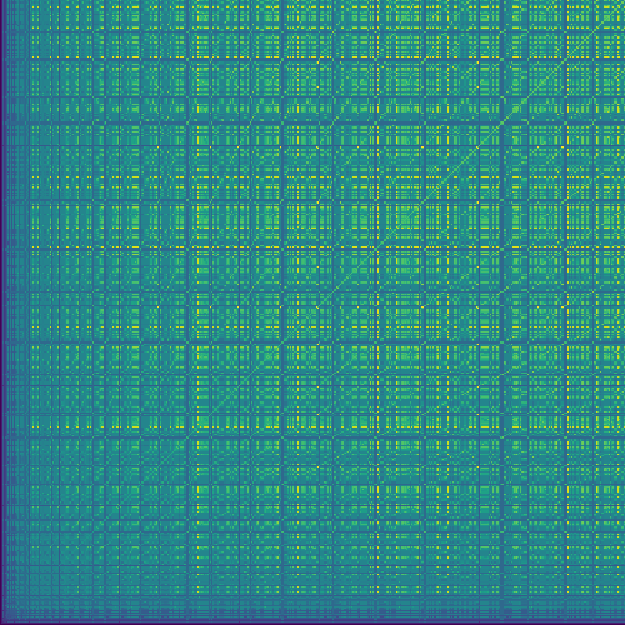
Each pixel represents an (x, y) pair, with (1, 1) in the lower left. Hue is determined by the magnitude of the number at which the trajectories of x and y merge.
2 Likes
Not sure if this is of any use, but it was just something I wanted to share to show what I think happens when we are using the the 3n+1 formula. The numbers used are 7 and -35:
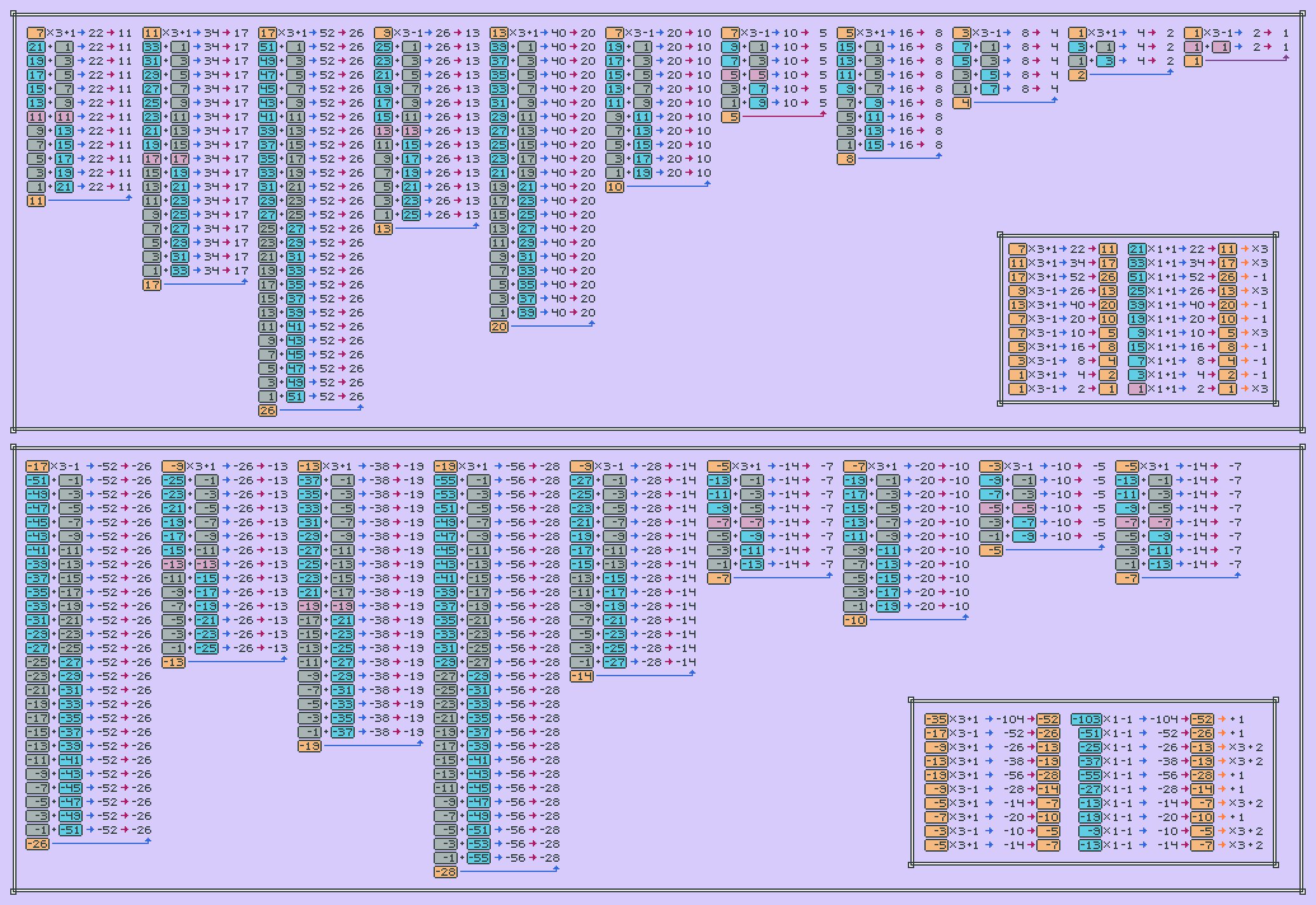
I guess it is useful, because I found something that might be interesting . This is what it looks like when using the Collatz Conjecture in conjunction with the Primitive Prime Conjecture (see my previous artwork and the topic Is 3n+1 a Computer?):
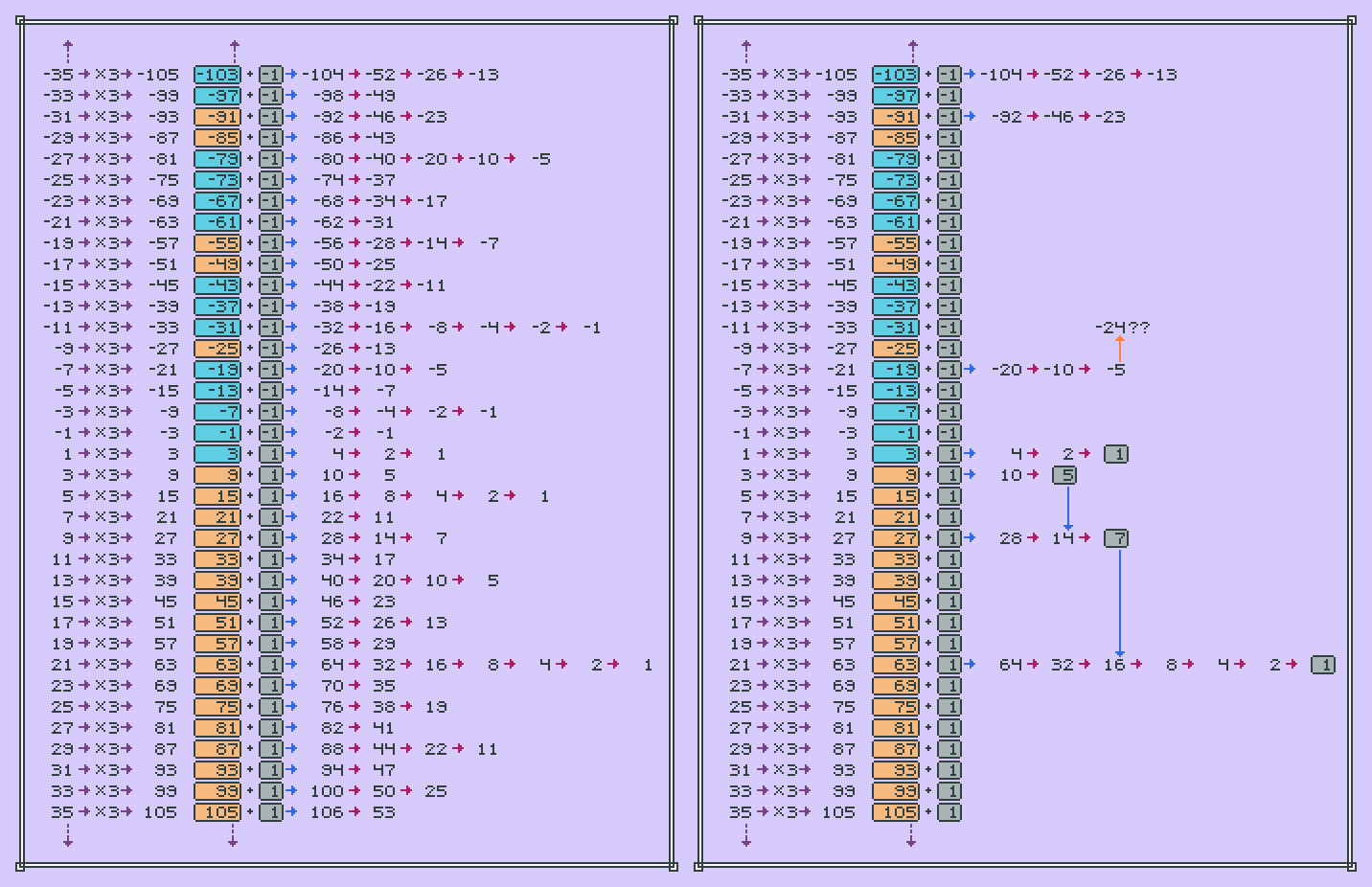
As you can see it creates problems for the negative side of the 3n+1 formula. The Primitive Prime Conjecture doesn’t work because the prime numbers in blue can not connect with other numbers. They will create weird patterns and unfinished loops.
Unlike the negative side, the positive side has only 1 prime number which loops into itself and that is 1 * 3 = prime number 3. All other numbers are not prime numbers when using both conjectures and they neatly loop into each other when using the Primitive Prime Conjecture. As an example I used regular number 3 * 3 = 9 which returns back to 1 trough 27 and 63.
That means the Primitive Prime Conjecture on this side works and every regular number will always return back into their 1 loop when using +1 as a starting point. It will use other numbers to do so, creating an invisible grid that has all numbers connected when using the Collatz Conjecture.
So where are the positive prime numbers for the positive side? Well, they are neatly skipped by the /2 part and used by the 3n-1 formula, which works exactly the opposite way.
I want to apologize in advance for my weird mind creating silly things, but I hope this makes any sense and can be of use to you professional mathematicians.
Side note: I am not sure if the Primitive Prime Conjecture is a proper name for the conjecture I came up with. Any neat suggestions are welcome!